


Business Sectors
Business Sectors
Events
Contents

Ukraine crisis distracts from bigger trends in seaborne LNG market
The Ukraine crisis has sent global gas prices sky rocketing, but there may be bigger forces at work in the seaborne LNG market. While the world awaits developments on pipeline supplies, ship tracking data on seaborne LNG volumes may assuage the worst fears, says VesselsValue analyst Vivek Srivastava
The European benchmark TTF gas price has risen 135% so far in 2022, with a near-vertical spike since Russia commenced hostilities in eastern Ukraine on 24 February.
Russia is the world’s largest exporter of gas, and Europe is heavily reliant on this, as Russia exports approximately 23Bn CBM of gas every day, about half of which goes to Germany, Italy, France and Belarus. However, the vast majority is piped and neither Russia nor Europe are explicitly threatening pipeline supplies yet. Despite supermajors moving to unwind their interests in the country and a visible impact on Russia’s oil exports, there is not yet any visible drop in LNG volumes.
Russia’s share of the seaborne LNG market is certainly large enough to move the needle on the global supply/demand balance. Of the top 20 export regions over the last 12 months, Russia accounted for two, highlighted in red in Figure 1 below. The Eurasian Arctic contributed 4% of total volumes and the Russian Pacific another 2%. However, there are four much larger export regions, which each account for double-digit shares: the Middle East Gulf (20%), the Gulf of Mexico (14%), southeast Asia (12%) and west coast Australia (also 12%). Smaller changes in any of these four regions can outweigh larger changes in the two Russian regions.
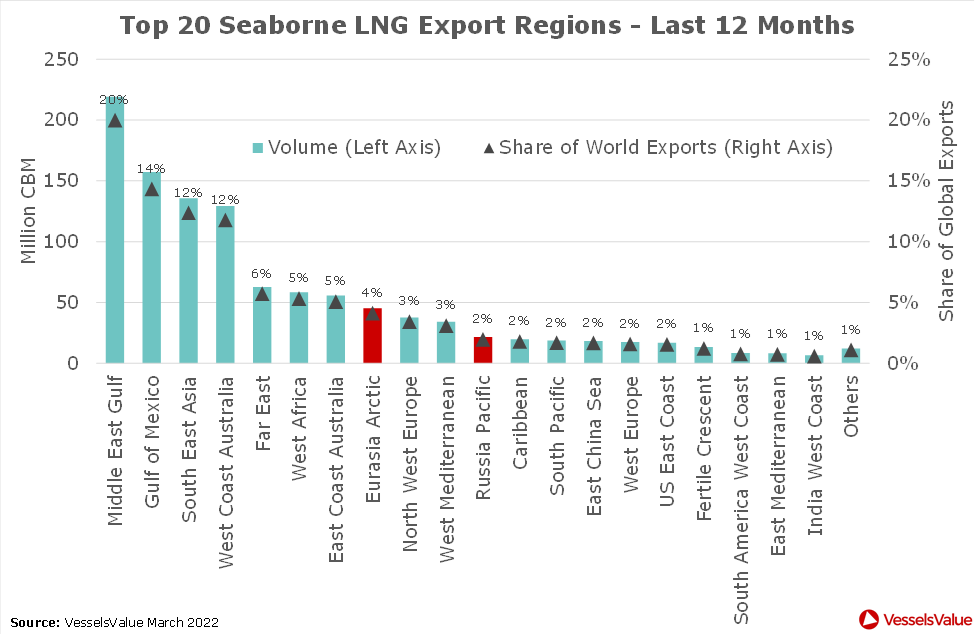
Neither of the two Russian regions are yet exhibiting any unusual drop in seaborne volumes. As shown in Figures 2 and 3, below, volumes on the water are currently trending in line with recent historical averages and last year’s levels. Compared with oil exports, which have plummeted as traders have shown almost complete unwillingness to buy Russian cargoes, this is to be expected, as oil is dominated by spot purchases, whereas LNG is dominated by long-term offtake agreements. The cargoes have, in effect, already been bought. How long it takes for these exports to then find buyers willing to import them, particularly for Yamal LNG’s westbound cargoes from the Eurasia Arctic, is another matter. But for the time being, supplies are there and, with the market so hot, they should soon clear.
You have viewed your 10 articles for this month.
To continue reading this article please register or login below.




Related to this Story

Events
Maritime Regulations Webinar Week
 16 Dec 2025
 GMT - ONLINE
Floating energy: successfully unlocking stranded gas using FLNGs and FSRUs
24 Feb 2026GMT - ONLINE
© 2026 Riviera Maritime Media Ltd.


