


Business Sectors
Business Sectors
Events
Contents
Register to read more articles.
Unique dual-fuel tugs built for Hong Kong LNG terminal
Hongkong Salvage & Towage will use two LNG-diesel fuelled tugs to support gas carriers at an FSRU and provide emergency support


Two powerful terminal standby and ship-support ships were completed by a Chinese shipyard and entered service at an LNG import terminal in Hong Kong during Q2 2024.
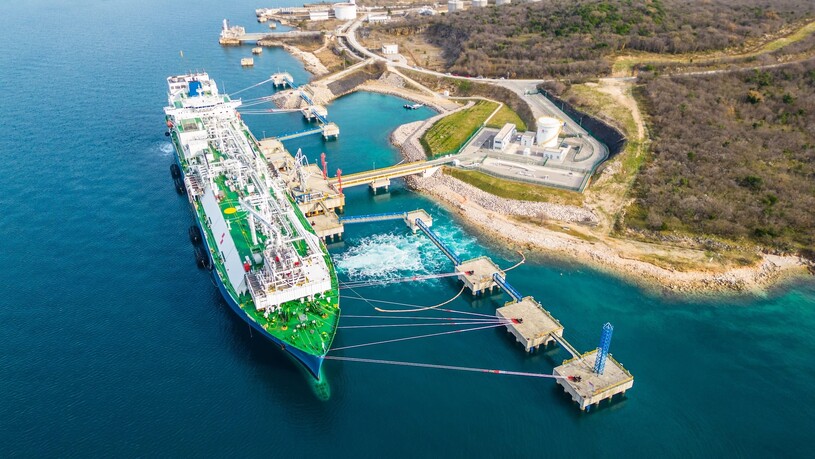
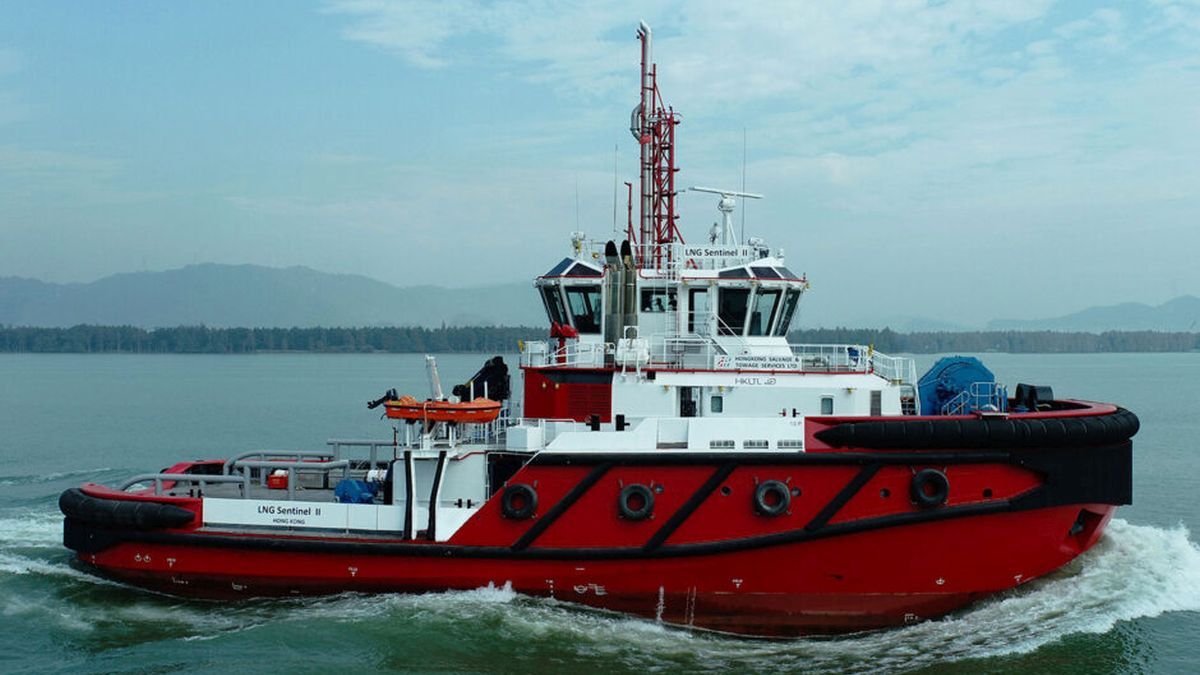
A pair of dual-fuel, diesel and LNG, escort and standby tugs were delivered to Hongkong Salvage & Towage (HKST) by shipbuilder Cheoy Lee Shipyards to support operations at the Hong Kong LNG Terminal, where gas carriers will offload LNG at a jetty to a floating regasification and storage unit (FSRU).
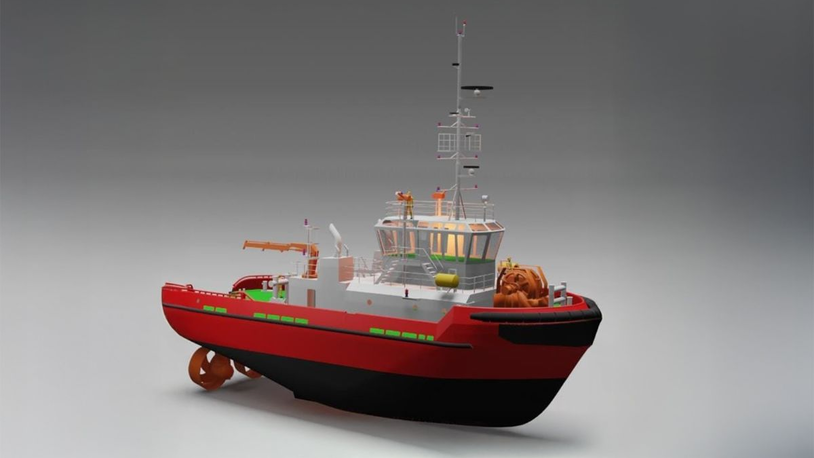
LNG Sentinel I and LNG Sentinel II were specifically designed by Robert Allan Ltd for service at this import terminal. They were built to RAstar 4200-DF design with a bollard pull astern of around 105 tonnes and a top speed of 14 knots.
These vessels will help maintain a safety zone around the terminal and assist LNG carriers berthing at the jetty. They will also transport personnel and equipment between Hong Kong harbour, the FSRU and terminal’s jetty.
Naval architects worked with HKST and Cheoy Lee Shipyards to customise these 42-m vessels for their work roles and to minimise emissions. Robert Allan says these vessels have a unique electrical propulsion system with Z-drive thrusters capable of receiving power from both diesel and dual-fuel generator sets.
Wärtsilä supplied two 9L20 diesel-electric propulsion gensets, each generating 1,880 ekW, and two 8L20DF dual-fuel electric propulsion gensets, of 1,500 ekW each.
These provide power to two 3,000-kW ABB electric motors, which drive Wärtsilä WST-32 fixed-pitch Z-drives, with a 3.3-m diameter propeller in a nozzle.
Caterpillar supplied a C4.4 diesel harbour and emergency genset, developing 82 ekW of power and Schottel delivered a STT 60 electrically driven fixed-pitch bow thruster, of 125 kW capacity, for improved manoeuvrability. Wärtsilä supplied the LNGPac double-wall, vacuum-insulated IMO Type C LNG storage tank, with an integral tank connection space and double airlock.
LNG Sentinel I and LNG Sentinel II have a moulded beam of 16 m, a moulded hull depth of around 7 m and a maximum navigational draft of 7 m. They are classed by Bureau Veritas with notations for dual fuel, unrestricted navigation, in-water surveys, fire-fighting 1 with water spray, oil recovery, and notations BV I ✠ Hull, ✠ Mach and ✠ AUT-UMS for automation and unmanned engineroom spaces.
These 1,275-gt vessels are equipped for standby duties, including for emergency towing of the FSRU, firefighting, spill response and rescue. They each have a FiFi1 off-ship fire-fighting system from FFS incorporating two pumps and two monitors, each capable of 1,200 m3/hr, plus a water spray unit, and 200 m of offshore spill recovery boom on a powered boom reel, plus one Palfinger-delivered RSQ 450 rescue boat under a pivoting davit.
Able to accommodate 11 crew and two supernumeraries, there is also space for 20 people rescued from emergency situations, plus one Dacon rescue scoop (RSA 500) for recovering overboard personnel using a Palfinger PK65002(M) folding knuckle boom deck crane with outreach of 16 m and safe lifting capacity of almost 3 tonnes.
MacGregor supplied a hydraulic deck-machinery package that features one double-drum hawser winch with 300 m of 76-mm diameter synthetic towline per drum, plus one single-drum towing winch and spooling gear, with 1,000 m of 64-mm steel wire.
Each vessel has one towing pin unit aft with 110 tonnes safe working load, two tugger winches, each with 100 m of 22-mm wire and horizontal warping head, and two vertical anchor windlasses with 400-mm throat warping heads, all from MacGregor.
LNG Sentinel I and LNG Sentinel II can store 265 m3 of diesel oil and 110 m3 of LNG to supply main propulsion gensets, plus 66 m3 of potable water, 46 m3 of recovered oil, 18 m3 of foam and 12 m3 of dispersant.
These are the eighth and ninth LNG dual-fuel tugs built and completed to five different Robert Allan designs, with three classification societies for service on three continents – Asia, Europe and North America. One of these, HaiSea Kermode, was named ITS Tug of the Year 2024 at a gala ceremony in May. It was built as one of two dual-fuel escort tugs by Sanmar Shipyards for HaiSea Marine’s services from the Kitimat LNG export terminal in British Columbia, Canada.
Other Chinese completions
Also this year, Cheoy Lee completed a series of azimuth stern drive (ASD) escort tugs with mechanical hybrid propulsion for Svitzer and BHP to support large dry bulk carriers into and out of Port Hedland, Western Australia. The first of these, Iron Quail, was delivered in early March and was followed by Iron Wren and Iron Robin in April and May and Iron Finch in June. These 28-m, 433-gt tugs were built to Robert Allan’s RAstar 2800-CL design with FiFi1 fire-fighting units and escort-class winches on the fore deck. These deliveries were followed in June by 433-gt ASD tugboat of a similar design, Nord Mayumba, which was heading to Nacala, Mozambique under the flag of Liberia in July, according to automatic identification system (AIS) data. In July, RAstar 3200-CL design Tahid Narmada was completed by Cheoy Lee, and it was sailing under the flag of St Vincent & Grenadines.
Also in China, Jiangsu Zhenjiang Shipyard launched a battery-powered ASD tugboat, Ning Gang Dian Tuo 1 on 1 July it is building for Nanjing Port (Group) Co to become the first pure electric propulsion tug to operate on the Yangtze River. It was designed by Zhenjiang Shipyard to have a lithium iron phosphate battery package, a DC power distribution network and permanent magnet motors driving azimuth thrusters for zero emissions and low noise during transits and operations.
Its construction is part of the Electrification of the Yangtze River project, promoting technological progress in reducing emissions in ports and along this key transport corridor.
On 8 July, Zhenjiang Shipyard laid the keel for a 3,824-kW ASD tugboat with a FiFi1 fire-fighting system for Cangzhou Port. On 18 June, the shipyard launched tugboats Yick Tug 106 and Yick Tug 107, which are a fourth set of a five-batch order from COSCO Shipping Bulk Cargo Transportation Co, which intends to use these 2,646-kW ASD vessels to support Bauxite exports from a mining project in Guinea.
Riviera’s TUGTECHNOLOGY ‘25 will be held in Antwerp, 22-23 May 2025. Click here for more information on this industry-leading event.


Related to this Story

Events

Maritime Regulations Webinar Week
 16 Dec 2025
 GMT - ONLINE
Floating energy: successfully unlocking stranded gas using FLNGs and FSRUs
24 Feb 2026GMT - ONLINE
© 2026 Riviera Maritime Media Ltd.


