


Business Sectors
Events
Contents

Register to read more articles.
VLCC secondhand values hit decade highs amid freight market rally
VLCC secondhand prices have climbed to decade highs, underpinned by the strong rally in freight markets


However, analysts caution that the pace at which upcoming newbuilding deliveries are absorbed will be a key determinant of market direction in the coming years.
Signal Ocean noted late last week that robust cash generation and improved freight visibility have pushed asset values sharply higher – not only for modern tonnage but also for older units.
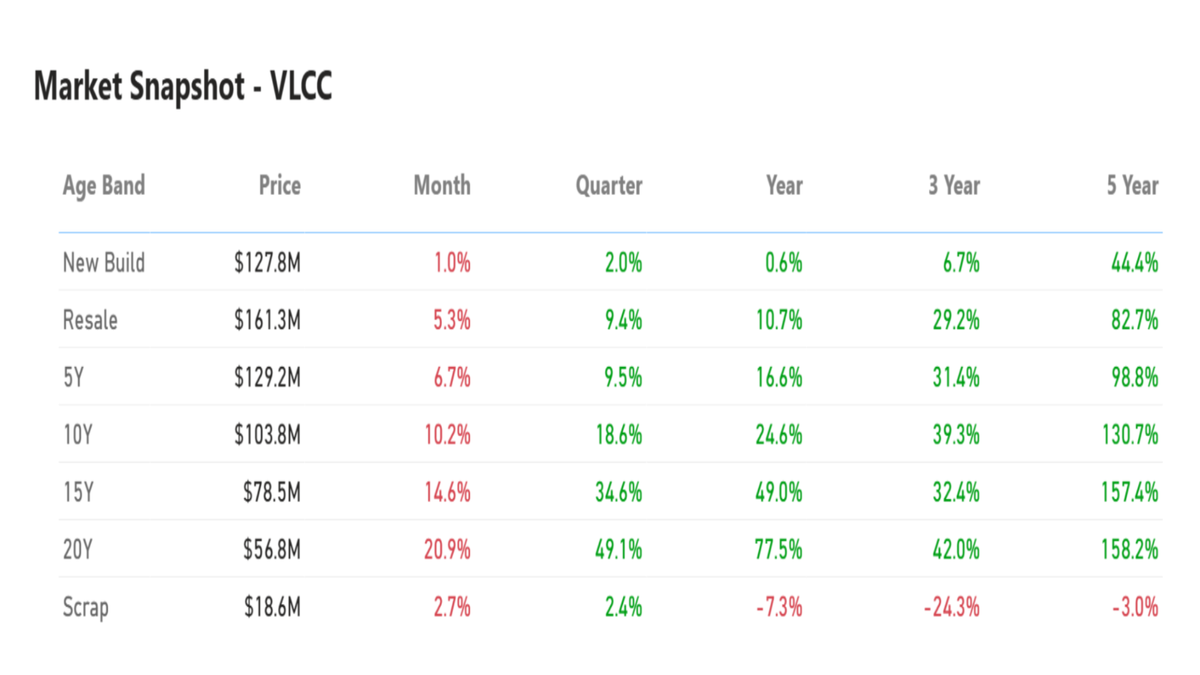
Five-year-old VLCCs, now valued at around US$129M, have appreciated by roughly 30% over the past three years and nearly 99% over five years. Similarly, a 10-year-old vessel, currently valued at approximately US$104M, has gained almost 40% in three years and more than 130% over five years.
Meanwhile, the price spread between five- and 10-year-old VLCCs has narrowed. According to Signal, in 2023, the discount for a 10-year-old unit versus a five-year-old stood at around 25%. Current indications suggest the gap has tightened to closer to 20%.
“Buyers are increasingly comfortable with mid-age tonnage, provided earnings remain supportive,” analysts noted.
By comparison, in February 2016, the discount was closer to 30%. “Today’s tighter spread reflects a firmer asset environment and confidence that strong earnings are not limited to the very modern end of the fleet,” Signal added.
Freight rally driving asset strength
The surge in asset values is fundamentally freight-driven.
MB Shipbrokers, in its latest weekly report, noted that VLCC freight rates have climbed to six-year highs, with spot earnings exceeding US$170,000 per day, supported by elevated Gulf crude exports and rising geopolitical risk premiums.
Signal highlighted shifting trade flows as another structural driver. “The Arabian Gulf remains central to Asian demand, particularly from China and India. Atlantic Basin barrels are also playing a growing role, extending voyage distances and supporting tonne-mile demand,” analysts noted.
Recent reports also indicate that Venezuela has chartered its first VLCCs following the easing of US sanctions, boosting crude exports to India.
Geopolitical dynamics continue to shape sentiment. Signal pointed out that since late January, the VLCC market has been navigating heightened tensions around the Strait of Hormuz, with any perceived risk to this key corridor influencing market sentiment. “Even without disruption, uncertainty alone supports risk premiums, influences chartering decisions, and tightens effective supply,” analysts said.
MB Shipbrokers further observed accelerated chartering activity ahead of potential US-Iran tensions, which, combined with higher war-risk premiums, has tightened prompt vessel availability.
Adding to supply-side pressure, Sinokor’s unprecedented expansion is widely viewed as another catalyst behind the rally. “Sinokor’s aggressive accumulation of VLCCs, potentially controlling over 20% of the spot fleet, is further concentrating supply and strengthening owners’ pricing power,” MB noted.
Delivery wave to test market absorption
Despite the supportive freight environment, the sector faces a significant increase in newbuilding deliveries following owners’ comeback to shipyards.
According to Signal, scheduled deliveries are set to rise meaningfully from 2026 onward, with 48 vessels expected in 2026, increasing to 69 in 2027 and peaking at 70 in 2028, before moderating to 24 in 2029 and just six in 2030.
While additions in 2026 remain moderate relative to the active fleet, deliveries become significantly more concentrated in 2027 and 2028 compared with the preceding years of limited fleet growth.
Notably, deliveries during this peak period are expected to exceed 20% of the existing fleet, representing a substantial expansion of capacity.
Signal concluded that “the pace at which the forward delivery schedule is absorbed will play an important role in determining the longevity of the current freight rally.”
Sign up for Riviera’s series of technical and operational webinars and conferences:
- Register to attend by visiting our events page.
- Watch recordings from all of our webinars in the webinar library.
Related to this Story

Events

Maritime Regulations Webinar Week
 16 Dec 2025
 GMT - ONLINE
Floating energy: successfully unlocking stranded gas using FLNGs and FSRUs
24 Feb 2026GMT - ONLINE
© 2024 Riviera Maritime Media Ltd.


