


Business Sectors
Business Sectors
Events
Contents
Register to read more articles.
Floating gas comes of age
Faster build times, standardised designs and a surging orderbook are reshaping the economics of floating gas infrastructure, but power-compression bottlenecks, shallow supply chains and geopolitical uncertainty are testing the industry’s ambitions


The floating gas sector has reached a pivotal moment. With 17 FLNGs now tracked globally, 52 FSRUs in operation, and a new generation of standardised, rapidly deliverable units entering the market, developers and host governments are discovering that monetising stranded gas reserves no longer requires the multi-decade timelines and prohibitive capital commitments that once defined the sector. Yet even as project execution improves, supply chain constraints, particularly in power generation and compression equipment, are introducing new scheduling risks that could limit the pace of expansion.
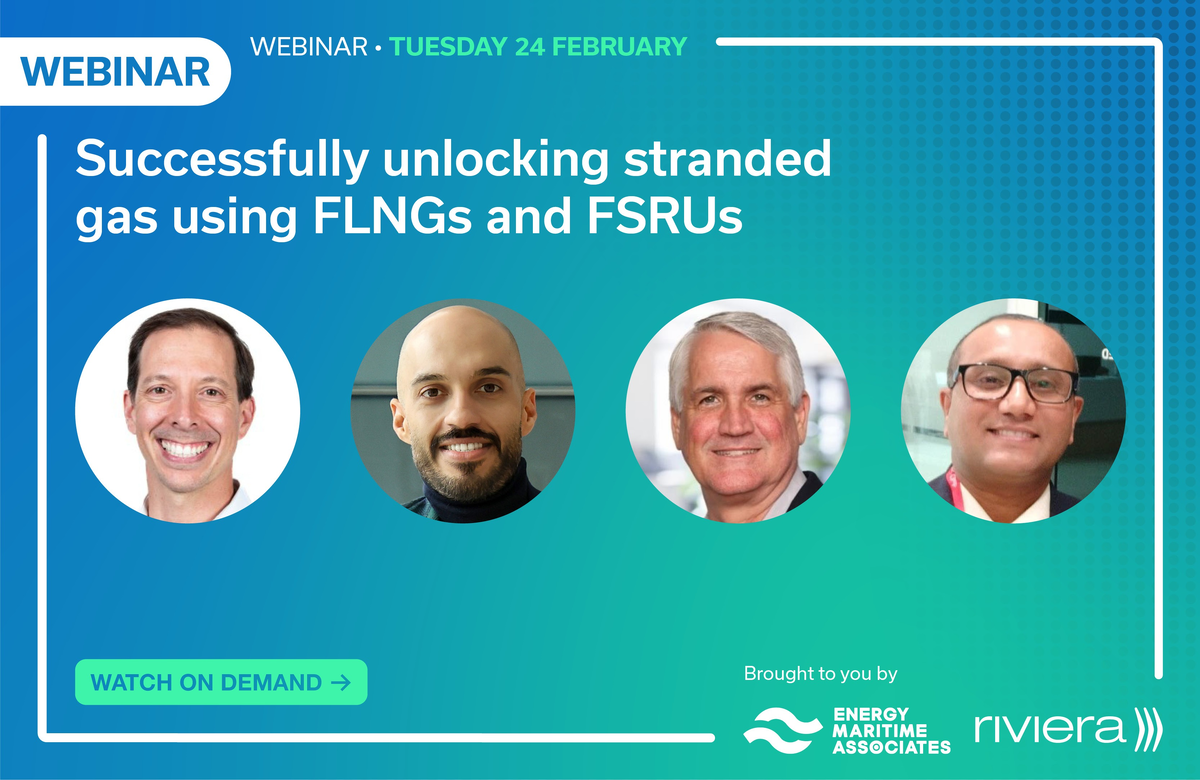
These were among the central themes explored at a recent webinar hosted by Energy Maritime Associates and Riviera Maritime Media, bringing together senior figures from across the floating gas value chain.
A market transformed
The FLNG sector has undergone a fundamental shift since Shell’s Prelude, the world’s first FLNG, was ordered in 2011. That vessel, purpose-built to extract, separate and liquefy hydrocarbons directly from an offshore field in harsh Australian conditions, represented an engineering first. Scepticism about its technical viability was widespread at the time.
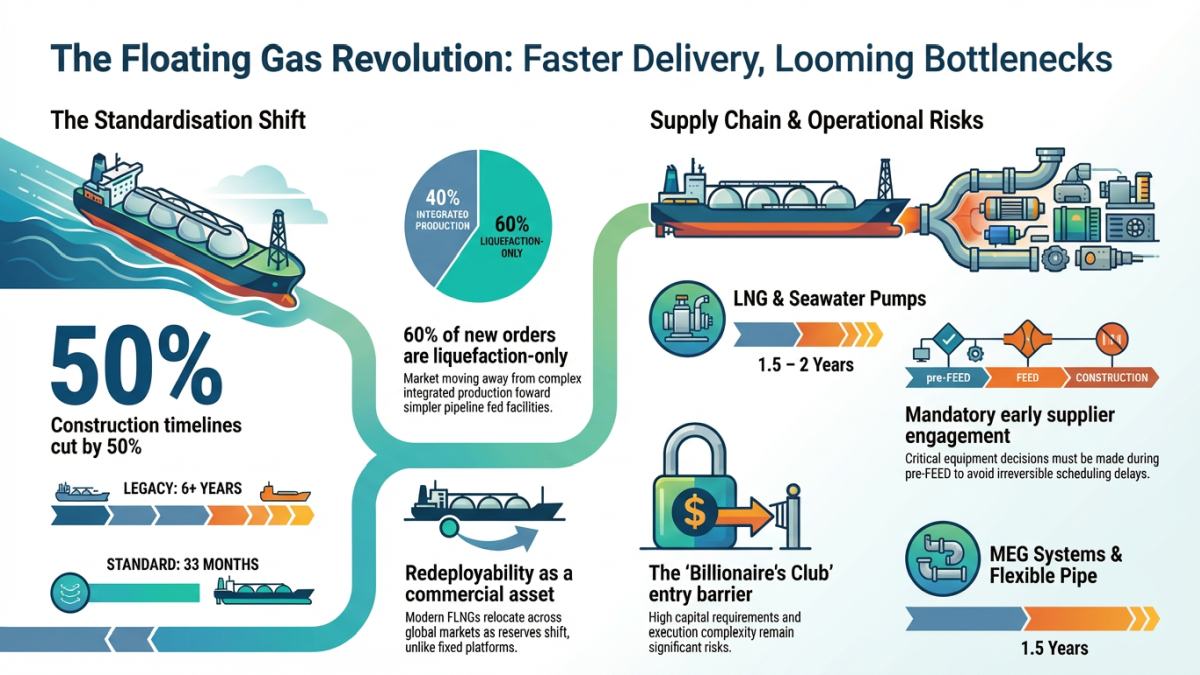
Fifteen years on, the technology is firmly established. Energy Maritime Associates director David Boggs noted that the market has moved significantly away from the integrated offshore production and liquefaction model pioneered by Prelude and Petronas’s PFLNG units, towards pure liquefaction facilities that receive already-processed pipeline gas. Of the current installed fleet, 45% are liquefaction-only units; among vessels on order, that proportion rises to 60%. Geographically, the centre of gravity has shifted from Australia and southeast Asia to Africa, which now hosts the largest number of installed FLNGs, towards the Americas. Projects in Argentina, Mexico and Canada are centred on onshore gas seeking export routes, with floating liquefaction providing a substantially faster path to first cargo than any onshore LNG terminal could offer.
Standardisation cuts delivery times dramatically
The most striking commercial development is the compression of construction schedules achieved through standardised design. Business development director for the Americas at Wison, Sinan Kilkety, pointed to his company’s Eni Ngoza project in Congo as the clearest demonstration of what standardisation can deliver. The 2.4M tonnes per annum (mta) FLNG was delivered in 33 months from contract signing, with first cargo celebrated in early February this year, making the total span from contract to first LNG approximately 38 to 39 months. Earlier generation units took six years or more.
Wison’s approach draws on a proprietary standardised range spanning 0.6 mta to 6.0 mta, with designs fully engineered inhouse across mooring configurations, liquefaction technology and power-generation options. The company fabricates SPB tanks in parallel with hull and topside modules, shortening overall construction time. Its newly operational Chidong yard, with a 520-m drydock capable of handling 250,000 tonnes of steel per annum, adds capacity specifically aimed at large-scale facilities.
A second project, the 1.2-mta Jengting FLNG for Indonesia, was contracted in June 2024 and reached hull launch in December 2025, 10M man-hours without a lost-time injury. Mr Kilkety noted that Wison’s integrated EPC model, owning both yards and executing engineering inhouse, gives it scheduling advantages that third-party contracting arrangements cannot easily replicate.
The redeployability of FLNGs has also gained traction as a commercial differentiator. Wison’s first delivered unit, originally built for Exmar and destined for Argentina, is now operating in Congo for Eni. Unlike FPSOs, which are tailored to specific reservoir characteristics and are impractical to redeploy, FLNGs handling standardised pipeline gas can be relocated with relative ease.
Equipment constraints loom over the backlog
NOV senior vice president for operators and geographical sales, Cobie Loper, offered a candid appraisal of supply chain pressures. Power generation and compression now carry lead times of three to five years, driven not only by FLNG and FPSO demand, but by competing global demand from data centres and other power-intensive sectors. Mr Loper observed that the more sophisticated operators have already responded by entering directly into long-term supply agreements with turbine manufacturers, citing Delfin LNG’s agreements with Siemens as an example.
Other equipment categories face stretched delivery windows. LNG and seawater pumps are running at 1.5 to 2.0 years, with MEG and gas seal systems, cranes and flexible pipe all in the 1.5-year range. For new entrants without established procurement relationships, these timelines represent a material scheduling risk.
Mr Loper’s broader argument was that equipment suppliers who will maintain and support floating assets for 30 years should be engaged during pre-FEED, not once the engineering has been frozen. Decisions made early about equipment selection and integration are effectively irreversible by the time detailed engineering commences. In a market where the lowest upfront bid may conceal significant long-term operational costs, the economics of early supplier engagement are increasingly well understood among major developers, if not universally adopted.
FSRU operations: lessons from the field
Vice president for FSRU terminal operations at Energos Infrastructure, Captain Devendra Kumar, brought a distinctly operational perspective. Energos, formed in 2022 following the acquisition of assets formerly held by Golar and New Fortress Energy, operates nine FSRUs, two floating storage units and two LNG carriers. The company sits among a small group of leading FSRU owners alongside Höegh LNG and Excelerate Energy.
Captain Kumar described the commissioning of four FSRUs across Egypt and Jordan over a four-month window last year as the company’s most demanding operational exercise to date. The vessels were redeployed units, two released from German projects, one completing a decade in Jordan and one finishing its tenure in Brazil. Commissioning timelines across the assignments ranged from four to eight weeks, where infrastructure compatibility was high, to longer periods where CNG send-out manifold modifications were required. Those modifications, involving high-pressure stainless steel and classification society approvals, introduced a minimum three to four-month procurement lead time that operators must account for early in project planning.
He distinguished between operations in warm-water environments, where open-loop regasification using ambient seawater suffices, and colder climates such as northern Europe, where closed or intermediate glycol loops require additional energy input and more complex operations. Europe currently hosts the largest concentration of FSRUs by region, a position established rapidly after Russia’s invasion of Ukraine drove more than 10 units into the continent.
The small market problem
A question from delegates highlighted a structural challenge the sector has not yet resolved: how to deliver gas economically to small island economies and archipelagic markets where throughput volumes cannot justify conventional FSRU infrastructure. Mr Boggs acknowledged that the economics remain difficult. Individual island markets are too small to receive conventional LNG parcel sizes, and the answer, where one exists, likely involves a hub-and-spoke distribution model: a primary import terminal serving as a break-bulk point, with gas then moved onwards by feeder vessel, containerised LNG or CNG. Indonesia has explored variants of this model. The Caribbean has discussed it for years without a scalable commercial solution emerging. Market observers suggest that until LNG bunkering infrastructure and small-scale distribution logistics mature further, fuel-switching in these markets will remain constrained.
Commercial structures and capital
On financing, Mr Kilkety outlined the two dominant commercial models: EPC ownership, where developers raise project or balance sheet finance and take title to the unit, and leasing, where EPC contractors such as Wison can support financing arrangements and developers reduce upfront capital exposure. The choice depends on a developer’s balance sheet capacity, risk appetite and strategic intent, and the leasing model has gained ground, particularly where shorter contract tenures or uncertainty over long-term field life make ownership less attractive.
The broader panel view on market risk for new entrants was sobering. Mr Boggs invoked a remark attributed to Bruno Chabas, former chief executive of SBM Offshore, that to become a millionaire in the FPSO business one must start as a billionaire. The FLNG market, still only 15 years old, retains much of that character. Capital requirements are large, execution complexity is high, and the cost of under-specification or poorly managed contractor relationships compounds over a 30-year asset life. Mr Loper summarised the view across the panel: the market is growing, execution discipline has improved materially over the past decade, and collaboration across the supply chain is replacing the more adversarial procurement practices of earlier years. For new entrants, understanding where to specialise and what risks to retain or pass through remains the defining strategic question.
The Floating Energy Forum takes place on 14 May 2026 at Norton Rose Fulbright’s offices, London.
Related to this Story
Events

Maritime Regulations Webinar Week
 16 Dec 2025
 GMT - ONLINE
Floating energy: successfully unlocking stranded gas using FLNGs and FSRUs
24 Feb 2026GMT - ONLINE
© 2026 Riviera Maritime Media Ltd.


