


Business Sectors
Business Sectors
Events
Contents

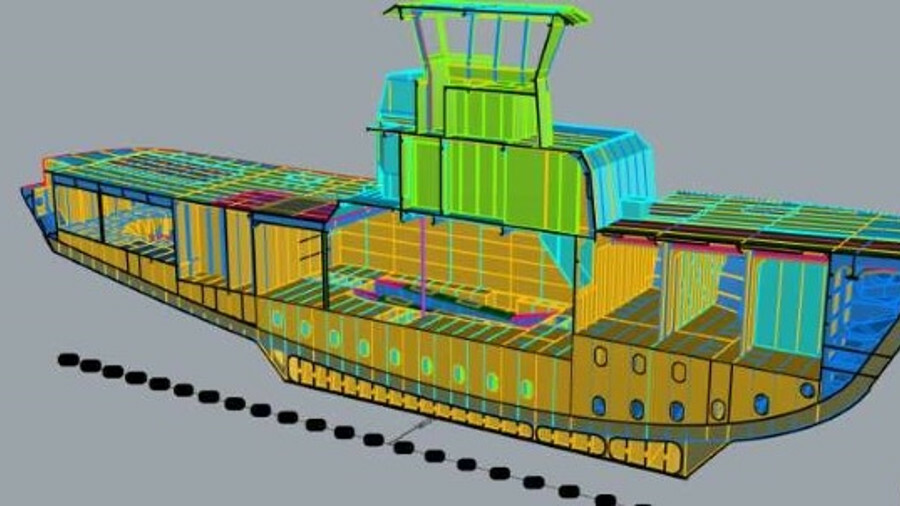
Designer leaps ahead in 3D CAD model class approval


ABS worked with Jensen Maritime to trial using computer-aided design 3D models for class approval of tug designs
Crowley Maritime’s naval architect group Jensen Maritime has taken a design technology leap through co-operation with class society ABS. Together they are piloting using 3D computer-aided design (CAD) models to support plan reviews for class approval.
This industry-first was completed on a tug design Jensen developed for North American towage, with a tug designed to operate with barges along the coast and in inland waterways.
Key results of this pilot project were the time savings achieved, estimated to be as much as 25%, and reduced designer’s costs for class approvals, as the ability to send 3D CAD models directly to ABS for class approval eliminated the need to create 2D drawings to submit for the class design-review process.
“Being able to send our 3D models directly to ABS for review saves us time and resources”
“Being able to send our 3D models directly to ABS for engineering review saves us the time and resources currently used to develop 2D drawings,” said Crowley Maritime vice president of engineering services Jay Edgar.
An important aspect to this pilot project and future transfers of 3D models is the ability to use any software. Which is why this Jensen Maritime-ABS pilot project was not proprietary to specific brands of CAD software, allowing designers to use software they are most familiar with, or is best suited to the design project.
“ABS’s CAD-agnostic approach is an important factor in this process because it allows us to use the modelling program that best fits our needs for the project,” said Mr Edgar. Jensen Maritime’s tug 3D model was seamlessly integrated with the ABS classification processes.
Models developed by using all major CAD modelling software can be uploaded into ABS’s class approval programme. These including widely used brands such as Aveva, Intergraph, Autocad and Rhino.
“Using 3D software models is the logical next step for ABS as we expand our digital footprint and continually enhance the class experience,” said ABS vice president for technology Gareth Burton.
He said using 3D models that are already an integral part of a design process to meet class requirements has clear benefits. “Until now, only 2D drawings have offered the fidelity of detail required to support ABS classification. But advances in technology and 3D modelling techniques enable one end-to-end project model, backed by an extremely detailed data set, for plan approval.”
Prior to reviewing the 3D model, ABS identified 3D model formats that Jensen Maritime wanted to submit. Both then determined the 3D models to be submitted for testing. During this pilot, ABS’ program was tested with hull scantling models.
ABS verified the design, conducting spot checks of the details required for plan review to ensure the models could be fully reviewed. Other details of the work scope included collecting and preparing documentation, data and the 3D model required for the test workflow. This addressed:
- Stamping.
- Commenting and amendments.
- Software compatibility.
- Archiving.
ABS then tested the pilot-approval workflow with the 3D model and accompanying documentation. It reviewed test results and development of best practices for the 3D model-based plan approval process based on the lessons learned from the pilot.
A major challenge ABS had to overcome was the interoperability of third-party platforms, with the class society developing a process so data could be shared across different CAD platforms.
“We expect significant time and cost savings for designers and shipyards”
To support this, Jensen Maritime created sectional views, which allowed ABS engineers to navigate the model. When used in tandem with a file-transfer protocol, engineers and naval architects could communicate comments and annotations of the 3D design and transfer data securely.
ABS developed its agnostic approach to accommodate as many of the industry’s established 3D modelling CAD tools and workflows as possible, said ABS vice president for class standards and software Dan Cronin. “It was essential to the success of the review process because it provides clients with the confidence that their models can be accepted and reviewed by us,” he said.
Mr Cronin expects more shipyards to use 3D CAD models during vessel construction phases. “We expect significant time and cost savings for designers and shipyards,” he said. “However, there will be challenges, because shipyards may need to modify some workflows.” He added that using 3D CAD models could affect more stakeholders in vessel construction, including equipment suppliers and flag states.
ABS plans to pilot using these models in class surveys. It is discussing with flag states how they could accommodate 3D models for plan reviews. ABS is also exploring ways to use 3D CAD models to reduce non-value-added modelling time.


Related to this Story


Events

© 2026 Riviera Maritime Media Ltd.


