


Business Sectors
Business Sectors
Events
Contents
Register to read more articles.

The strait that changed everything
For decades, the Strait of Hormuz has been described as the world’s most important oil chokepoint.


Approximately a fifth of all seaborne oil passes through its 33-kilometre navigable channel. The phrase has been repeated so often that it acquired the dull familiarity of a statistic that everyone knows and nobody fully believes; until the moment it stops being a statistic and becomes a fact.
The events of the past months have made it a fact. The closure, the ceasefire, the fragile calm that now holds — and may not hold — have done something that no amount of energy transition rhetoric has managed: they have concentrated the minds of executives, financiers and policymakers on the single most uncomfortable question in the energy business. What happens when the supply of hydrocarbons from the Gulf is no longer something you can plan around?
The answer, it turns out, has been developing quietly for years in the form of floating production technology. And it is suddenly very much in demand.
The arithmetic of dependency
The numbers are unforgiving. Vessels are trapped in the Arabian Gulf, employed but immobile. Freight rates on certain routes moving in ways that had not been modelled for. Insurance premiums repriced at speed. The broader disruption to global supply chains, the kind that does not make the front pages because it happens in slow motion, through contract renegotiations and cargo rerouting and quiet decisions by procurement managers, has been significant.
What the crisis has laid bare is the structural dependency of the global economy on a geography that it cannot control. This is not a new insight. It is an old insight that has finally become impossible to defer. The question of how to diversify away from Gulf supply, or at least to build redundancy into a system that has been optimised almost entirely for efficiency at the expense of resilience, is no longer a medium-term strategic question. It is an immediate operational one.
The floating answer
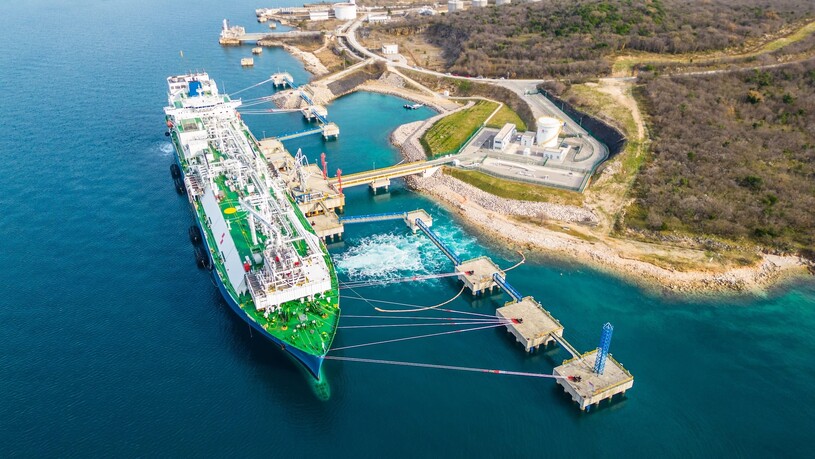
The solution that the industry has been developing, and that the crisis has accelerated, is floating production. FPSO, FLNG, and FSRU technologies exist precisely to address the problem of stranded or geographically challenging hydrocarbon resources. These are reserves that cannot be economically developed using fixed infrastructure, or that need to be brought to market faster than a conventional development timeline allows.
The pipeline of demand for these assets was already growing before the Hormuz crisis. It is now growing faster. The offshore frontier that is attracting the most attention is Africa, West Africa in particular, where the combination of deepwater reserves, improving fiscal frameworks, and the absence of pipeline infrastructure makes floating production the only viable development path. Nigeria, which has the largest proven reserves on the continent, is seeing renewed offshore exploration interest after years of underinvestment driven by above-ground risk and above-water politics. Angola, Mozambique and Senegal are all at different stages of the same journey.
South America presents a parallel story. Argentina’s Vaca Muerta formation has been discussed for years as a potential LNG export opportunity if the infrastructure challenge can be resolved. Brazil’s pre-salt deepwater programme remains one of the most productive offshore development stories of the past two decades, and demand for FPSOs to support it shows no sign of abating. Venezuela, whose politics make it an uncomfortable entry in any serious analyst’s workbook, nonetheless sits atop reserves whose scale means it will eventually return to the global conversation.
The common thread across all of these geographies is floating production. FLNG for monetising stranded gas that cannot reach a pipeline. FPSO for deepwater oil production at the frontier. FSRU for enabling LNG import in markets that lack the onshore regasification infrastructure to receive it. The technology is not new. What is new is the urgency.
The bottleneck is not the technology
The uncomfortable truth that the industry has been circling for some time is that the constraint on floating production development is no longer technological. The engineering challenges of building and operating an FPSO or FLNG vessel are well understood. What is not well understood, or rather, what is understood but not yet resolved, is the financing, contracting, and regulatory framework that allows projects to move from concept to FID at the speed the market now requires.
The gap between announced projects and sanctioned ones remains wide. The reasons are familiar to anyone who has sat through a project development discussion in the past five years: misalignment between developer and contractor on risk allocation, financing structures that do not adequately reflect the long-term nature of the revenue streams, contracting models that drive down unit costs on paper while driving up execution risk in practice, and a regulatory and classification environment that is still catching up with the pace of innovation in the sector.
None of this is insurmountable. But it requires the kind of frank, multi-stakeholder conversation that the industry does not always find easy to have...a conversation between operators, contractors, financiers, insurers, and classifiers in the same room, speaking plainly about where the real obstacles lie.
The conversation the industry needs
That conversation is precisely what will take place at the Floating Energy Forum in London on 14 May. The event brings together the senior figures who are navigating these questions in real time. Everyone, from FPSO and FLNG developers and operators, to the financial institutions that are being asked to fund projects whose risk profiles have shifted, to the classification societies and legal experts who are defining the framework within which these assets must operate.
The sessions will address the financing landscape for offshore projects, the contracting models that are emerging to replace the old three-bids-in-an-envelope paradigm, the question of how to screen solutions at an early stage to get to the right development concept without losing momentum, and the specific challenges of the FLNG sector as global capacity is set to triple by 2030.
But beneath all of these specific topics runs the broader question that the Hormuz crisis has made unavoidable: how does the world build a floating energy system that is genuinely resilient? One that can deliver hydrocarbons reliably when the geopolitical environment makes the conventional supply chains unreliable, and one that can be financed, contracted, and permitted quickly enough to matter?
The answer will not come from any single discussion. But it will come from the accumulated weight of many discussions, held by the people who are actually making the decisions. The Floating Energy Forum is one of those discussions. Given the events of the past months, it is a more important one than it might have seemed when it was first planned.
Join global energy leaders on 14 May 2026 at Norton Rose Fulbright LLP, 3 More London Riverside, London SE1 2AQ, for the Floating Energy Forum 2026

Related to this Story



Events

© 2026 Riviera Maritime Media Ltd.


