


Business Sectors
Business Sectors
Events
Contents
Register to read more articles.
Svitzer Balder: a practical blueprint for the green transition
Svitzer prepares to welcome the world’s first battery-methanol escort tug, Svitzer Balder, which was built in Turkey for its operations in the Port of Gothenburg, Sweden


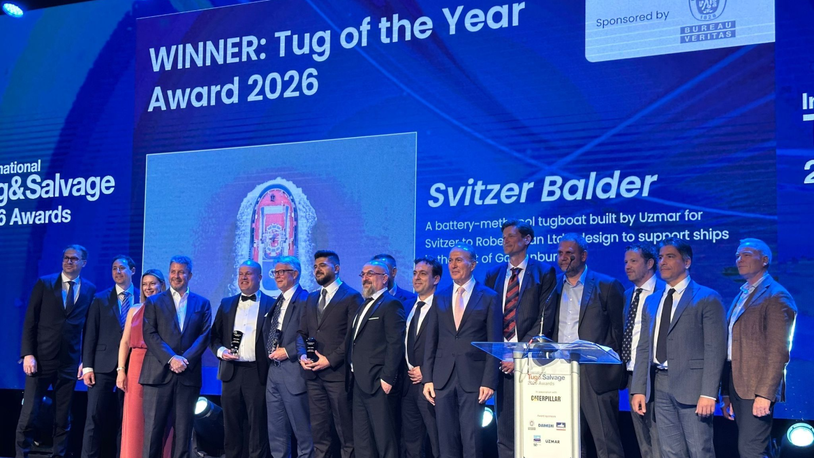
Svitzer Balder is a game-changer in tugboat construction and operations, being the world’s first escort tug with methanol generators and an energy storage system (ESS).
Uzmar built this 35-m vessel in Turkey for Svitzer’s towage and ship-escorting operations in Gothenburg, Sweden, in 2026 to a TRAnsverse 3500 design that the Danish shipowner developed in conjunction with Canada’s Robert Allan Ltd.
It has almost 6,000 kWh of battery capacity, two 350 ekW methanol generator sets, and one 1,960 ekW diesel genset that can also consume hydrogenated vegetable oil (HVO).
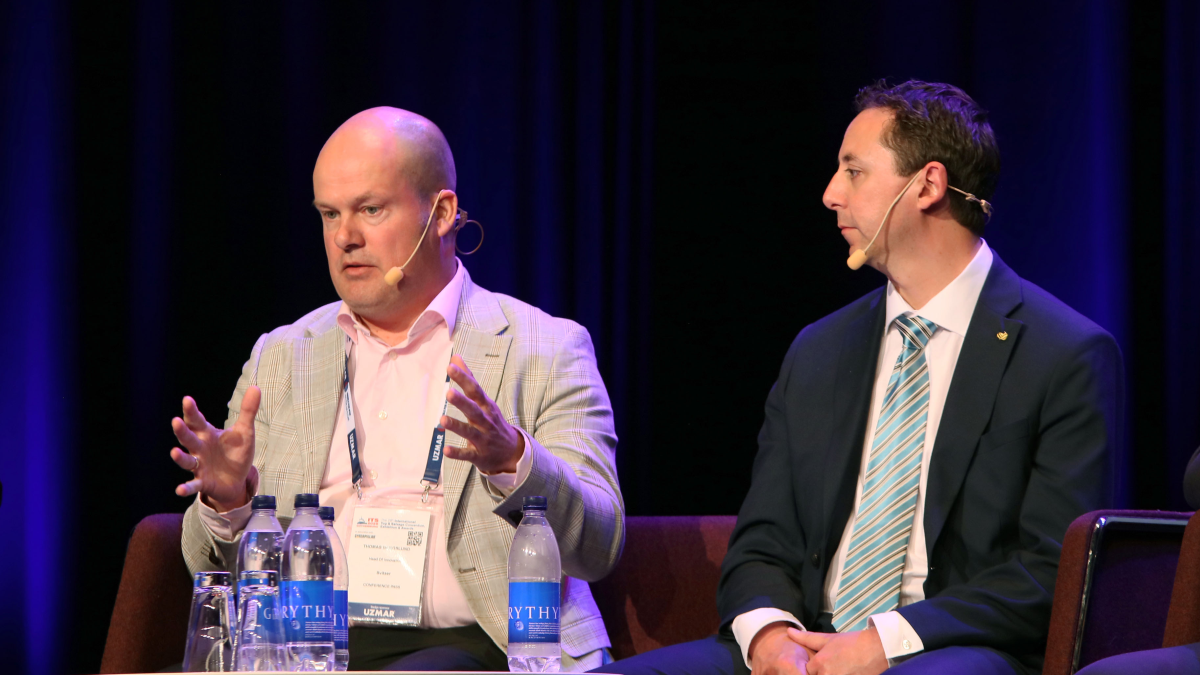
In the Port of Gothenburg, Svitzer Balder should be able to complete over 90% of jobs on battery power alone, said Svitzer head of innovation and group operations, Thomas Bangslund.
“Svitzer Balder is our flagship project and a highly capable escort tug with batteries for low emissions in a high-intensity operational environment,” he said at Riviera’s 28th International Tug & Salvage Convention, Exhibition & Awards being held in Gothenburg in association with Caterpillar, 19-21 May 2026.
“Port of Gothenburg is a good match for this investment, with access to green energy and experience in handling methanol fuels and a green agenda,” Mr Bangslund added.
He said Svitzer invested in this battery-methanol escort tug as part of its electrification and sustainable strategy and to gain experience with operating methanol gensets.
“We are setting standards for electrical tugs and are scaling up with four tugs ordered from Cochin Shipyard in India,” said Mr Bangslund.
Designing Svitzer Balder for safe, stable, resilient and low-emissions towage came with major challenges for naval architect Robert Allan.
One of those was the conflicting requirements for the multi-fuel and ESS within the confined space in the tugboat, said Robert Allan project director, Erik Johnston.
“We solved these challenges through close collaboration with Svitzer and Uzmar, and by reviewing various vessel arrangements,” he said.
Another issue to overcome was the requirement for occasional venting of methanol from tanks.
An initial plan to vent methanol through a heightened mast pipe was dismissed as the hazardous zone around the outlet was too large.
Mr Johnston said it was impossible to source explosion-proof marine electronics and communications equipment, particularly radar, to be installed within the hazardous zone. Therefore, other solutions were found.
“No venting should occur as excess gas will be returned to the tank through a venting return line,” he said.
In the need for venting, methanol would be released underwater. “All methanol would be released and absorbed in the water column,” Mr Johnston said.
Uzmar also overcame engineering challenges during construction of Svitzer Balder, particularly involving integration of multiple energy, power and propulsion technologies into one vessel.
The Turkish shipbuilder had to combine the large-scale ESS with the methanol- and diesel-fuelled auxiliary gensets, shore charging connection and advanced direct-current (DC) power management in a compact vessel.
“Rather than serving as a technology demonstrator, the vessel has been developed as a fully capable frontline asset, retaining the performance standards required for modern harbour operations,” said Uzmar project manager Furkan Yildiz.
His presentation followed the project from concept development through engineering, construction, commissioning and delivery.
He outlined the main challenges in its construction including the density of machinery in the ice-class vessel, the complexity of cable and pipework routeing, ventilation and cross-discipline systems integration.
Following completion, Svitzer Balder undertook sea trials and achieved 87 tonnes of bollard pull and 155 tonnes of steering force, but it became clear that refinements would be required to the behaviour of the software-driven hybrid power plant.
Once this has been completed and approved, Svitzer Balder will be sailed to Gothenburg to start its operations.
“The project demonstrates that the future of harbour towage will be defined not by a single fuel or propulsion technology, but by the intelligent integration of multiple energy systems into commercially effective working vessels,” said Mr Yildiz. “Svitzer Balder offers a practical blueprint for that transition.”
Related to this Story

Events

© 2026 Riviera Maritime Media Ltd.


