


Business Sectors
Business Sectors
Events
Contents
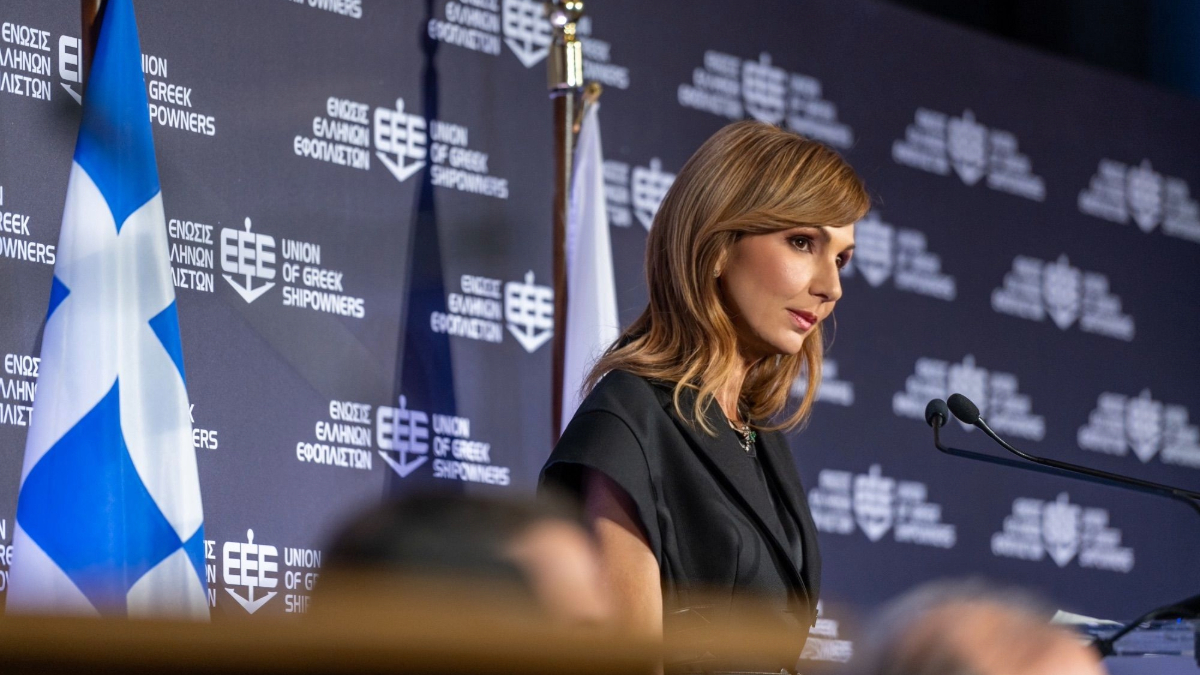
'Shipping fell into a trap': Melina Travlos on unrealistic environmental targets as IMO followed EU’s path
The global shipping industry fell into a trap regarding decarbonisation, being carried away by the EU’s ambitious and unrealistic targets, said Union of Greek Shipowners (UGS) President Melina Travlos during the customary press conference on the final day of Posidonia


“Following the EU’s introduction of regional measures, and in an effort by the International Maritime Organization (IMO) to align with that approach and shift toward global measures, the IMO moved towards the 2050 targets – targets which are unrealistic,” Ms Travlos said.
She once again criticised the proposed Net-Zero Framework (NZF), arguing that it was moving in the wrong direction and would effectively turn the IMO into a revenue-collection mechanism.
“Nobody understood where all this money collected would be directed,” Ms Travlos said.
She revealed that during a discussion with IMO Secretary-General Arsenio Dominguez, he stated that the funds would be allocated to poorer African countries and island states.
“I do not understand what shipping has to do with this,” Ms Travlos said.
She praised the Greek government’s handling of the issue, noting that it recognised the importance of shipping for both Greece and Europe and understood that the proposed regulation was flawed.
As a result, Greece abstained in a vote to adjourn last October’s extraordinary MEPC session until 2026, while other EU member states voted to continue negotiations.
Regarding the next stage of the process, Ms Travlos noted that alternative proposals had been submitted, pointing to those from Liberia and Japan, but declined to say which option the UGS favours.
“We are in a better position now. If a compromise can be found, it will benefit not only shipping but the global economy as a whole,” Ms Travlos said.
Owners should not be involved in Hormuz toll discussions
Commenting on the Middle East crisis and the possibility of shipowners paying tolls to transit the Strait of Hormuz, Ms Travlos stressed that owners should not be involved in such arrangements.
“We are asking for freedom of navigation, which is of paramount importance,” she said.
“This is the real problem. Ships have been targeted and weaponised. International laws and treaties should be respected.”
Her comments came amid diverging views expressed during Posidonia. While Evangelos Marinakis said that shipping would be better served by paying the tolls and avoiding the current disruption, the majority remained opposed to any form of payment for passage through this vital global trade artery.
Unfair targeting of Greek shipping in dark fleet debate
Turning to the dark fleet issue, Ms Travlos said that it is not a shipping problem but rather a threat to the industry.
“Whenever there are partial measures instead of universal ones, dark fleets are created,” she said, referring to sanctions regimes.
“As an industry, we must coordinate our response and determine how to deal with this phenomenon. As long as sanctions are not applied globally, distortions in competition will continue to grow,” Ms Travlos explained.
She also argued that Greek shipping is being unfairly singled out in discussions surrounding the dark fleet.
“We need to make it clear that it is not only Greek-owned ships that have ended up in the dark fleet, but vessels from many other countries as well,” she said.
“Greek shipping dominates the global tanker fleet. If tankers are sold and subsequently end up in this fleet through a second or third transaction, that is not something we can control.”

Related to this Story

Events

Maritime Regulations Webinar Week
 16 Dec 2025
 GMT - ONLINE
Floating energy: successfully unlocking stranded gas using FLNGs and FSRUs
24 Feb 2026GMT - ONLINE
© 2026 Riviera Maritime Media Ltd.


