


Business Sectors
Business Sectors
Events
Contents


Starlink - the opportunities and the pitfalls.
Gregor Ross, Chief Commercial Officer at SnakeWays GmbH, lends some insight into how and where Starlink can make a significant improvement in ship to shore connectivity.


Gregor has been involved in Maritime Satellite communications since the very early days of Inmarsat, some 40 years ago. He has worked with, and advised on the deployment of, every innovation in the Maritime Satcom field since then. Inmarsat from A to FX, Iridium, Globalstar, Thuraya, and multiple VSAT providers, Gregor has worked with them all. He is therefore extremely well placed to give some advice on Starlink, the latest “game changer”.
Are you thinking of moving to Starlink?
For maritime and remote users Starlink is indeed a game changer. It brings remote connectivity forward 20 years. With Starlink you can now connect to a vessel mid-ocean in exactly the same way, using exactly the same tools, as you would to any land based office or domicile.
Therefore you no longer need those satellite technology experts, those specialist remote connectivity tools, or specialist applications – right?
Wrong? At least in part. Why?
Are you Mobile or In Motion?
Whilst the standard Starlink is “mobile” in the sense you can move your antenna from one location to another, a moving platform such as a vessel is classed as being not only “mobile” but also “in motion”. Therefore you need a specialist high performance antenna and a subscription to Starlink’s Maritime service.
Starlink’s Maritime service is their most expensive offering and it is a metered service. I.e. you pay monthly for a limited amount of data and pay per Gbyte if you exceed that package. It is true that those “limited amounts of data” (starting at 50 Gbytes and going up to 5 Terabytes) far exceed the traditional packages available from maritime satellite service providers. However, bear in mind that a “normal” Netflix user can exceed 5 Gbytes per day and at download speeds of 220 Mbps, 50 Gbytes can disappear in a few hours.
So, if you want to stay within budget, you will need some kind of control. For the smaller package you may need a firewall that restricts access to certain streaming services. For the larger packages you may want to assign individual bandwidth quotas to each of your crew members. If you are concerned about working/rest hours on board you may want to limit crew access to a maximum numbers of hours per day.
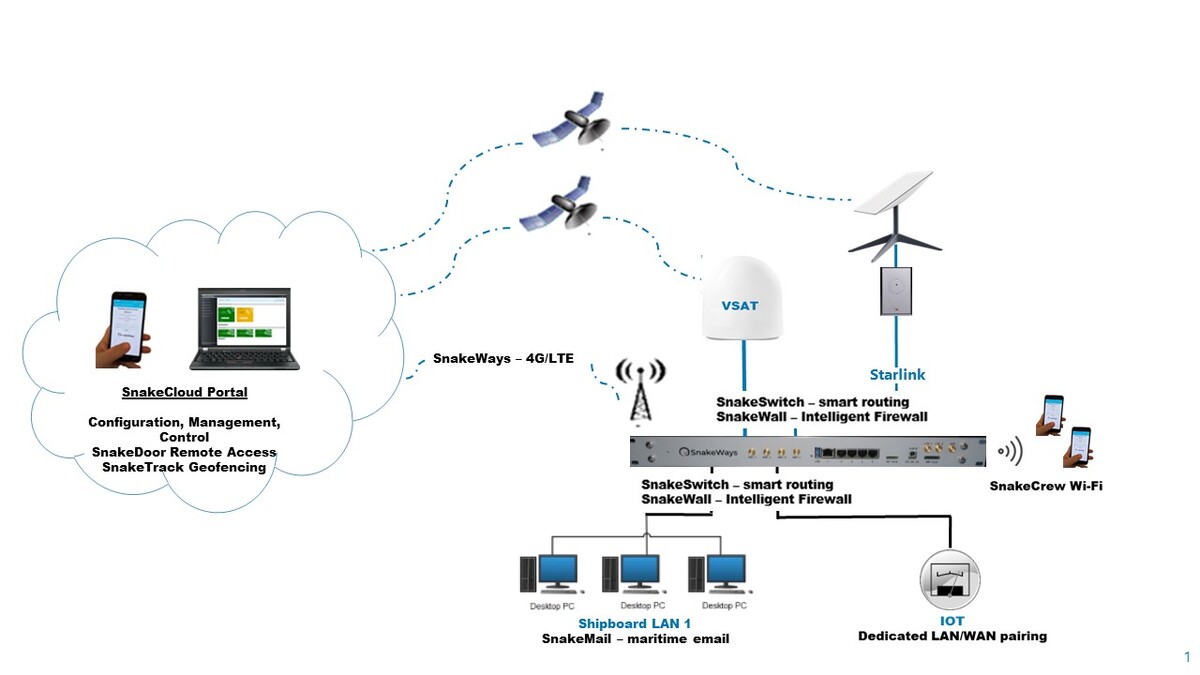
This is one area where specialists such as SnakeWays come in. Our SnakeBoxes host both a state-of-the-art firewall service (SnakeWall), that can block services with high bandwidth requirements, alongside a quota and time management service for crew (SnakeCrew).
Is it legal?
At the time of writing Starlink’s standard service is approved in more than 50 countries. But it is important to note two things –
• Many countries require separate approval for the “in motion” services and some have yet to give that approval – Singapore for example.
• If Starlink is not yet approved in a specific country then it is not approved in that country’s territorial waters.
Take those two together and there is a highly significant proportion of the world’s maritime traffic that is trading in waters where Starlink services are not yet approved. A simple glance at any of the web based AIS tracking services demonstrates how much of that traffic follows the coastline.
From Tripoli to Djakarta, Cairo to Cape Town, there are no coastal waters where Starlink services are approved. And that includes the straits of Malacca and indeed most of SE Asia.
Whilst it is reasonable to expect that many individuals, boat owners, fishermen or individual crew members, may ignore those restrictions on the basis of risk/reward and the fact that enforcement in many countries is almost non-existent, most responsible ship managers would want to ensure that their Captain and crew were notified where and when they might be in breach of local regulations.
How is that done? – Geofencing.
However, most geofencing tools on the maritime market today are linked to a specific satellite provider. SnakeWays offer a completely independent geofencing service, SnakeTrack. Hosted on the SnakeBox, SnakeTrack can alert all concerned when the vessel enters or leaves the territorial waters of any country where Starlink is not approved.
Do I need a backup service?
Game changer maybe, but the Starlink Maritime service is not perfect. Apart from the legal restrictions on use in ports and territorial waters, Starlink remains a “best efforts” service and as such can suffer from congestion, particularly in busy port areas. It also needs a very clear view of the sky to operate. This can be an issue when in port, particularly for some commercial vessels, container ships for example.
Feedback from Starlink Maritime customers contains reports of frequent disconnections, albeit for short periods. This may have little effect on many services but can cause some difficulty and frustration when using certain tools, video conferencing for example.
A back up option is therefore needed for all but the most casual Starlink users.
A terrestrial cellular service, 4G/LTE even 5G, is the obvious option for coverage in port and territorial waters. For ocean going vessels, L-Band services such as Iridium Certus or Inmarsat Fleet Broadband can be very cost effective and many vessels will already have the necessary equipment in situ. A significant number will also have existing VSAT antennae and service contracts.
How to integrate all this?
The SnakeBox with the SnakeWays services such as SnakeSwitch and SnakeWall offers a fully featured SD WAN capability that will automatically chose the best alternative should Starlink be unavailable. Not only that, the SnakeWall rules can ensure that access is limited to essential services when connectivity falls back to more limited and expensive bandwidth.
SnakeMail, designed to perform regardless of the bandwidth available, ensures that corporate email continues to flow smoothly over Starlink and any of these backup services.
As an added bonus the SnakeBox SL and the SnakeBox XL both come with a 4G/LTE router already installed. All you need is a SIM card.
Do I need to upgrade my shipboard network?
Possibly. The Starlink terminal can deliver up to 220 Mbps to the vessel. Is the shipboard network itself capable of delivering that game changing bandwidth to critical applications, to the officers and the crew?
The physical infrastructure of many shipboard networks is not new. Cabling for example, is it really up to handling the speeds that Starlink offers? Wi-Fi Access points are another. The crew will be expecting huge improvements in their internet access, only to find that the existing Wi-Fi network simply cannot cope with what Starlink has to offer.
Other, slightly more obscure, choke points or bottlenecks may exist. Are the ethernet ports on the current shipboard router or “Smart Box” actually capable of handling 220 Mbps? Many of those ports may be limited to 100Mbps or less. The core processor on older network components such as the vessel “Smart Box” may also have issues performing tasks like firewalling and address translation at high speeds and with significant data volumes. To ensure the optimum performance of a Starlink Maritime installation then all this needs to be considered.
The entire SnakeBox family is based on current technology and we have tested extensively with our own Starlink terminal. The SnakeBox is not a choke point or bottleneck and will help distribute the benefits of Starlink’s ground breaking performance to all users on the shipboard network, including those using Wi-Fi.
Doesn’t all this control and complexity nullify Starlink as the Game Changer?
Not at all! The transmission speeds, the data plans, the pricing and the ease of installation all combine to make Starlink a true game changer for the Maritime industry across the board. What is missing is the ability to optimise the integration of Starlink into the shipboard operations and get the best out of this exciting new service.
That’s where SnakeWays comes in.
If you would like to know more about Starlink and the SnakeWays services or need some technical advice on how best to deploy Starlink with the SnakeBox then please don’t hesitate to get in touch. info@snakeways.com




Related to this Story



Events

© 2026 Riviera Maritime Media Ltd.


