


Business Sectors
Business Sectors
Events
Contents

Register to read more articles.

Aerodynamic LR1 tanker design with 35% gain in efficiency
BAR Technologies and Deltamarin’s Project Aquilo incorporates WindWings sails within the dimensions of an LR1 tanker, with dramatic results


Project Aquilo is one of the latest design collaborations between Finnish designers Deltamarin and the WindWings designer BAR Technologies - the two companies have spent more than a million person-hours on projects together.
Deltamarin, independently run but owned by the China Merchants shipbuilding group, prides itself on closely monitoring all aspects of its designs – a one-stop office is how Deltamarin senior advisor, Mauri Harki, described the Finnish design house’s approach.
BAR Technologies CEO, John Cooper, explained how the collaboration utilised the company’s computer simulations and high-speed computing, developed during America’s Cup campaigns.
While sails are now a familiar feature of energy-saving design concepts in the tanker sector, Project Aquilo is very different - as the eye travels aft across the superstructure it is truly innovative. The bridge is literally a bridge crossing two slender accommodation blocks, producing a structure not dissimilar to La Défense in Paris, and equally dramatic.
The genesis of the project was a Deltamarin Kamsarmax dry bulk carrier design which had been undertaken for a client, but not built. This is not unusual, noted Mr Harki; the company had undertaken over 5,000 concepts and delivered 1,500 vessels. This concept however, used BAR Tech’s skill set to produce an LR1 tanker design aerodynamically optimised for the location of the sails. Each sail has moveable parts and integrates, via software and telemetry, with the other sails on the deck. As per other WindWing sails, the mast fold down on to the deck.
“As the eye travels aft across the superstructure it is truly innovative”
The aerodynamic input did not stop there and led to the optimised geometry of the deck house. There is also considerable computation into the hydrodynamics of the Project Aquilo hull shape, but Deltamarin and BAR Tech are keeping the hull design secret for the time being. The official comment is that the hull is hydrodynamically optimised for sailing and engine running.
It did reveal that the hull dimensions were relaxed compared to the original design. In particular, the breadth of 42 m was allowed to flex to between 39 m and 47 m. It will be intriguing to learn more about the underwater form, but a broader beam will have a different impact on sailing characteristics.
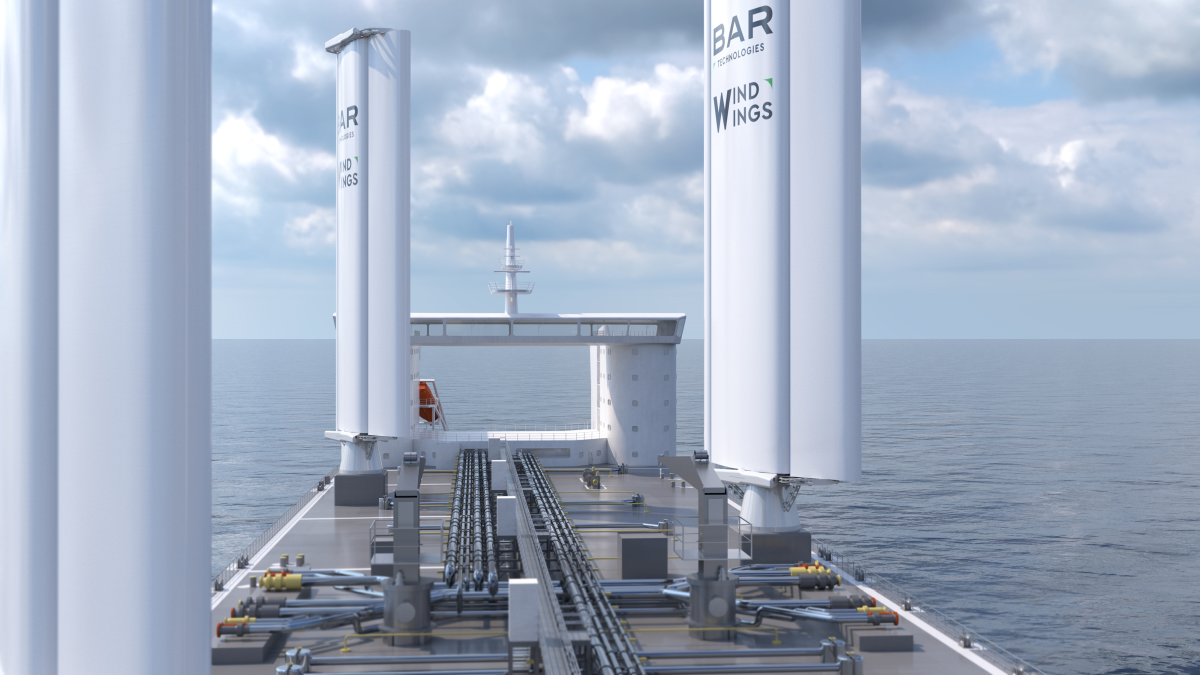
One dimension that has remained is the draught of 15 m and the depth of 22 m, which are dictated by the requirement to pass through the Straits of Denmark.
In many respects, the Aquilo Concept seems very close to fruition. The design is already specified with a MAN5G70ME-C10.7 main engine with ratings of 12,180 Kw (SMCR) and 8,800 kW (NCR). The key aspect of the design is in the fuel savings and emissions reductions.
At design draft on main engine alone, at 14.5 knots, fuel consumption is 32.8 tonnes per day. With the Area Bridge arrangement, the fuel consumption drops to 31.3 tonnes per day. Adding the WingWind sails in correct specified position reduces consumption to 26.8 tonnes per day.
“At 12.0 knots, the savings are even more significant”
At 12.0 knots, the savings are even more significant, with the combined consumption a mere 12.6 tonnes per day.
The supporting accommodation modules of the Aero Bridge are not simple blocks. The design is not a standard accommodation module sliced in half and pushed out to create a space through the middle. The individual accommodation modules are aerodynamically wing-shaped, with leading edges to smooth the air around the structure and lessen the disturbance seen with traditional block shaped modules.

While this does mean there is no longer the benefit of a push from a following wind, the dramatic shape creates what Mr Cooper calls a ‘Hero Ship’ impact. This is a reference to his background in automotive Formula One, where there is a client association between the technologies developed in appearing in the top of the range Hero Cars.
He also noted that with WindWing vessels already in the water, such as Berge Bulk’s Berge Olympus, there is a certain cachet – Berge Olympus is known as the most powerful sailing cargo ship in the world.
The overall gain in efficiency is 35%, according to Deltamarin and BAR Tech, with 18% assigned to the WindWings, 11.5% from the yet-to-be-revealed hull hydrodynamics and 4.5% from the Aero Bridge.
Project Aquilo specifications:
Length overall: 250 m
Breadth: 43.4 m
Depth: 22.3 m
Capacity at design draft: 100,000 dwt at 13.5 m
Capacity at scantling draft: 115,000 dwt at 14.8 m
Cargo tanks: 12 + 2 slop tanks
Segregation: 3 grades
Tank coating: pure epoxy
Total tank volume: 137,000 m3
Main engine: MAN 5G70ME-C10.7
Output (SMCR): 12,180 kW
Output (NCR): 8,800 kW
Diesel generators: 3 X 940 kWe
Emergency generator: 900 kWe
Source: BAR Tech and Deltamarin
Riviera Maritime Media’s International Chemical and Product Tanker Conference will be held in London, 23 April 2024, click here to register your interest in this industry-leading event





Related to this Story


Events

Maritime Regulations Webinar Week
 16 Dec 2025
 GMT - ONLINE

Floating energy: successfully unlocking stranded gas using FLNGs and FSRUs
24 Feb 2026GMT - ONLINE
© 2026 Riviera Maritime Media Ltd.


