


Business Sectors
Business Sectors
Events
Contents

Register to read more articles.

Booming LNG exports drive US tugboat fleet growth and owner investment campaigns
When it comes to adding newbuild tugboats in North America, LNG is attracting the greatest interest in many US states and one Canadian province


The US has become the world’s largest exporter of LNG over this decade, due to the huge gas resources extracted from the country’s onshore and offshore fields and because of rising global demand and restricted alternative sources.
The opening of new and expanded LNG production and export terminals has fuelled a frenzy of tug newbuild ordering in the US, making this one of the busiest shipbuilding activities in the nation, perhaps only surpassed by the production of towboats for inland waterways navigation.
The majority or ordered US tugs will be prepared for escorting, manoeuvring, berthing and undocking gas carriers at the growing number of LNG export terminals along the US Gulf coast.
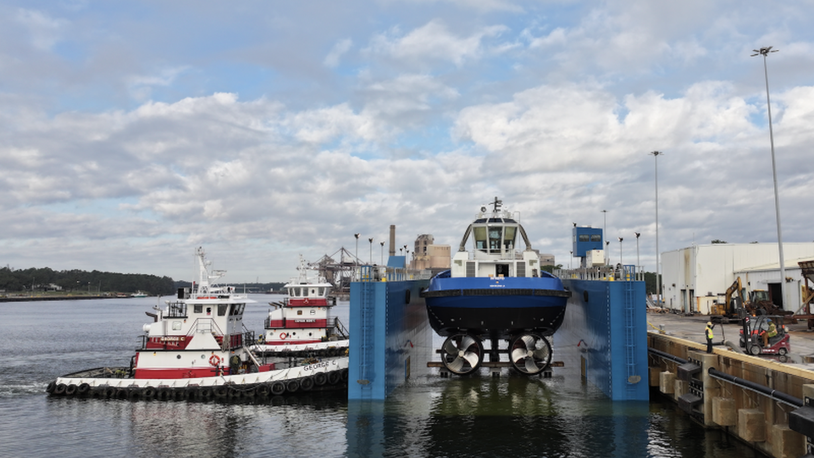
In the past three years, US shipyards have been inundated with contracts to build escort tugs tailored for supporting the docking of gas carriers at existing and new terminals.
Deliveries in the past year, and in several years to come, are dominated by LNG terminal tugs, rather than those built for handling container ships, which was the prominent driver for shipyard orders in the 2010s and the first half of this decade.

Newbuilds are either expanding fleets at existing terminals or being prepared for new export hubs. There are six existing terminals located in Texas and Louisiana: Sabine Pass; Corpus Christi; Freeport; Calcasieu Pass; Plaquemines; and Cameron, plus Cove Point in Maryland and Elba Island in Georgia.
Another five projects are either increasing output or adding new capacity: Golden Pass; Corpus Christi Stage 3; Rio Grande; Port Arthur; and Woodside, plus there are potentially six additional projects in various stages of federal review and development.
In British Columbia, LNG Canada exported its first cargo from the Kitimat terminal in June 2025. In September, Shell and joint venture partners agreed to invest up to US$23Bn in Phase 2 to double its production capacity to 28 mta.
Other LNG projects on Canada’s west coast include Ksi Lisims, Woodfibre, Cedar and Tilbury Phase 2. These projects in Canada and the US will continue increasing demand for newbuild ship-assist tugs to 2030 and beyond.
So far this year, at least 12 tugboats have exited US shipyards, the same number as all 2025 deliveries, while there are orders for at least another 30 tugs to come in the next three years, which is a conservative estimate.
In Canada, HaiSea Marine contracted Turkey-headquartered Sanmar Shipyards and Dutch construction group Damen Shipyards to build three tugs to top up its existing British Columbian fleet.
As long as gas production climbs, worldwide demand rises and LNG exports from rival sources, such as Qatar, the United Arab Emirates and Russia, are restricted by conflict, the US will remain the global leader in this sector and terminals will sprout up like offshore wind turbines in the North Sea.
US terminal tug construction is a booming market that more shipyards will join and owners will use to expand and modernise their fleets.
Connect with the international tug community at TUGTECHNOLOGY ‘27, the industry’s premier technical gathering, taking place in Rotterdam, the Netherlands, on 19-20 May 2027. Join tug owners, operators, builders, designers and technology providers for two days of industry insight, knowledge sharing and valuable networking. Find out more here.





Related to this Story


Events

Maritime Regulations Webinar Week
 16 Dec 2025
 GMT - ONLINE

Floating energy: successfully unlocking stranded gas using FLNGs and FSRUs
24 Feb 2026GMT - ONLINE
© 2026 Riviera Maritime Media Ltd.


