


Business Sectors
Business Sectors
Events
Contents

Register to read more articles.
Rise of anti-GPS-jamming tech reflects high risks for seafarers
Technology has been developed to support shipping sailing through conflict zones, where GPS jamming is impacting navigation


Shipping channels are being impacted by Global Navigation Satellite System (GNSS) jamming and spoofing, increasing the risk of ships grounding or colliding with hazards.
Outages or misinformation are leaving ships without positioning, navigation and timing (PNT) information and sailing blindly in areas already at risk of physical attacks.
Modern conflicts are fought across multiple domains, including the electromagnetic spectrum, with GNSS jamming becoming increasingly common in the Middle East, Red Sea, Black Sea, eastern Mediterranean and Baltic areas.
GNSS interference is being reported well beyond immediate conflict zones, and impacts all shipping regardless of ownership, registration and class, demonstrating how electronic warfare can have far-reaching impacts.
With this background, technologies have been developed, and capital is being invested in solutions for preventing GNSS jamming affecting ship navigation.
Advanced Navigation has secured more than US$95M of funding to accelerate the development of its resilient PNT solutions used to outpace signal interference and provide assurance to shipping. A series C funding round was led by Airtree Ventures, along with Quadrant and the National Reconstruction Fund Corp, to provide finance to develop sensors that can sense, adapt and navigate independently without relying on GPS.
Advanced Navigation plans to establish PNT centres across Europe to support global maritime partners in distributing this hardware and supporting software. Backers of Advanced Navigation include Main Sequence, KKR, In-Q-Tel, Alpha Intelligence Capital, Malcolm Turnbull and OIF Ventures.
“The world’s reliance on any single navigation technology has evolved from a technical limitation into a systemic vulnerability,” said Advanced Navigation chief executive and co-founder Chris Shaw.
He added that deep-learning software with high-precision hardware helps autonomous vessels navigate through seas impacted by GNSS jamming.
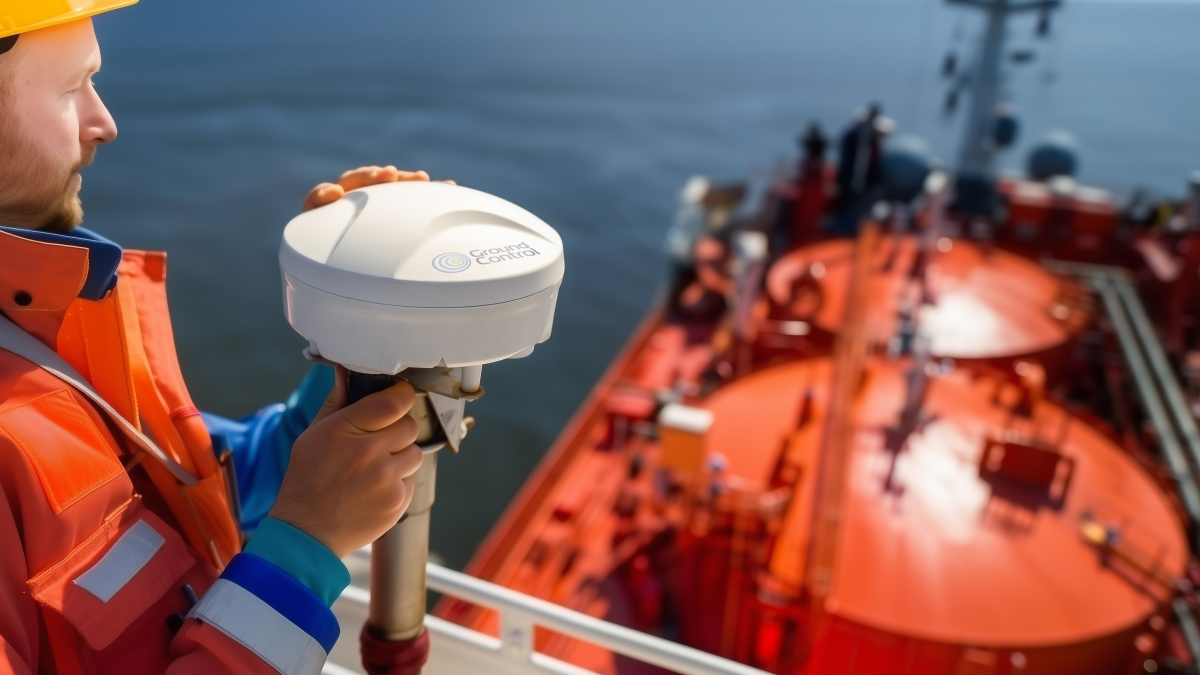
Ambrey has partnered with a satellite communications and positioning technology provider, CLS Group subsidiary Ground Control, to launch RockFleet Assured, an alternative PNT solution to safeguard vessel navigation in environments vulnerable to GPS denial, jamming, and spoofing.
“GNSS disruption is a practical challenge for commercial fleets operating in and around high-risk regions,” said Ground Control chief executive Alastair Macleod.
“RockFleet Assured pairs operational maritime insight with assured positioning capabilities, as a straightforward way for ship and shore teams to validate position, flag anomalies, and maintain oversight when GNSS cannot be trusted.”
Alternative PNT
Plextek is developing alternative PNT solutions to help vessels maintain navigation and timing when GNSS is degraded or denied.
“We are also developing systems that allow organisations to safely simulate GNSS and communications interference in controlled environments, so equipment and operators can be tested against realistic disruption scenarios,” said Plextek lead for technology solutions, Dan Gardner.
This would help teams develop and test the tactics, techniques and procedures needed to operate in contested electromagnetic environments.
“Reliable GNSS cannot be taken for granted anymore,” said Mr Gardner. “With jamming and spoofing on the rise, and growing reliance on satellite navigation, it is essential that systems and operators are trained and prepared to operate in these environments and that resilience is built into PNT solutions from the outset.”
AIS manipulation
Pole Star Global also highlighted the frequency of GNSS and the automatic identification system (AIS) manipulation, with hundreds of ships reporting suspicious positional anomalies.
From 5 March to 15 March 2026, Pole Star Global tracked almost 3,400 vessels in and around the Strait of Hormuz. Roughly 1 in 15 of them, 230 ships, encountered patterns consistent with GPS and AIS interference, such as sudden jumps in positioning.
“This is no longer a story about isolated glitches. It is a systematic, geographically clustered distortion of reality at sea,” said Pole Star Global chief data and analytics officer, Saleem Khan.
He said some ships leaving the Strait of Hormuz are transmitting over AIS messages to discourage targeting by military forces.
“Turning what should be a navigational field into a live political message of ‘do not shoot, we are not your target’,” said Mr Khan.
In 2025, Frontline, Wallenius Wilhelmsen, Tschudi Shipping trialled an electronic navigation tool to provide secure ship positioning in sea areas where GNSS signals were jammed or spoofed.
This device includes assured PNT technology and connectivity to Iridium’s low Earth orbit (LEO) satellites for global coverage.
This LEO satellite network transmits secured PNT signals which are 1,000 times more powerful than GNSS/GPS and is resilient to jamming and spoofing.
This secure information is used by other bridge electronics, such as ECDIS, for accurate positioning and then by crew for safe voyage execution.
Tschudi Shipping and SGM Technology from Norway teamed up with Virginia, USA-headquartered NAL Research to develop and test PntGuard.
GNSS disruption
On 1 March 2026, more than 1,100 vessels experienced simultaneous GPS and AIS interference across the Middle East Gulf region as an escalation of the offensive on shipping using the Strait of Hormuz by Iranian forces.
According to reports, Liberia-flagged container ship Source Blessing was impacted by GNSS interference north of Jebel Ali, UAE, when it was also struck by a projectile on 12 March, and tanker Shenlong experienced repeated GPS loss during its 8 March transit through the Strait of Hormuz.
Across the wider region, more than 1,650 vessels have reported navigation disruptions. These incidents span 12 flag states and operators from nine countries.
Enhanced situational awareness
Orca AI has upgraded its artificial intelligence (AI)-backed hardware and software used to provide a 360-degree field of view (FOV) around ships that can be used for collision avoidance and autonomous navigation.
This configuration is enabled by three SeaPod watchkeeper units, each equipped with high-sensitivity red-green-blue and thermal cameras. Working in unison, they deliver continuous full-perimeter coverage and unified situational awareness around the ship, enabling overtaking vessels and piracy threats to be detected, and overcoming line-of-sight constraints caused by cranes, wind rotor sails and other deck equipment.
“A full 360-degree FOV represents a meaningful step forward in providing unmatched situational awareness for vessels operating in increasingly complex navigation environments,” said Orca AI chief technology officer and co-founder, Dor Raviv. “It is a foundational requirement for enabling safe autonomous operations.”
Orca AI and Riviera will be hosting a navigation briefing on 30 March 2026 in a webinar: GPS Under Attack: Preparing for a World of Unreliable Navigation. Use this link for more information and to register your interest to attend.



Related to this Story


Events

Maritime Regulations Webinar Week
 16 Dec 2025
 GMT - ONLINE
Floating energy: successfully unlocking stranded gas using FLNGs and FSRUs
24 Feb 2026GMT - ONLINE
© 2026 Riviera Maritime Media Ltd.


