


Business Sectors
Business Sectors
Events
Contents
Dali civil trial postponed amidst late-hour settlements
Shipowner Grace Ocean and operator Synergy Marine settled wrongful death lawsuits and other civil claims surrounding box ship Dali’s destruction of the Francis Scott Key Bridge in Baltimore in 2024


A US federal judge for the Maryland District has postponed a civil trial covering claims related to the collapse of Baltimore’s Francis Scott Key Bridge just before the trial was due to begin.
Shipowner Grace Ocean and operator Synergy Marine of Dali, the container ship that hit Baltimore’s Francis Scott Key interstate bridge, reportedly settled wrongful death suits with the families of the six construction workers who were killed in the incident. The workers were on the bridge at the time of the incident and were killed when the bridge collapsed.
According to Insurance Journal, court documents show that the wrongful death settlements are part of more than 30 settlements been reached as of May 29 in litigation over damages related to the bridge’s collapse. The settlements reportedly include reimbursements for workers’ compensation payments and cargo losses, but no details have been disclosed in the wrongful death settlements. A settlement was also reached in the personal injury claim brought by a bridge worker who plunged into the river and was rescued.
In the wake of the settlements, US district court justice James K Bredar postponed the civil trial after reportedly previously denying a request by Synergy to delay the trial to allow the company to focus on criminal charges in the incident announced in May 2026 by the US Department of Justice.
At issue in the postponed civil trial is the level of financial liability of Grace Ocean and Synergy for damages related to the bridge’s collapse. Both companies have invoked an 1851 law, the Limitation of Liability Act in support of their claim. Until the settlements and subsequent postponement of the case, Grace Ocean and ship manager Synergy had been proceeding with claims of a right to limit their liability in the incident to the value of the vessel and its cargo, which was stipulated as US$43.7M following the incident. Riviera has contacted representatives for both companies, and neither company had a comment on the civil case.
Continuation of other lawsuits related to the incident
To date, the two companies have settled civil lawsuits with the state of Maryland for an estimated US$2.25Bn for economic damages and with the US federal government in 2024 for specific damages related to the costs of clearing bridge wreckage and the containership, Dali, that was pinned beneath the wreckage in the channel leading to the port of Baltimore.
While it has finalised its civil lawsuit with Dali’s owners and operators, Maryland said it is continuing to pursue some economic damages claims as well as claims against the shipbuilder, Hyundai Heavy Industries, that built Dali.
As Maryland’s attorney general’s office said in a statement, "The National Transportation Safety Board, in its final report issued in November 2025, found Hyundai Heavy Industries to be at fault in causing the M/V Dali’s loss of power and its allision with the Francis Scott Key Bridge."
Synergy Group has previously referred to the NTSB’s findings of the cause of Dali’s power loss as being "due to a manufacturer’s latent defect".
HHI and Baltimore city officials reportedly responded to the US DOJ’s May 2026 criminal charges against Synergy by indicating the charges support their claims that the operator is partly responsible and are consistent with the investigation by the NTSB.
According to court documents, in addition to Baltimore’s claims, there are about 10 other claims unsettled from insurers and other businesses.
In the US Department of Justice’s criminal lawsuit, 18 counts in the indictment brought charges against Synergy companies Synergy Marine, based in Singapore, and Synergy Maritime, based in Chennai, India, along with an Indian national, Radhakrishnan Karthik Nair, who worked for both subsidiary companies as the technical superintendent for Dali.
The charges against the three defendants included conspiracy, misconduct or neglect of ship officers resulting in death and obstruction and violations of the ports and waterways safety act, among others, according to US district attorney for Maryland Kelly Hayes, and followed a two-year investigation by the FBI, the Environmental Protection Agency (EPA), and the US Coast Guard (USCG) that was separate from the investigation by the NTSB.
NTSB report finds ’loose wire’ the cause of Dali allision with Francis Scott Key interstate highway bridge
In the early hours of 26 March, 2024, Dali left the Port of Baltimore bound for Sri Lanka and lost power while navigating through the Fort McHenry Channel, a deepwater route that leads from the port to the Chesapeake Bay.
Initially, the ship was able to broadcast a mayday call and regain power, but it soon lost power again before striking the Francis Scott Key bridge. The major interstate highway bridge collapsed seconds later, killing six construction workers.
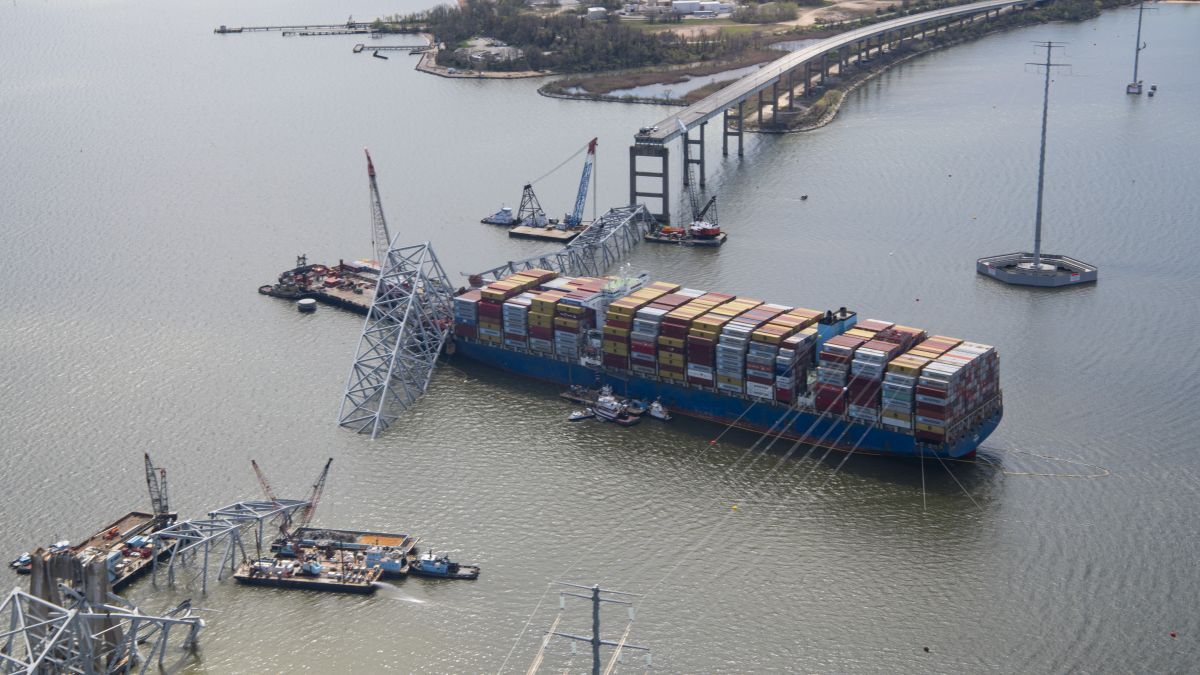
A long stretch of the bridge collapsed into the river, and sections of the pier, deck and truss spans collapsed onto the vessel’s bow and forward-most container bays.
The wreck of Dali and the remnants of the bridge obstructed the navigable channel and brought all shipping into and out of the Port of Baltimore to a standstill.
NTSB investigators spent more than a year and a half investigating the incident and piecing together a detailed accident report in which they found that a single loose wire caused power outages on board the 9,962-TEU container ship Dali that led to the allision with and the eventual collapse of Baltimore’s Francis Scott Key Bridge.
During a public meeting on the findings of the investigation into the incident, NTSB investigators said the loose wire in the ship’s electrical system caused a breaker to unexpectedly open. Investigators found that "wire-label banding prevented the wire from being fully inserted into a terminal block spring-clamp gate, causing an inadequate connection".
NTSB chairwoman Jennifer Homendy said her team had accomplished ’the impossible’ in isolating the single wire that caused the blackout on board Dali. She likened the effort to "hunting for a loose rivet on the Eiffel Tower," which is around the same height as the container ship’s 330-m length.
Related to this Story
Events
Maritime Regulations Webinar Week
 16 Dec 2025
 GMT - ONLINE
Floating energy: successfully unlocking stranded gas using FLNGs and FSRUs
24 Feb 2026GMT - ONLINE
© 2026 Riviera Maritime Media Ltd.


