


Business Sectors
Business Sectors
Events
Contents
Flexible future: retrofit-ready tugs for harbour, coastal towage
Azimuth stern drive tugs are being planned with space for retrofits, ensuring greater certainty around fuel availability and shore charging


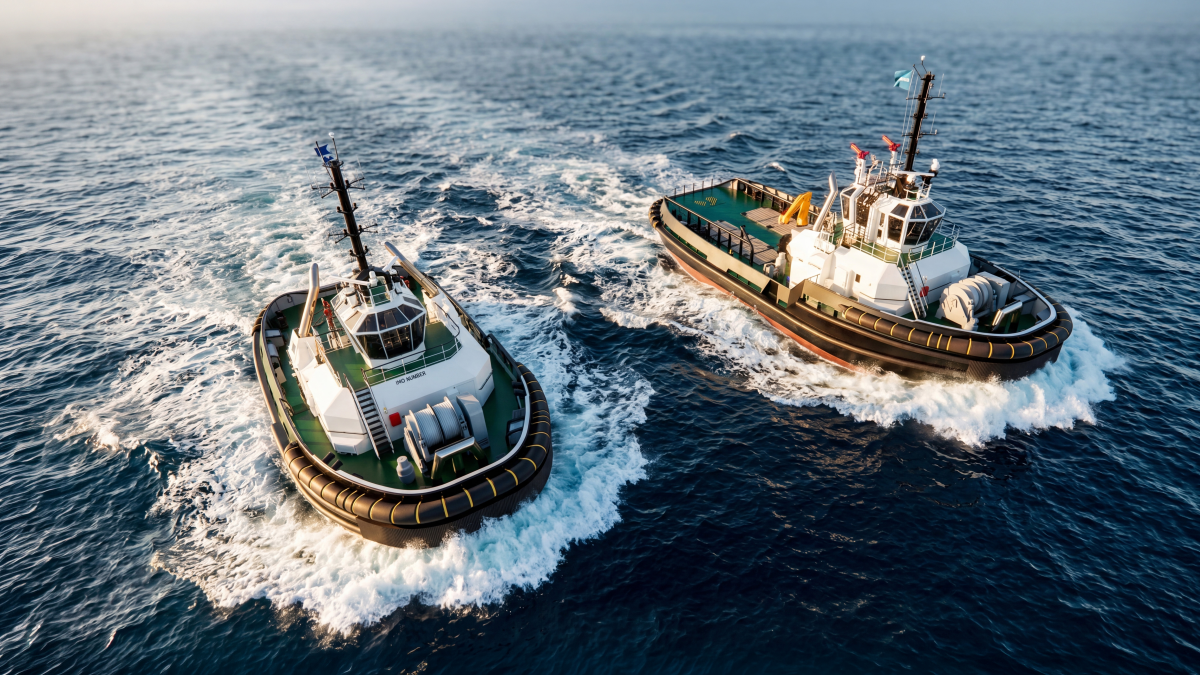
Damen Shipyards has developed naval architecture for azimuth stern drive (ASD) tugs that would be able to switch to alternative fuels or batteries in the future.
The Dutch shipbuilder is providing solutions for some of the most difficult decisions owners will need to make in terms of renewing their fleets and expanding into new towage markets, at a time when there are growing uncertainties as to which marine fuel to back.
Damen created its fuel-flexible (FF) range of tugboats to provide owners with options and versatility in their newbuild investment decisions, as there is currently no way of knowing which fuels will be available and affordable – or perhaps, mandatory – during the lifetime of these assets.
ASD tugs would be built for low-emissions diesel-based operations and prepared for conversion to various fuel and energy solutions later in their lifecycle.
“When making an investment in a tug today, owners need something that is going to be able to compete in today’s market conditions and prepared for tomorrow’s,” said Damen product manager for tugs, Erik van Schaik.
Regulatory, environmental, commercial and operational requirements are likely to change, potentially multiple times, for tugs expected to operate over 30 years.
“The fuel-flexible tug would be built to operate on diesel, but they could be adapted once we have gained more clarity,” Mr van Schaik said.
ASD tugs built to operate in emissions control areas would have Damen’s own selective catalytic reduction (SCR) systems, which reduce marine NOx emissions by 80%, for IMO Tier III compliance.
“There will be a cost of conversion in the future”
Engines on these tugs would also be capable of operating 100% on carbon-neutral hydrotreated vegetable oil (HVO) and potentially fatty acid methyl ester (FAME) biofuels. They could be replaced or retrofitted in future repower projects to run on other fuels, particularly methanol or ethanol in a duel-fuel or single-fuel mode.
On FF tugs, Damen would also include additional space for the installation of an energy storage system (ESS) and switchboards, or a methanol-fuelled propulsion system.
“There will be a cost of conversion in the future, but this will come at a time when there is clarity, and when a return on the investment can be expected,” said Mr van Schaik.
Having these spaces included in the naval architecture and in the newbuild means owners can retrofit these tugs in the future at far lower capital costs than if they wanted to upgrade a conventional vessel or order another newbuild in the coming years to run on methanol fuel as a replacement.
“Our FF series of vessels are cost-comparable, per tonne of bollard pull, with a current, standard model,” said Mr van Schaik.
To account for the additional pressure of methanol Damen would apply different welding procedures and tank constructions, and place insulation in different locations, while venting would be underwater.
“If you think about what is necessary in the future and prepare the product for that, it is not expensive,” said Mr van Schaik.
“If you do not think about it, and build a conventional tug, which you later want to operate with an alternative solution, then it is, at best, expensive, and in the worst case, impossible.”
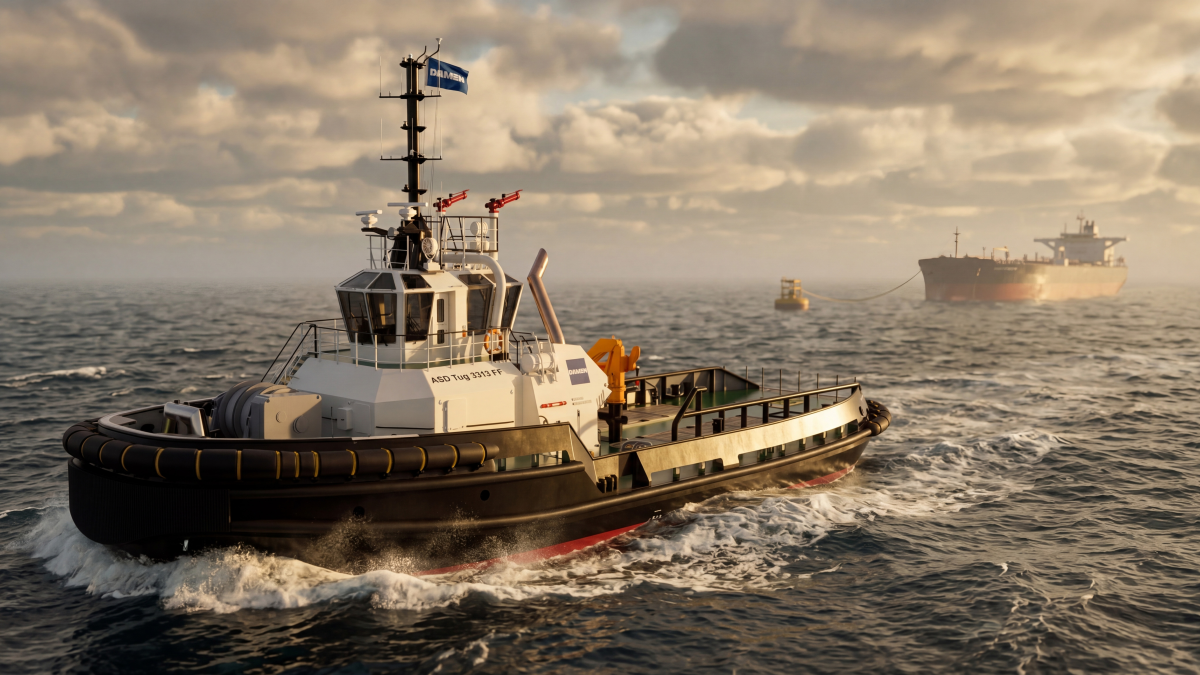
Damen’s FF tugs benefit from future-proof methanol-prepared class notation and will be ready for the installation of a future Damen ultra-low emissions vessel (ULEV) system that would combine a diesel particulate filter with Damen’s existing SCR.
Two FF tug designs have been produced, and one is under development, ready to build at the group’s shipyards in Asia.
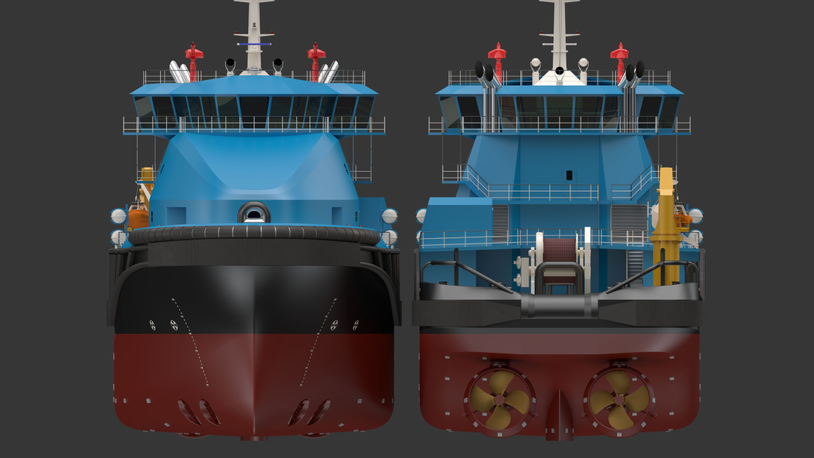
Damen’s ASD Tug 2713 FF, at 397 gt, has an overall length of 27 m, a beam of 13 m, a bollard pull of 90 tonnes and tank capacity to store 126 m3 of diesel or 115 m3 of methanol.
Its ASD Tug 3313 FF, at 497 gt, has an overall length of 33 m, a beam of 13 m, a bollard pull of 100 tonnes ahead, an aft deck of 110 m2 and tank capacity to store 240 m3 of diesel and 200 m3 of methanol.
Mr van Schaik said an ASD 2713 FF tug would be suitable for handling large vessels, including LNG carriers, in terminals and an ASD 3313 FF tugboat could be employed on various operations, including long-distance towage, buoy, hose and anchor handling, oil pollution control, salvage, standby and rescue, and firefighting, with a capacity to deliver up to 7,200 m3/hr or a water/foam mix.
Additionally, Damen is in the early stages of developing an ASD Tug 2512 FF with a length of 25 m, a beam of 12 m and 80 tonnes of bollard pull for operations in ports with more confined ship-manoeuvring space.
Electric tugs
Damen already builds electric-powered reverse stern drive (RSD) tugs to its RSD 251 design and with a long-life ESS on board for zero-emissions harbour operations at its facilities in Vietnam. It is planning to build battery-powered ASD tugs in the near-term.
Robert Allan Ltd (RAL) has developed its AmpRA series of battery-powered tugs for construction in Asian shipyards to complement its ElectRA range, already built in Turkey and operating worldwide.
The Canadian naval architect’s latest development involved producing naval architecture for AmpRA 2900-CL tugs that Hong Kong-headquartered Cheoy Lee Shipyards intends to build in China.
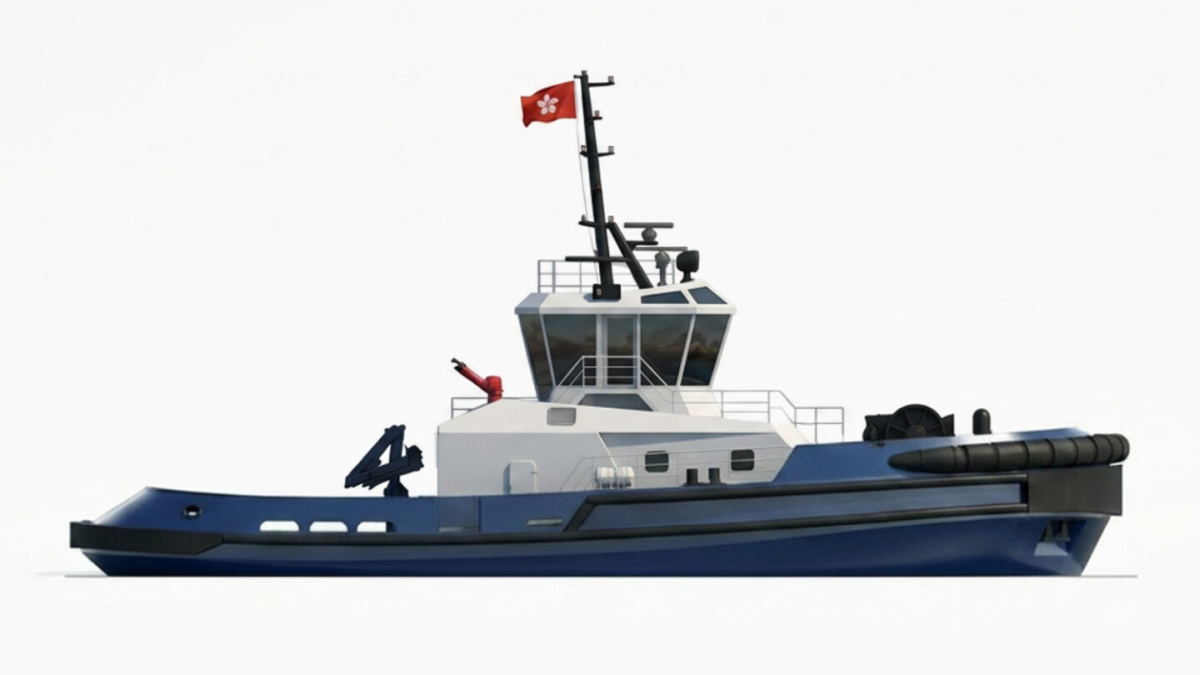
These 29-m tugs would have around 7 MWh of battery capacity and a bollard pull of around 70 tonnes, both being sufficient for ship escort and manoeuvring capabilities, and with back-up generators ready to run on low-carbon fuels.
Also in China, Shandong Port Group’s Rizhao Port is building two harbour tugs to RAL’s AmpRA 3600 design,with 7,300 kWh of lithium iron phosphate (LFP) batteries and back-up generators. RAL anticipates these will have continuous operation for over 15 hours at a service speed of 8 knots in full electric mode, with zero emissions.
Zhenjiang Shipyard in Jiangsu Province is building AmpRA 3600 tugs for Tianjin Port Towing Co with a battery system of 7,315 kWh and class smart-ship notations i-Ship(M) for advanced machinery systems, i-Ship(E) for energy efficiency, i-Ship(I) for integrated platform capabilities, and i-Ship(T) for towing operations.
Elsewhere, Sanmar Shipyards has built 14 ElectRA series tugs with Corvus Energy batteries, including four delivered this year to Turkish terminal operator, Botas.
Also in Turkey, Med Marine Holdings worked with RAL and Caterpillar to develop and build a VoltRA battery-electric harbour tug, which is scheduled for completion at the shipyard in Eregli in Q3 2026.
VoltRA will have hybrid propulsion, combining Caterpillar’s latest LFP battery system with back-up generators and an intelligent energy management system. Med Marine expects it will operate purely on batteries in harbours and seamlessly transition between electric and diesel-electric hybrid modes.
Repower, retrofit
Naval architect Glosten is currently involved in the retrofit of a derrick barge and the repowering of a pilot vessel.
In Alaska, Manson Construction Co. completed the upgrades to heavy-lift vessel Wotan as part of a terminal modernisation project, near Anchorage.
Glosten supported the engineering for the upgraded crane configuration, including structural, stability and finite element analysis and designing a boom insert to extend the boom length.
Along the US West Coast, Glosten assisted in the repowering of Puget Sound Pilot’s Puget Sound in Port Angeles to replace original main engines with higher-power, lighter-weight units to improve vessel performance and reliability. Glosten conducted a laser scan and gathered field data aboard Puget Sound and observed pilot transfer operations on sister vessel Juan de Fuca as part of its support for the project.
Riviera will host TUGTECHNOLOGY ‘27 in Rotterdam, the Netherlands, 19-20 May 2027. Use this link for more information and to register.
Related to this Story

Events

Maritime Regulations Webinar Week
 16 Dec 2025
 GMT - ONLINE
Floating energy: successfully unlocking stranded gas using FLNGs and FSRUs
24 Feb 2026GMT - ONLINE
© 2026 Riviera Maritime Media Ltd.


