


Business Sectors
Business Sectors
Events
Contents

Register to read more articles.
Class sets the pace with implementing digital, electric maritime technologies
Bureau Veritas Marine & Offshore senior vice-president Christophe Chauviere explains the importance of digital tools, remote inspections, drones, batteries, automation and new fuels to shipping overcoming the growing challenges it is facing now and in the future


Modern maritime challenges require enhanced solutions from classification societies if the industry is to successfully navigate the dual challenges of sustained geopolitical volatility and the ongoing energy transition.
The IMO’s clearly defined commitments to achieving net-zero greenhouse gas (GHG) emissions by 2050 have resulted in a sharp acceleration in the development and integration of new and more advanced clean technologies and fuels.
However, the practical and political obstacles to keeping pace with the IMO’s ambition are also evident, not least as its intermediate 2030 decarbonisation goals draw closer, said Bureau Veritas Marine & Offshore senior vice-president for technical and operations excellence, Christophe Chauviere.
“From a class perspective, this trend creates a tension within the industry as rapid technological change can risk outpacing regulation,” he said.
“New fuels and clean propulsion systems, digital tools and automation are being developed and adopted at speed, and common standards are required to manage them safely,” Mr Chauviere told Riviera.
Service vessels, such as workboats and tugboats, are well positioned to benefit from these advancements, especially within hybrid electric propulsion solutions.
Mr Chauviere said Bureau Veritas Marine & Offshore is leading the way in determining the requirements for battery systems on vessels, through the process of comprehensive certification, and by developing rules for the design, installation, operation and maintenance of battery systems.
Its role in advancing maritime electrification was evidenced by the delivery in Q1 2026 of the Bureau Veritas-classed Eon, the first fully electric harbour tug in south-east Asia. Built by PaxOcean and owned by Kuok Maritime Group under the Coastal Sustainability Alliance, Eon is assigned Bureau Veritas’ Battery System notation, reflecting its fully electric propulsion architecture.
“The project represents an important milestone in efforts to accelerate the decarbonisation of coastal shipping,” Mr Chauviere said.
Bureau Veritas has developed a more agile approach to vessel survey engagements using remotely controlled vehicles and connectivity technology.
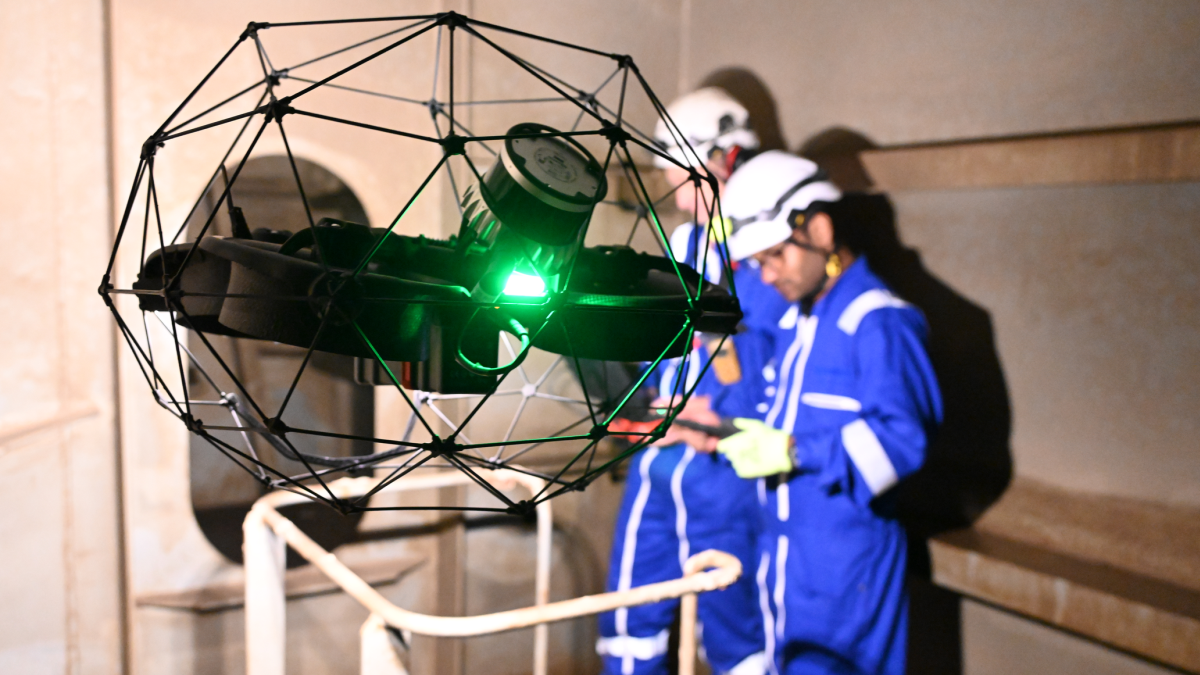
Its remote-inspection techniques (RIT) is an advanced inspection methodology that combines specialist surveyor expertise with drone-enabled inspections and artificial intelligence (AI)-supported analysis.
“Unlike traditional remote surveys, RIT inspections are performed onboard by qualified Bureau Veritas surveyors,” said Mr Chauviere.
These surveyors are trained specifically by vessel type “to ensure inspections are conducted by subject matter experts with a detailed operational understanding of the asset,” he said.
These specialists employ unmanned aerial vehicles to inspect confined and hazardous spaces without the need for human entry, reducing physical operations within confined spaces by between 60-70%.
This technique is designed to enhance the depth of analysis and insight that each survey engagement can provide.
“The qualified, ship-type-specific expertise of the class surveyor remains central to every inspection, with technology extending its reach and precision,” said Mr Chauviere.
By deploying drones equipped with advanced imaging systems, a full vessel RIT engagement can generate thousands of minutes of inspection footage from ballast tanks, cargo holds, and structural areas.
Data is then processed using Bureau Veritas’ augmented surveyor 3D capabilities combined with AI-supported analysis to identify, categorise and standardise inspection findings, which are then validated by a qualified surveyor.
“The maritime industry is no stranger to navigating periods of sustained uncertainty and disruption,” said Mr Chauviere, referring to the ongoing impact to international shipping from conflicts in the Middle East, Red Sea and Black Sea.
“Fortunately, the capability and expertise of classification societies continue to evolve in order to meet these challenges, providing dedicated, innovative and expert guidance to maintain safety at sea for an industry in transition,” he said.




Related to this Story



Events

Maritime Regulations Webinar Week
 16 Dec 2025
 GMT - ONLINE

Floating energy: successfully unlocking stranded gas using FLNGs and FSRUs
24 Feb 2026GMT - ONLINE
© 2026 Riviera Maritime Media Ltd.


