


Business Sectors
Business Sectors
Events
Contents
Register to read more articles.
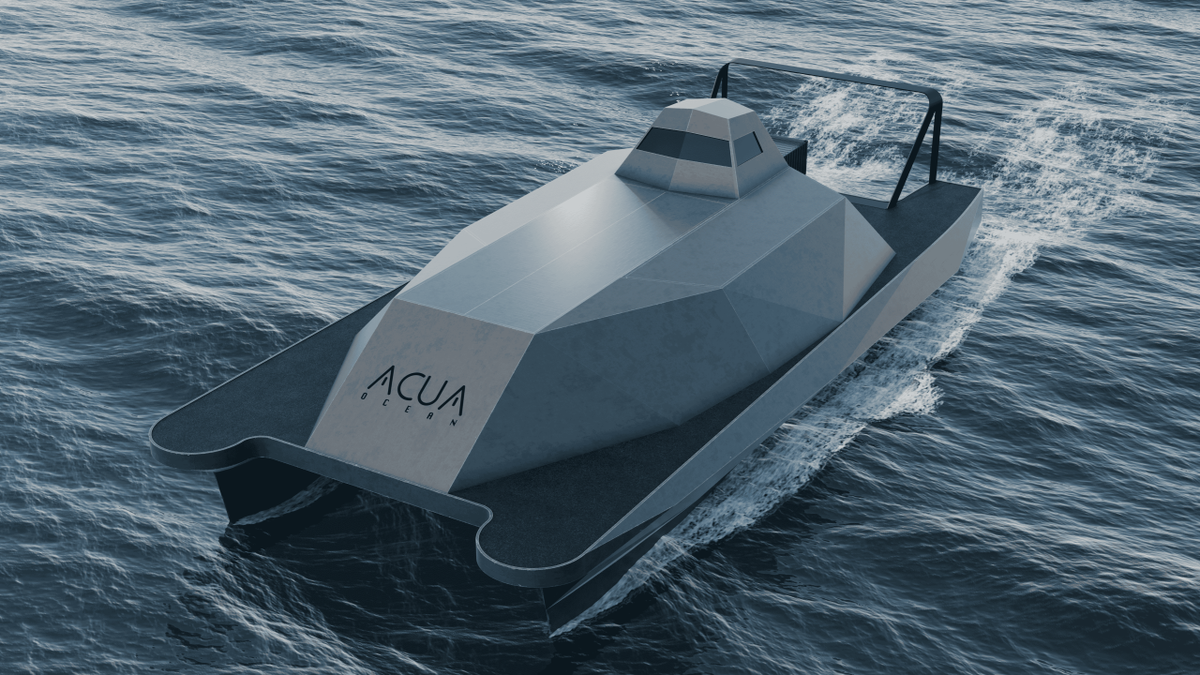
Consortium secures UK government backing for uncrewed offshore support vessel
A consortium led by ACUA Ocean has secured UK government backing to develop a new class of medium-sized uncrewed support vessel


The MROS consortium – which also includes Houlder, Ad Hoc Marine Designs, Trident Marine and the University of Southampton – was awarded funding in May 2025, as part of the UK Department for Transport’s CMDC programme.
Since the award, the MROS partners have been advancing designs for the 43-m vessel which is now progressing with resistance and seakeeping tank testing led by Southampton University Marine & Maritime Institute and the world-renowned Wolfson Unit.
Powered by a hybrid-electric propulsion system, the USV is designed to operate autonomously or optionally crewed. The prototype designs explore methanol fuel and consider efficiency, performance, maintainability and emissions reductions compared with hydrogen, ammonia and diesel variants.
Following the success of ACUA’s 14-m Pioneer-class USV design, the new vessels will also feature a small waterplane area twin hull (SWATH), optimised for low motions and platform stability in high sea states.
MROS comes four months after USV Pioneer became the first – and so far only – USV to achieve UK Maritime Coastguard Agency Workboat Code 3 regulatory approval. Trials with Pioneer provided a testbed with real-world operational insights scalable to the larger MROS platform, ensuring the vessel’s architecture benefits from proven, full-scale learning.
Controlled in either autonomous or remote modes, or by an optionally embarked small crew housed in a modular accommodation pod, the new vessel will be capable of operations in Sea State 6+, featuring DP1 station-keeping, a 2,500 nautical mile range, 20+ days endurance, and a sprint speed of over 20 knots.
The MROS USVs are designed to satisfy a wide variety of tasks that require persistence and robustness, such as offshore logistics, maritime surveillance, subsea inspection and intervention, and the commissioning and decommissioning of offshore infrastructure. It offers a payload of 80 tonnes, to permit the embarkation of cargo or specialist sensors and payloads. The vessel features a moonpool configured with room for twin launch and recovery systems for a variety of underwater payloads, such as tethered or untethered ROVs and XUUVs.
As with USV Pioneer, the MROS USV cargo and payload bays are configured to accommodate ISO-standard transport container (TEU and FEU) sized footprints, simplifying the mechanical installation, interchangeability and logistical management of the vessel’s various tasks and maintenance.
ACUA will announce partnerships with several systems developers in the coming months, as part of its strategy to develop a panoply of compatible and integrated mission payloads for both Pioneer and MROS USVs that satisfy the existing operational needs of end users, and also present new, previously unconsidered concepts.
ACUA Ocean chief executive Neil Tinmouth said, “The MROS project builds on ACUA Ocean’s ability to deploy proven and certified vessels. Most excitingly, this new design offers significant capability and cost-saving benefits over other USVs currently in development; delivering new solutions for a range of offshore commercial partners.”
Ad Hoc Marine Designs director John Kecsmar said he “firmly believes in this larger platform going beyond the norm and setting new standards of offshore operability.”
Houlder Ltd chief executive Rupert Hare said the project is “about turning credible autonomy into offshore capability and beyond. Houlder will lead the development of a concept for launch and recovery systems for underwater payloads, such as ROVs and XUUVs and contribute to hull design and optimisation and the integration of the alternative fuel systems.
Riviera’s Annual Offshore Support Journal Conference, Awards & Exhibition 2026 will be held in London on 3-4 February 2026. Use this link for more information and to register for the event.

Related to this Story

Events

Maritime Regulations Webinar Week
 16 Dec 2025
 GMT - ONLINE
Floating energy: successfully unlocking stranded gas using FLNGs and FSRUs
24 Feb 2026GMT - ONLINE
© 2026 Riviera Maritime Media Ltd.


