


Business Sectors
Business Sectors
Events
Contents

Register to read more articles.
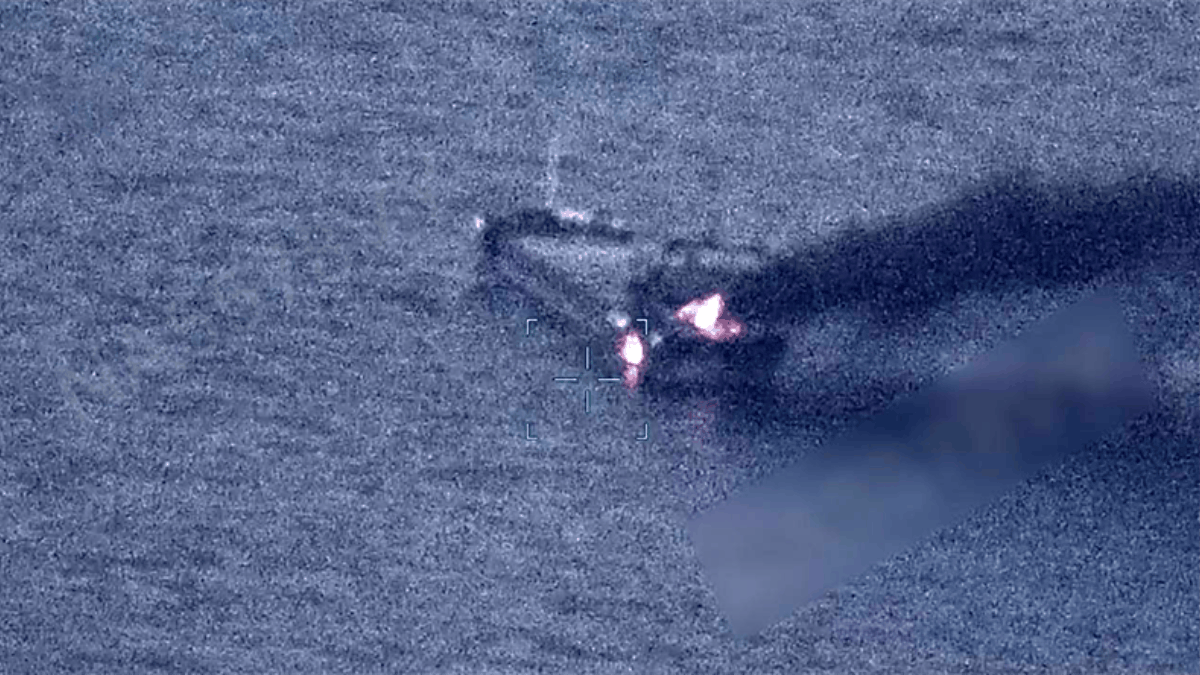
Crew missing from sunken ship as drone strikes on merchant ships in Black Sea intensify
Commercial vessels in and around multiple Black Sea ports have come under attacks as diplomatic efforts to establish a maritime ceasefire remain stalled


Maritime intelligence firm Ambrey reported that two general cargo vessels were damaged and multiple seafarers missing in apparent drone strikes in Bulgaria’s exclusive economic waters on 6 October.
The UK-based firm reported that the entire crew of a Togo-flagged general cargo vessel are missing, with search and rescue operations underway after what it called unmanned aerial vehicle (UAV) drone strikes, 70 nautical miles southeast of Varna, Bulgaria.
A Bulgarian ferry, Dioscuria, that witnessed the attack and sailed to assist the vessel found only an overturned lifeboat and life jackets, according to early reports following attacks on two vessels in the area in the early morning hours, local time.
In the second attack, a Palau-flagged general cargo ship was reportedly struck by UAVs and unmanned surface vessels (USVs) approximately 67 nautical miles southeast of Balchik, Bulgaria, while sailing from Galati, Romania, to Istanbul. The attack caused a fire and forced all 18 crew members to abandon ship. Two crew members were reportedly injured and taken to hospital after all crew were rescued by the same Bulgarian-flagged Ro-Ro passenger vessel, Dioscuria, with assistance from Bulgarian authorities.
Bulgarian Prime Minister Rumen Radev condemned what he said were ’absolutely unacceptable’ drone attacks on two merchant ships in Bulgaria’s exclusive economic zone during an emergency meeting after the incidents, calling them "a flagrant violation of maritime law".
"Such an attack within the Bulgarian exclusive economic zone is absolutely unacceptable," he said.
The attacks came a day after a deadly attack off Romania on a Saint Kitts and Nevis-flagged general cargo vessel sailing from Izmail to Ravenna. The vessel was struck by a UAV south-southeast of Sfântu Gheorghe, within Romania’s Exclusive Economic Zone and outside its territorial waters. The impact caused a fire and forced the crew to abandon ship. Two fatalities were confirmed and 11 crew members rescued, according to Ambrey. Ukrainian President Volodymyr Zelenskyy stated that the vessel was struck by two Russian drones, although Romanian authorities have not confirmed the cause of the fire. The vessel, reportedly carrying corn, subsequently sank following the evacuation of its crew.
In further attacks in the region, a Liberia-flagged crude oil tanker was struck by a Ukrainian UAV south of Adler, Russia, while sailing from Novorossiysk to Istanbul. No injuries or pollution were reported, and the vessel remained adrift. The incident was reported as part of Ukraine’s ongoing campaign against Russian-affiliated shipping under Operation MoLoChKa.
Additional merchant vessels were reportedly targeted near Odesa and Chornomorsk, including a chemical/oil tanker damaged in a port-area UAV strike.
Ambrey reported another merchant vessel damaged during a Russian Unmanned Aerial Vehicle (UAV) attack on the port of Chornomorsk, Odesa Oblast, Ukraine. Ukrainian authorities stated that the vessel was loaded with a shipment of vegetable oil when it was targeted. One crewmember was killed and seven were injured as a result of the attack. The Russian Ministry of Defence stated that a dry cargo ship was “delivering dual-use cargo” intended for the Armed Forces of Ukraine. Video footage from a Russian UAV showed that a vessel was targeted while berthed at the vegetable oil terminal. The footage also showed a UAV strike set fire to four oil storage tanks within the port area.
The latest incidents indicate a significant escalation in attacks on commercial shipping, extending beyond Ukrainian ports to international transit routes off Romania, Bulgaria and Russia.
Responsibility for the attacks off Bulgaria has not been assigned, but Reuters indicated initial assessments pointed to Russia.
Russia has intensified its drone attacks in recent days, regularly attacking Kyiv with new jet-powered drones, according to reports, although diplomatic efforts to reduce hostilities were said to be continuing.
Ukrainian Foreign Minister Andrii Sybiha reportedly indicated that Ukraine has received four international proposals on possible ceasefire formats from Turkey, Egypt, India and the United States. While two of the proposals focus specifically on restoring safe grain exports in the Black Sea, India has introduced a more comprehensive framework, and the US has put forward its own energy ceasefire initiative.
The Ukrainian Foreign Minister has said his country is ready for an energy and maritime ceasefire with Russia, indicating that would have to entail "a complete energy ceasefire, an end to strikes on all energy facilities, including port infrastructure".
"We have presented our vision, based on our reasoning and our understanding of how this should work. We are ready for an energy and Black Sea ceasefire, but only in that combination: energy and a ceasefire in the Black Sea," the minister said.
During a similar spate of attacks in August, Reuters reported that Ukraine had given US negotiators proposals for ending the war, citing President Volodymyr Zelenskiy in an 11 August report, though no details were made public.
Reuters said Ukraine had also proposed, through a third party, that Russia and Ukraine halt attacks on civilian targets in the Black Sea. Turkey had reportedly put forward separate proposals for a moratorium on military operations in the Black Sea.
At the time, Russia rejected the prospect of a limited Black Sea ceasefire, according to a Reuters report. Foreign Ministry spokeswoman Maria Zakharova said Moscow saw no grounds for what she described as “half-measures”, while accusing Ukraine of attacks on civilian shipping.





Related to this Story

Events

Maritime Regulations Webinar Week
 16 Dec 2025
 GMT - ONLINE

Floating energy: successfully unlocking stranded gas using FLNGs and FSRUs
24 Feb 2026GMT - ONLINE
© 2026 Riviera Maritime Media Ltd.


