


Business Sectors
Business Sectors
Events
Contents

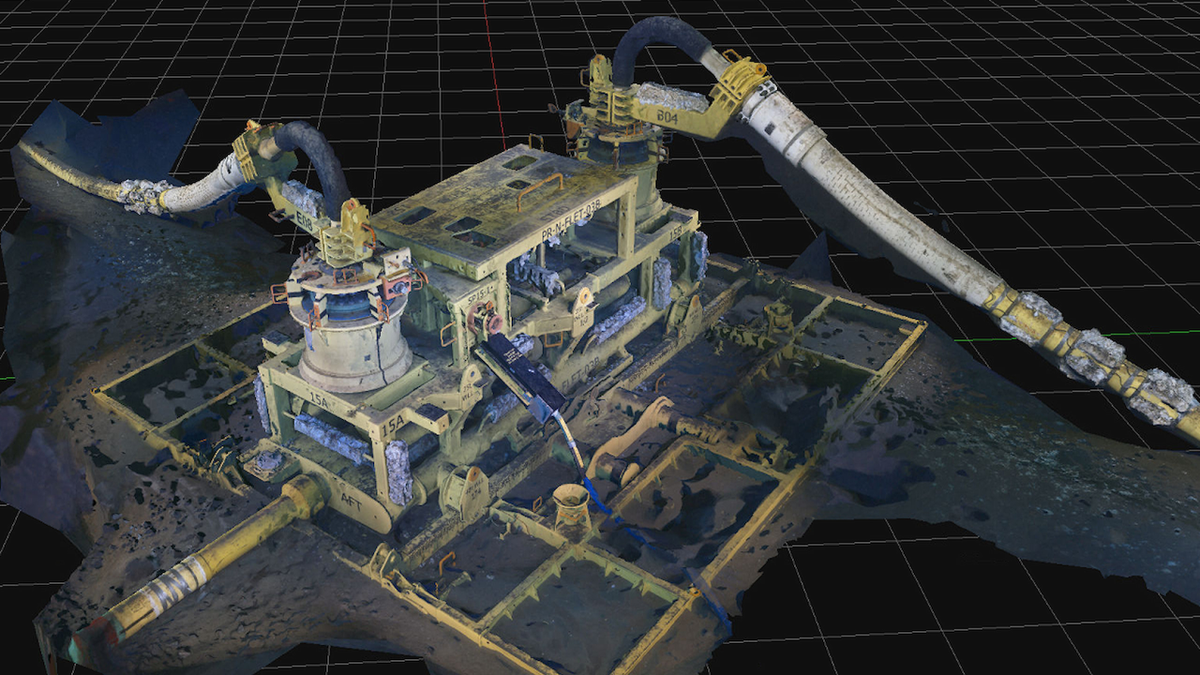
Dual-scope approach to inspection reduces vessel days and costs
DeepOcean has completed what it describes as a pioneering, simultaneous inspection and 3D scanning project on subsea infrastructure offshore Senegal


The project on the Sangomar field, undertaken on behalf of client Woodside, applied new methodology and technology to produce time savings and reduce vessel days and costs.
The project saw DeepOcean undertake a full-field, baseline survey and a full 3D scan simultaneously, for the first time, without deploying additional offshore personnel. The dual-scope campaign encompassed 69 subsea structures.
DeepOcean chief executive Øyvind Mikaelsen said, “Inspection and 3D scanning of subsea infrastructure have usually been undertaken separately, but we have developed a remotely supported system that allows us to conduct both simultaneously, enabling us to cut vessel days and costs for the operator.”
Mr Mikaelsen said the simultaneous inspection and 3D scanning project drew on the use of specialist competence, hardware and proprietary software solutions.
DeepOcean put together a work package that included inspection engineers, remotely operated vehicle (ROV) pilots, ROVs equipped with specialised scanning equipment, data processing software that enables the use of computer-aided drawings, ROV footage and sonar, digital twins, and proprietary subsea 3D imaging software that converts data to 3D models.
The concept also draws heavily on the use of photogrammetry, using precise measurements to create 3D information from photographs, and combines optics, geometry, computer vision and imaging to convert 2D photos and other data into precise spatial data or full 3D reconstructions.
“This isn’t just about software or hardware, but how our service is integrated with the overall subsea inspection offering and the wider business,” said Mr Mikaelsen. “By applying 3D reconstructions, we improve our capacity to detect structural anomalies such as cracks or deformities, and understand their proximity to critical components, enabling timely maintenance and preventing failures.”
For the Senegalese project, DeepOcean was tasked with executing a ‘scanning-for-planning’ campaign covering 69 subsea structures, including 17 subsea trees. The objective of the campaign was to capture high-resolution data to support the detailed planning and execution of future inspection and maintenance activities.
“We completed the simultaneous operation in about half the time it would take to perform two separate operations, while doubling the data output for our client Woodside,” said DeepOcean executive vice president EMEA Robin Mawhinney.
Sign up for Riviera’s series of technical and operational webinars and conferences:
- Register to attend by visiting our events page.
- Watch recordings from all of our webinars in the webinar library.

Related to this Story
Events

Maritime Regulations Webinar Week
 16 Dec 2025
 GMT - ONLINE
Floating energy: successfully unlocking stranded gas using FLNGs and FSRUs
24 Feb 2026GMT - ONLINE
© 2026 Riviera Maritime Media Ltd.


