


Business Sectors
Business Sectors
Events
Contents
EU backs 'open access' carbon capture programme with US$240M grant
Grant to fund the Altera-led Starfish programme, EU’s first large-scale carbon capture and sequestration project


Norway-headquartered mlutinational shuttle tanker and FSO fleet owner Altera Infrastructure and London-listed independent oil and gas energy company Harbour Energy have been awarded a grant from the European Union’s (EU) Innovation Fund for €225M (US$243M) to support the companies’ carbon capture and storage project.
Known as the Sequestration Technology And Reservoir: Floating Injection and Storage in Havstjerne (STARFISH) project, the companies say that, when operational STARFISH will provide a "first-of-its-kind, large-scale solution for CO2 sequestration using shared, flexible offshore infrastructure".
Plans for the open-access CO2 storage concept intend to sequester captured emissions from multiple sources for storage in the Havstjerne reservoir, located 100 km southwest of Egersund, Norway.
In 2023, the project partners were awarded an exploration licence for the reservoir, and Phase 1 of the project is expected to enable the storage of 42.75M tonnes of CO2-equivalent (CO2-eq) over the first 10 years. Altera said the initial phase is projected to cut 42M tonnes of CO2-eq emissions, in total, with a relative greenhouse gas (GHG) avoidance potential of 98%.
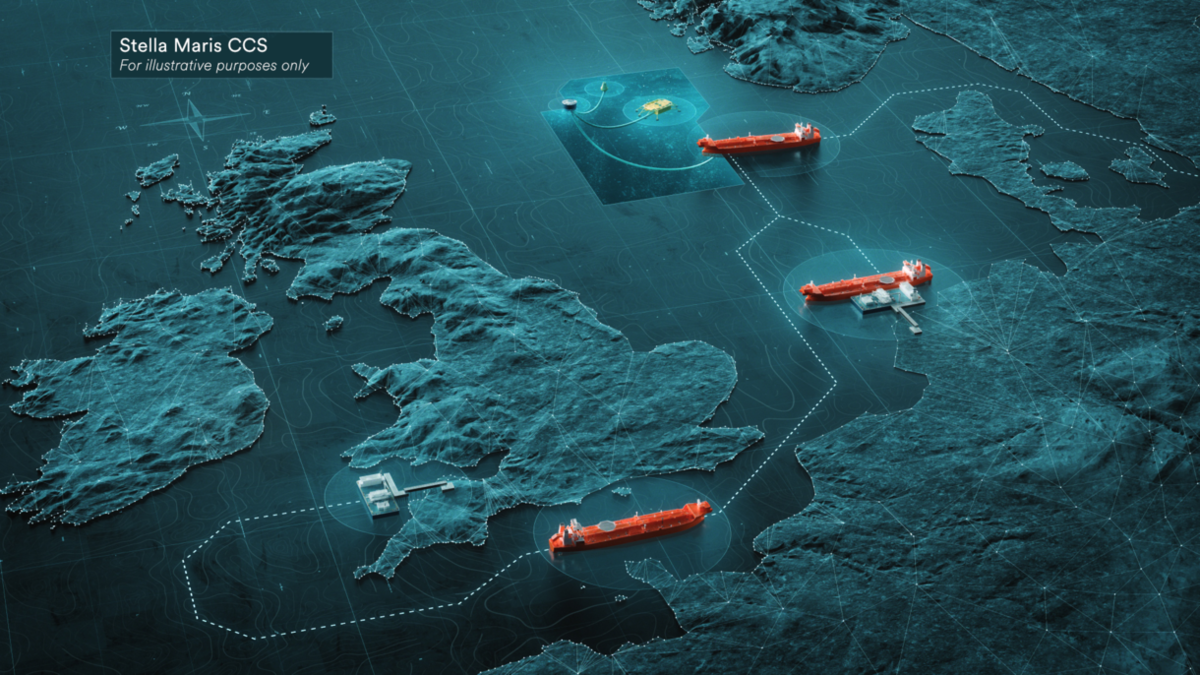
Havstjerne represents the first phase of what the project partners refer to as the Stella Maris value chain, which eventually envisions multiple collection hubs across Europe and a dedicated fleet of large shuttle tankers to transport CO2 to permanent storage sites on the Norwegian Continental Shelf.
Altera Infrastructure acting chief executive Duncan Donaldson said the funding is "a significant validation of our innovative Stella Maris CCS [carbon capture and storage] approach to CO2 transport and storage infrastructure. As we work towards achieving the goals of the Paris Agreement, CCS projects like STARFISH are essential for safely and permanently storing captured CO2."
STARFISH is the first offshore CO2 storage project designed to transport liquid CO2 via purpose-built ships directly to an offshore reservoir. This approach allows for a streamlined, cost-efficient process. The project will feature a specially designed injection unit capable of directly receiving large volumes of liquid CO2 from transport vessels for secure and permanent storage.
The initiative aligns with the European Commission’s goal of achieving 50M tonnes per annum of storage capacity by 2030.
According to Altera, the funding is subject to the successful conclusion of the Grant Agreement Preparation process, with the aim to finalise that process by Q1 2025.
Sign up for Riviera’s series of technical and operational webinars and conferences:
- Register to attend by visiting our events page.
- Watch recordings from all of our webinars in the webinar library.

Related to this Story

Events

Maritime Regulations Webinar Week
 16 Dec 2025
 GMT - ONLINE
Floating energy: successfully unlocking stranded gas using FLNGs and FSRUs
24 Feb 2026GMT - ONLINE
© 2026 Riviera Maritime Media Ltd.


