


Business Sectors
Business Sectors
Events
Contents
Hormuz: IRGC refuses UAE box ship's transit; COSCO restarts Persian Gulf bookings
IRGC Navy Commander says transit through the Strait of Hormuz for any vessel requires ’full co-ordination with Iran’s maritime authority’


Iran’s semi-autonomous paramilitary organisation, the Islamic Revolutionary Guard Corps (IRGC), is publicly communicating its control of vessel traffic through the Strait of Hormuz.
In a post on X (formerly Twitter), the account associated with the commander of the IRGC’s navy said it had barred passage for a small container ship.
"The container ship SELEN was turned back by the IRGC Navy due to failure to comply with legal protocols and lack of permission to pass through the Strait of Hormuz. The passage of any vessel through this waterway requires full co-ordination with Iran’s maritime authority," Alireza Tangsiri’s post said.
Commodore Alireza Tangsiri is an Iranian naval officer who serves as the commander of the IRGC Navy, and Iran’s semi-official Mehr news agency reported on the post, attributing it to the naval commander.
The vessel, Selen, is a relatively small, 658-TEU feedermax container vessel listed under ownership and management of UAE-based Exceed Oceanic Trading, with conflicting reports for the flag state. The vessel is listed in Equasis as high risk, being under black designations by Paris and Tokyo MOUs.
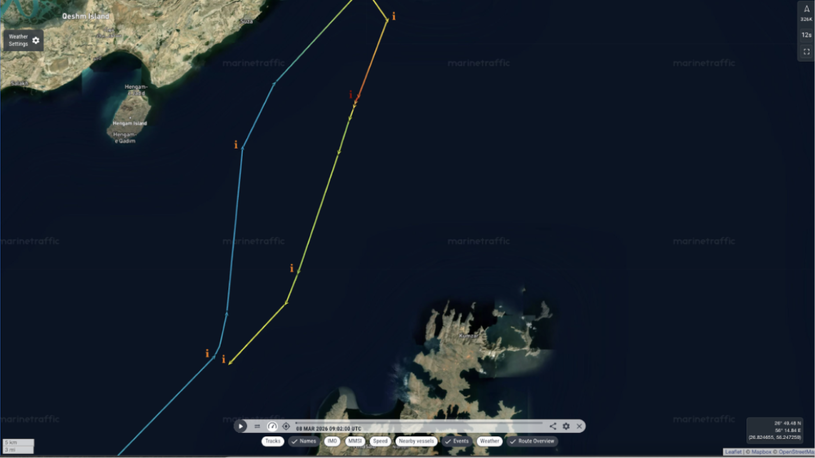
AIS vessel tracking on ship valuation website VesselsValue shows the vessel using its AIS destination to communicate "Karachi. Food for PK". The ship’s track shows the vessel moving from a position outside the UAE port of Sharjah on 23 March and reaching a location near Iran’s Qeshm Island at the entrance to the Strait of Hormuz late on 24 March, before retreating westward, with the most recent AIS update on the morning of 25 March showing the vessel’s speed at less than one knot.
Iran claims the Strait of Hormuz is ’not closed’
The apparent refusal of the vessel’s passage took place after Iran’s Foreign Minister Seyed Abbas Araghchi posted to his X account on 22 March that the Strait of Hormuz remains open.
"Strait of Hormuz is not closed. Ships hesitate because insurers fear the war of choice you initiated — not Iran," the post read. "No insurer — and no Iranian — will be swayed by more threats. Try respect — Freedom of Navigation cannot exist without Freedom of Trade. Respect both — or expect neither," Mr Araghchi’s account said.
On 24 March, Iran’s delegation to the International Maritime Organization (IMO) submitted a letter from Iran’s Ministry of Foreign Affairs dated 22 March with a request for IMO to post the letter to IMO member states as a circular.
The letter claimed that Iran has "consistently upheld the freedom of navigation and the safety and security of maritime activities" and claimed that "military aggression by the United States and Israeli regime against Iran" constitutes a violation of the United Nations Charter.
Iran said it has "restricted the passage [through the Strait of Hormuz] of vessels belonging to or associated with the aggressors and those participating in their acts of aggression".
Iran said vessels associated with the US and Israel and any other "participants in the aggression" do not "qualify for innocent or non-hostile passage".
"Accordingly, and as repeatedly emphasised, the Strait of Hormuz remains open, and maritime traffic has not been suspended. Navigation continues, subject to compliance with the necessary measures," the letter said.
What the letter called ’non-hostile vessels’ can be, according to Iran, granted safe passage "in co-ordination with the competent Iranian authorities".
"The full restoration of security and sustainable stability in the Strait is contingent upon the cessation of military aggression and threats, the end of destabilising actions by the United States and the Israeli regime, and full respect for Iran’s legitimate interests," the letter concluded.
The claims made by Iranian officials stand in contrast to claims made by US President Trump, who said the war "has been won" and that Iran is "wiped out militarily".
Ambrey: ’Do not make assumptions based on public statements’
A threat circular issued on 23 March by a UK-based maritime security consultancy cautioned against taking public statements on maritime safety at face value.
Ambrey assessed Iran as "highly likely still capable of damaging shipping transiting the Strait of Hormuz", noting that the "most likely explanation is an IRGC-led escalation with operational autonomy".
Ambrey advised companies to "adopt a risk-managed approach that preserves safety and legal defensibility while avoiding normalisation of coercive practices".
Vessel activity data gathered by intelligence analysts at British-Israeli firm Windward AI shows what the analysts said is clear evidence that Iran is operating a "managed corridor".
Windward also noted that, while the IRGC is allowing some vessels to pass, it is ’escalating’ the threat environment for other vessels, and noted the likely presence of mines in the Strait of Hormuz.
"US intelligence assessments indicate the presence of Iranian naval mines within the Strait, introducing a persistent and largely invisible risk to maritime operations. While diplomatic signals suggest potential de-escalation, the physical risk to vessels transiting the waterway remains acute," the firm said.
COSCO reopens bookings for containers to Middle East
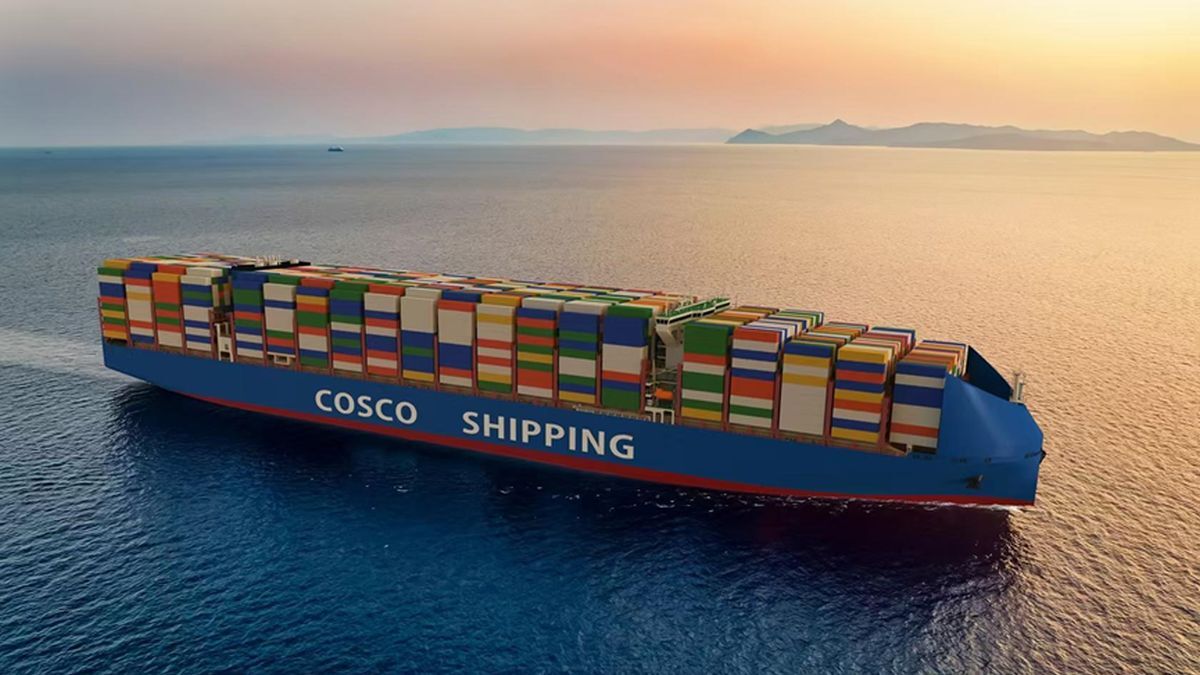
Chinese shipping giant COSCO Shipping Lines has resumed new booking services for general cargo containers to the Middle East, effective immediately. The company later revised its advisory to highlight the use of multimodal transport solutions. Analysts have already questioned whether pre-war service patterns can be restored before the conflict is resolved.
In its initial customer advisory issued on 25 March, COSCO said the resumption applies to new bookings for shipments from the Far East to the United Arab Emirates, Saudi Arabia, Bahrain, Qatar, Kuwait, and Iraq.
In a subsequent update, COSCO clarified that local cargo to Abu Dhabi and Jebel Ali will be transported via bonded land bridge through either Khorfakkan or Fujairah Port.
Cargoes destined for the upper Gulf countries will also move via bonded land bridge – from Khorfakkan or Fujairah Port to Abu Dhabi CSP – connecting to COSCO’s feeder network for transshipment to other parts of the UAE, Saudi Arabia, Qatar, Bahrain, Kuwait, and Iraq.
Finally, shipments to Oman will be transshipped via Nhava Sheva, India, to reach Sohar, Oman.
“Please note that the above new booking arrangement and the actual carriage are subject to change due to the volatile situation in the Middle East region,” the company said.
COSCO added that the new booking services will not affect or prejudice bookings accepted before the publication of the notice.
“We will continue to monitor developments in the Middle East and provide updates through our official website and customer service channels as more information becomes available,” the company said.
COSCO, along with other major liner operators, had previously suspended Middle East bookings, although it had maintained limited exceptions for Khor Fakkan, Fujairah and Jeddah.
Riviera contacted a COSCO spokesperson, who declined to comment on the bookings or on any permissions related to transits through the Strait of Hormuz.
Return to pre-war services unclear
Commenting on the COSCO development, Drewry senior manager for container research Simon Heaney told Riviera that, to his understanding, most major carriers have resumed bookings but have not reinstated pre-war service connections.
He noted that services to and from the region are now taking more circuitous routes, often involving alternative hubs and overland corridors.
French liner giant CMA CGM said on 17 March that it is deploying alternative multimodal solutions – combining maritime, rail and road transport – to maintain the flow of logistics despite the situation in the Strait of Hormuz.
“I don’t think prior container service connections will resume until the war is concluded and the Gulf is deemed safe,” Mr Heaney said, adding, “There are still missiles overhead, even if Iran says Hormuz is open to non-hostile shipping, so I don’t expect the current situation to change anytime soon.”
--Jamey Bergman and Georgios Georgiou contributed reporting to this story
Riviera’s International Chemical and Product Tanker Conference will be held in London on 21-22 April 2026. Use this link for more information and to register for the event.

Related to this Story
Events

Maritime Regulations Webinar Week
 16 Dec 2025
 GMT - ONLINE
Floating energy: successfully unlocking stranded gas using FLNGs and FSRUs
24 Feb 2026GMT - ONLINE
© 2026 Riviera Maritime Media Ltd.


