


Business Sectors
Business Sectors
Events
Contents

Register to read more articles.

How Hafnia uses TECOS to diversify technical risk
More than 55 Hafnia-owned or operated vessels are under TECOS, while Hafnia retains commercial control and spreads DOC risk across multiple managers


Technical outsourcing (TECOS), is a flexible model used on owned vessels under which Hafnia retains ownership and commercial control while entrusting day-to-day technical operations to shipmanagement partners. Hafnia vice president and head of the TECOS fleet Mikkel Boesen described it as a practical response to growth, organisational reach, flexibility and the need to spread exposure across multiple Document of Compliance (DOC) holders.
Historically, during the Hafnia Tankers period from 2013 to 2019, all vessels in the fleet were technically outsourced.
Mr Boesen pointed to TECOS’ recent strengths in Hafnia’s expansion into chemical tankers and the establishment of a chemical commercial hub in Dubai. He said that when Hafnia acquired Chemical Tankers Inc (CTI), it created a new hub in Dubai, where the chemical commercial operation is based. He added that Hafnia benefited from many of those vessels ending up under outsourced management, with TECOS giving the company a structure for overseeing that outsourced technical footprint from within Hafnia itself. He also notes that when Hafnia agreed to acquire the outstanding shares in CTI, the CTI fleet comprised 32 IMO II product and chemical tankers.
Mr Boesen described TECOS as operating alongside an in-house technical management organisation, with Hafnia using both models for different reasons. “The idea behind outsourced management is diversifying and making your ownership more flexible,” he said. “It’s easier to adjust the number of vessels with outsourced management … than in house.”
"TECOS links technical choices to measurable operating performance rather than supplier claims"
By contrast, he argued that in-house management remains important because shipowners “want to build up the capabilities, and the experience in actually operating the vessels yourself”. In his view, TECOS sits in the overlap: Hafnia remains the technical owner in terms of setting standards and exercising oversight, while day-to-day technical operations sit with external managers.
The clearest benefit Mr Boesen identified related to trading access and the risk attached to DOCs and oil major acceptance. With a mix of Hafnia’s internal DOC and multiple third-party managers, he said Hafnia could avoid a single point of failure if one DOC were challenged by a major customer. “If something happens … and one of the DOCS, no matter which one gets blocked by an oil major, it’s only … a partial [number] of our fleet that will be affected,” he said. He described that as risk management that “safeguards our tradability”.
Operationally, Mr Boesen presented TECOS as an oversight and co-ordination function spanning multiple offices and managers. He said his fleet was spread across three offices, with one group managed from Singapore and another overseen from Dubai. He also described a fleet split by size, saying TECOS covered “predominantly an amount of smaller … vessels, meaning handy tankers and MR tankers … [and] a small group of LR1 tankers”, while Hafnia’s in-house technical management vers towards larger vessels, including “MR, LR, and LR2 tankers”. His emphasis, however, was less on vessel count than on the need to run technical outsourcing as a structured system rather than as a set of one-off third-party relationships.
In practice, that system extends into dry docking, performance monitoring and retrofit decision-making. Mr Boesen insisted that accountability for dry-docking decisions remains with the teams closest to the vessels: “Those people who have the day to day responsible for the ships, should be the ones close to the dry docking … because they will be accountable afterwards.” At the same time, he said Hafnia has built a small dry-dock support team to help with specifications and process alignment, arguing that outcomes depend heavily on detail. “A good specification is hard work,” he said. He also warned against false economies during docking: “Don’t compromise, don’t save, when you are in a dry dock.”
Mr Boesen’s comments on coatings illustrated how TECOS links technical choices to measurable operating performance rather than supplier claims. Asked what had performed best, he replied: “Definitely silicon paint.” He said Hafnia paints ships for 60 months and monitors end performance just before the next dry dock. Where application and conditions are controlled, he said Hafnia has seen “a four to five percent increased in performance”. He also acknowledged the operational friction that follows from taking a stricter line on application conditions, saying coating campaigns had become “more delicate”, with Hafnia sometimes having to accept weather delay rather than poorer application quality.
“You make trials with the heavily discounted equipment, so if it doesn’t work, it’s a write off, and then you go in and make the big orders when you have confirmed it’s working”
Off-hire management was another area where Mr Boesen described clear value from central oversight. He drew attention to the periods around the yard call, saying costs are not limited to yard invoices or the dock slot itself, but also include positioning decisions “just before and just after the dry dock”. He cited an example where routing choices created large avoidable costs, including canal charges, and said: “So you can end up with over half a million US dollars in cost just to position.” His point was that technical management decisions, if taken without a fleet-level lens, can load costs into the operating model in ways that are not visible on a single ship’s technical budget.
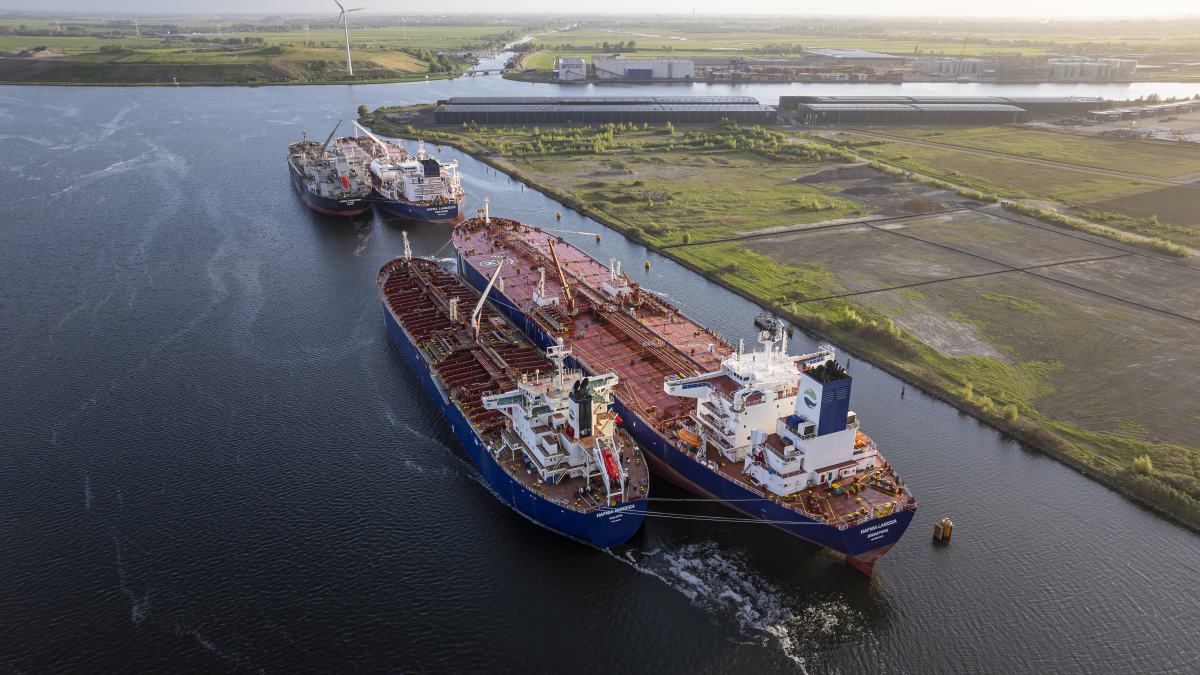
On decarbonisation and future fuels, Mr Boesen described Hafnia as running a mixture of trials, project work and selective investment. He said Hafnia has “tested the biofuel” and referred to dual-fuel ships in the fleet. He also pointed to Hafnia’s methanol joint venture, saying Hafnia had “dual fuel ships with methanol capabilities in a joint venture … together with Socatra … in a company called ECOMAR”. The methanol MR newbuilding programme’s first vessel delivered in January 2025 and that the ships are time-chartered from ECOMAR to TotalEnergies, with three further deliveries in 2025 and the fourth in 2026.
Hafnia is also trialling energy-saving and decarbonisation technology through pilot studies, while keeping a close focus on risk control and evidence gathering. Mr Boesen said discounted pilot studies provide a way to test performance before scaling up: “You make trials with the heavily discounted equipment, so if it doesn’t work, it’s a write off, and then you go in and make the big orders when you have confirmed it’s working.” TECOS, in that sense, is also a governance tool that Hafnia uses to improve internal standards, process discipline and its approach to technical innovation before committing across the fleet.
Mr Boesen returned to the same core argument: outsourced technical management gives Hafnia flexibility, but only if the company maintains enough internal capability to set direction, measure outcomes and manage exposure. On that basis, the TECOS model suggests that outsourcing need not mean a loss of control, and that DOC exposure, dry-docking risk and technical change can be managed as company-level choices rather than as the by-product of fragmented management arrangements.
Sign up for Riviera’s April 2026 International Chemical and Product Tanker Conference:
- Register to attend here: The International Chemical and Product Tanker Conference 2026, London.
- View the latest issue of Tanker Shipping & Trade here: Tanker Shipping & Trade.




Related to this Story
Events

Maritime Regulations Webinar Week
 16 Dec 2025
 GMT - ONLINE

Floating energy: successfully unlocking stranded gas using FLNGs and FSRUs
24 Feb 2026GMT - ONLINE
© 2026 Riviera Maritime Media Ltd.


