


Business Sectors
Business Sectors
Events
Contents

Register to read more articles.
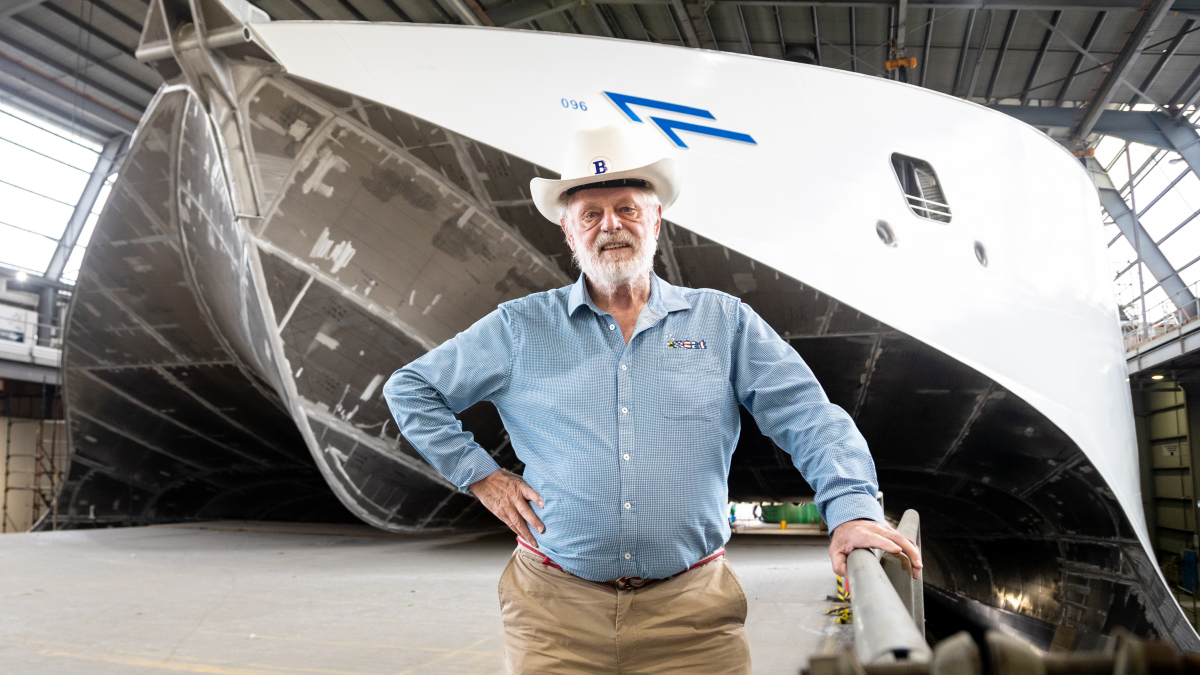
Iconic Tasmanian shipbuilder discusses his ‘electrifying’ journey
Incat chairman, Robert Clifford, discusses his company’s path to success as the world’s leading builder of large, fast, aluminium ferries, and why the future is electric


Over the past 50 years, few have done more to advance fast ferry design, construction and technology than Incat chairman Robert Clifford. The legendary Tasmanian shipbuilder’s success was borne out of innovation, constructing his first high-speed aluminium ferry in 1977, just a short walk away from the massive production sheds at his shipyard’s current location on Prince Wales Bay.
While Chinese shipbuilders grab most of the headlines, Incat continues to build the most advanced aluminium high-speed ferries in the world. The Australian shipbuilder’s engineering success stems from perfecting the design and construction of seagoing, wave-piercing, high-speed, aluminium ferries that are capable of moving people, vehicles and cargoes reliably and efficiently.
Mr Clifford recalled the eureka moment for the wavepiercer design came at the Americas Cup in 1987, held in Fremantle, Western Australia. A demonstration of the high-speed ferry’s open ocean performance at the event “made a significant impact on several clients,” he said.
Orders started rolling in. “The delivery voyage to North Queensland of our first 20 m aluminium catamaran resulted in orders from five different customers. They all wanted similar vessels. The sixth customer wanted two more, so we had no option but to licence another Queensland shipyard.” He said this required additional shipyards to be licensed in Hong Kong, New Zealand, and the US to construct the company’s designs.
Mr Clifford and his business partner, Phil Hercus, parted ways in 1988. But both men went onto success. While Mr Clifford formed Incat Tasmania in 1989, Mr Hercus continued his design work at Incat Designs and Hercus Marine Design. Today, the company he founded operates as Incat Crowther.
Global export success
1990 set the stage for Incat Tasmania’s global export success over the next 30 years. That year, the 74 m Hoverspeed Great Britain won the Hales Trophy on its delivery voyage from Tasmania to Europe. It set the record for the fastest transatlantic crossing, averaging more than 36.6 knots, while eclipsing the 38-year-old mark set by SS United States. Hoverspeed Great Britain’s performance turned a lot of heads. “This resulted in many repeat vessels, proving that new tech vessels must be seen to be believed,” said Mr Clifford.
This high-profile success led ferry owners in Europe, the Middle East, Asia, and the Americas to order wave-piercing ferries. Among these were two more Hales Trophy winners, Catalonia and Cat-Link V, the current holder of the Blue Riband.
“Weight control is everything”
Over the next two decades, these advanced aluminium vessels steadily increased in size, capacity and technology, with Denmark’s Molslinjen and Greece’s Sea Jets both ordering series of 112 m wavepiercing catamarans, and Buquebus’ Francisco, the first large high-speed ferry powered by LNG. Incat-designed and built high-speed ferries currently operate in some 24 countries, carrying millions of passengers annually.
Electrification
With fuel costs, efficiency and decarbonisation top of mind for owners, Mr Clifford sees electrification as the future of ferries, and Incat plans to lead the charge. This past year, it won the Sustainability and Green Economy Award at the 2025 Tasmanian Export Awards, recognising the company’s leadership in sustainable shipbuilding.
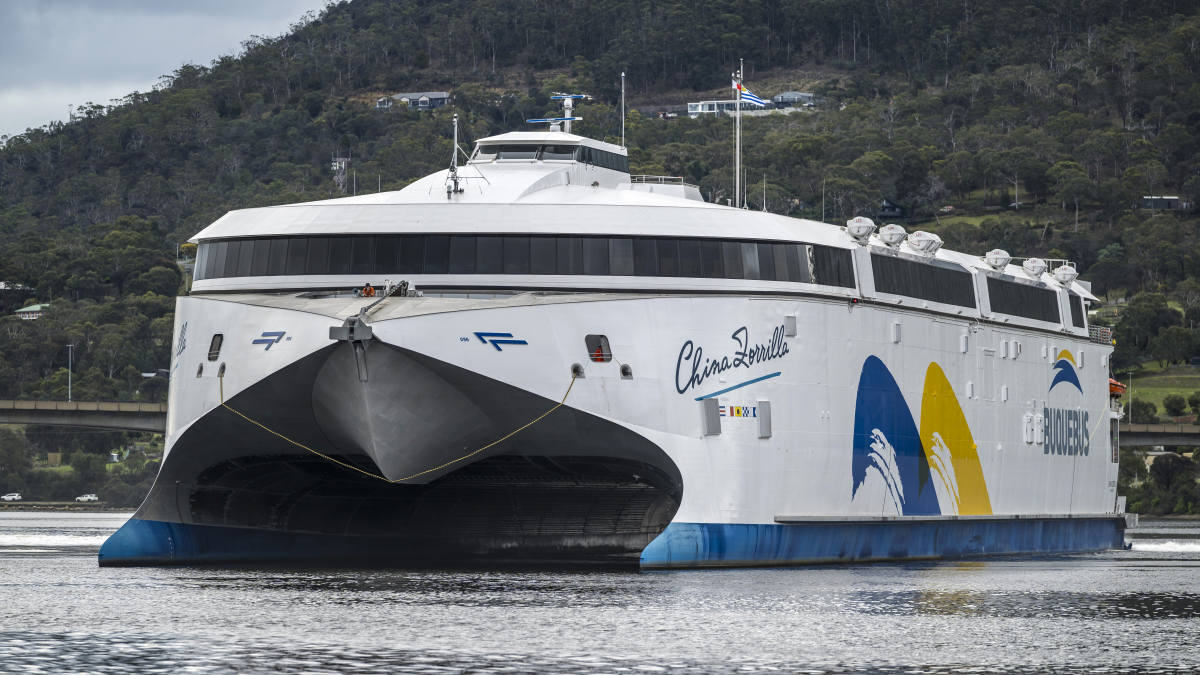
Proof positive of the firm’s sustainable shipping commitment is China Zorrilla (Hull 096), the world’s largest electric-powered ship and the largest Incat has built to date, at 130 m long. The ship, ordered by long-time customer Buquebus, was loaded onto the heavy-lift ship Black Marlin at the end of July for its long journey to Argentina.
“New tech vessels must be seen to be believed”
The successful loading represents years of planning, design, engineering and construction by the shipbuilder and is another major moment in a project that has attracted worldwide attention for redefining the future of large-scale sustainable shipping. Mr Clifford called it "an extraordinary moment, not just for Incat, but for the future of sustainable maritime transport," adding that it was “the most significant project in Incat’s history.”
Mr Clifford said supplier cooperation was vital in the vessel’s construction and points to several elements that made the engineering challenging. “Matching the waterjets, e-motors, switchboards, and batteries with lightweight aluminium structures. Weight control is everything.”
And Incat is not done yet. In early July, it marked a major construction milestone in its electric ferry programme for Danish operator Molslinjen, successfully completing the rollback of Hull 102 at its Prince of Wales Bay shipyard. The rollback in the production bay allows for the installation of the vessel’s passenger deck superstructures.
Hull 102 is one of three 129 m battery-electric ferries for Molslinjen as part of the world’s largest electrification project at sea. Once delivered, the vessels will be the largest electric ferries operating in Europe.
The three-vessel programme forms part of the Danish ferry owner’s decarbonisation strategy and will operate on Denmark’s busy Kattegat routes, delivering high-speed, high-capacity, low-emissions transport.
“We are moving full steam ahead with the green transition right now,” said Molslinjen chief executive, Carsten Jensen, on the firm’s increasing use of electricity to power its fleet. He anticipates all of his company’s routes will be transitioned to electric operation by 2030.
Mr Jensen expects the newbuilds to join his company’s fleet in 2028, ushering in an electric future for high-speed ferries on the Kattegat routes.
Construction continues on the three vessels at Incat’s Hobart shipyard as the company scales up production to meet growing international demand for large-scale electric ships.
“Even very large ships will have some level of batteries installed,” noted Mr Clifford. “However, the emphasis will be on short service vessels. Now the limit is around 100 nm at service speeds. This will shortly grow to 200 nm as technology advances. This makes an extraordinarily large number of ships that will be electric,” he observed, noting, “They will be even bigger in future.”
When asked what he saw as the biggest challenge ahead for Incat, Mr Clifford, said: “Supplying the market. Only shipyards experienced in lightweight construction will succeed, and they can be counted on one hand.”





Related to this Story
Events

Maritime Regulations Webinar Week
 16 Dec 2025
 GMT - ONLINE

Floating energy: successfully unlocking stranded gas using FLNGs and FSRUs
24 Feb 2026GMT - ONLINE
© 2026 Riviera Maritime Media Ltd.


