


Business Sectors
Business Sectors
Events
Contents

Register to read more articles.

Marfin Management CEO: ‘I would love to be the ambassador for smaller companies using AI’
Marfin Management aims to leverage its early adoption of AI to outpace the growth of similarly sized competitors


Unusually for a vessel owner of its size, Marfin Management has been developing its own software inhouse for two decades. At the core of this technological self-reliance is chief executive Alex Albertini, a self-confessed IT geek, who is now leading the company’s integration of new AI systems. Crucially, he is not undertaking this task alone.
"When Complexio came around and showed us the capabilities of its system and what it was going to do, it was a wow moment for us. I knew we had to act fast to become development partners because what it presented is exactly where we think digitisation is going to go."
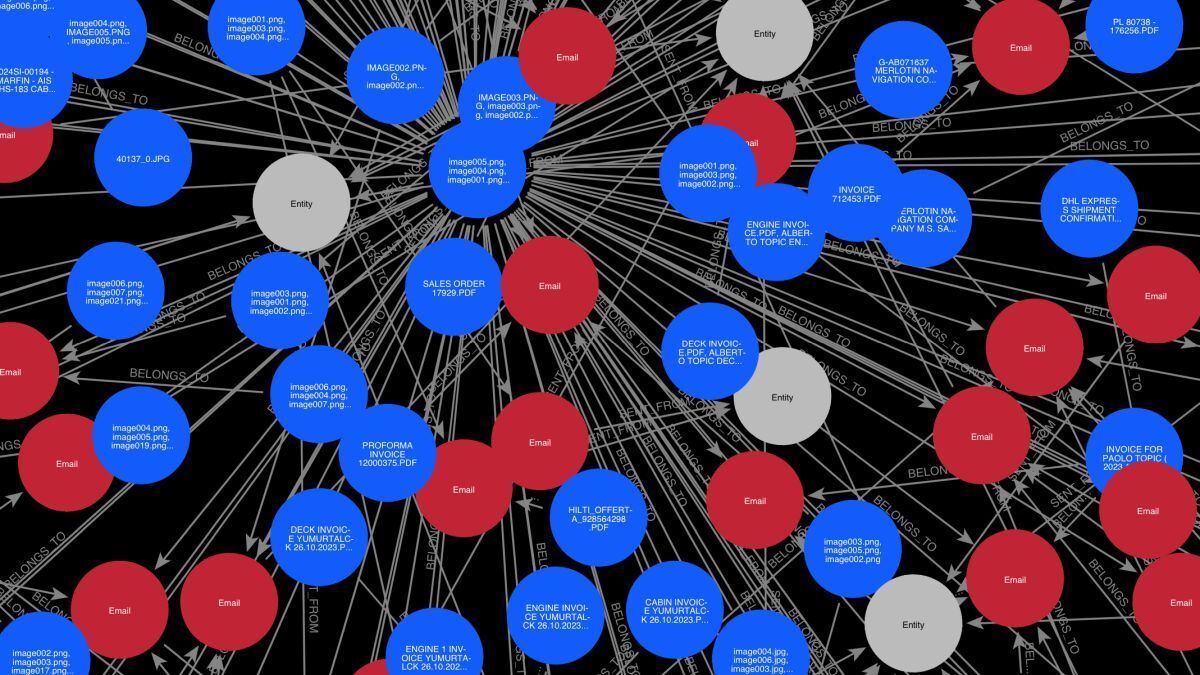
Complexio is a Foundational AI joint venture between tanker company Hafnia and Símbolo, a deep tech firm. The platform is designed to enhance business operations by automating and optimising various tasks across an organisation and providing a centralised AI-driven platform for whole-company insights. It achieves this by ingesting and mapping both structured and unstructured data from existing systems, allowing it to understand and analyse how enterprises conduct their business activities. Key features of the system include whole-company data integration, automation of routine tasks and delivery of enhanced operational insights through mapping relationships within the data to understand patterns of business behaviour.
The partnership group presently comprises Marfin Management (joined in 2023), C Transport Maritime (joined in 2023), Trans Sea Transport (joined in 2023), and BW Epic Kosan (joined in 2024). Each of the partners have identified an exploratory use case they are developing as a cornerstone to kick-start model learning. The initial benefits include task automation, improved decision-making capabilities, and the potential to streamline their operations significantly, as the model deepens its understanding.
“AI won’t immediately transform our business model, but we expect it to significantly boost our operational efficiency in the short to medium term,” says Mr Albertini. “Complexio’s AI will enhance our risk management by analysing previously unstructured data. There is a vast amount of information flowing through emails, WhatsApp, Skype, Teams chats, and even voice communications and currently no effective way to analyse all this data comprehensively. Much of our understanding relies on experience and gut feeling. Complexio will enhance our ability to identify correlations between processes and data that we couldn’t see before.”
Mr Albertini says Complexio already being used by his financial department, and next will be operations with ‘claims’. “Ultimately, we know that this will encompass a 360° approach, spanning all departments, so I’m not overly concerned about prioritising one area over another. Everything will align in due course.”
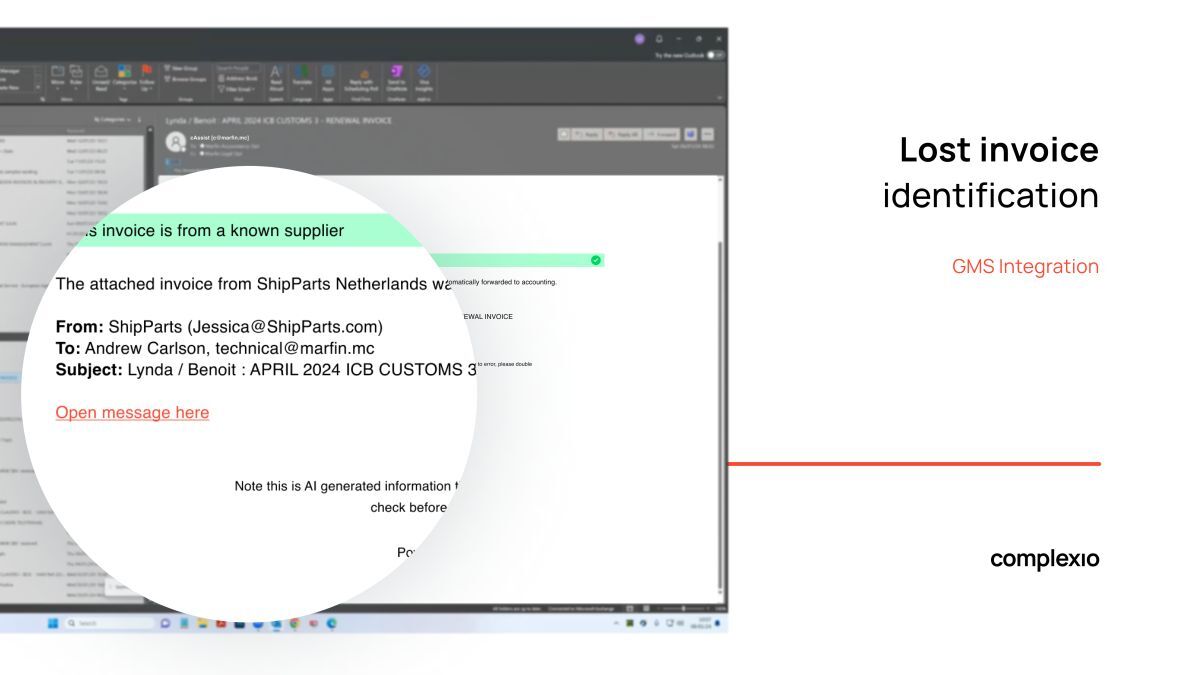
The initial use case in the finance department is a workflow around identifying, tracking and finding lost or misdirected invoices. Currently, Complexio reads and understands all incoming emails and attachments every 24 hours and automatically identifies lost invoices. It also confirms through historical data that the invoices belong to a valid and existing vendor. Those invoices that are suspected lost, and not matched to a purchase order, are then forwarded to the appropriate accounts’ person for review and processing. The same logic for lost invoices will also be applied to other areas of the finance department, like lost credit notes, using the patterns it has already identified to flag them. These simple automated ‘tasks’ provide an increased level of governance over accounting areas, preventing discrepancies, saving costs, and allowing teams to focus on more high-value tasks.
While Marfin Management does not have a single, specific KPI for measuring Complexio’s performance, Mr Albertini says the early wins are being seen in a reduction in human errors and speedier responses. “There are many man-hours spent on monitoring, repeating tasks and ensuring everything is in order. These will be replaced as the entire process is analysed from the outset. The secondary control will be quick because we can trust that the process will be streamlined from the beginning. This applies to every area, including administration, accountancy and the crew department, where we must ensure all certificates are in place and that everyone is following procedures. In operations, any request that is similar and can be handled by Complexio will have automated replies prepared for us to review and validate.”
Any discussion on AI inevitably brings up the issue of data privacy.
“First and foremost, we ensure that all algorithms run on local servers, preventing any data from being transmitted in and out,” says Mr Albertini. “Our team actively monitors the data flows from the AI core server to ensure that nothing is released that shouldn’t be. Since the core of Complexio operates on the premises, all analyses are conducted inhouse. We even invested in a custom central processing unit to establish a dedicated AI server. This on-premise AI server allows us to maintain control over all aspects of our data, ensuring it does not get lost in the cloud. Even if we had a cloud infrastructure, the same principle would apply: everything would run on a secluded server that we either rent or own, ensuring all data remains secure.”
Regardless of whether a company has a cloud or on-premise infrastructure, Mr Albertini says he is confident there is no risk of data leaking via Complexio to external servers for analysis and then returning. “Each partner within the network determines the environment they trust, and Complexio operates within those confines.”
A related question is the quality and accuracy of the data being fed into the AI models. For Mr Albertini it’s more about the quality of the output data rather than the input.
“The input consists of my unstructured data, and if I were to judge its quality, I would have to conclude that all the data I’ve been working with for the past 20 years is inadequate. The focus needs to be on asking the right questions to verify and analyse the accuracy of the results.
“Since Complexio is trained on our own company data, there are no discrepancies. In contrast, using a generative AI model like ChatGPT, which processes vast amounts of information from the internet, may yield inconsistent answers. Some argue that around 70% of online content is unreliable. If you ask ChatGPT the same question multiple times, you might receive different and contradictory responses. Because our dataset is consistent and linear, having been produced over the years, we do not encounter contradictory answers to the same question. There is no misinformation or ’fake news.’ When we pose a question, the dataset consistently produces the same answer.”
For all Complexio’s sophistication, Mr Albertini says the biggest barrier to its implementation is not technological, but psychological.
“The initial reaction of many people to this technology is fear. It is crucial to help everyone understand that this technology will not make them redundant. This is the first conversation leaders need to have with their staff, and in Marfin we have adopted this strategy.
“Truthfully, I felt the same fear when I first heard about generative AI. When I hired two developers, I worried they might be made redundant by this technology. However, I soon realised that it actually presents an opportunity. We can enhance everyone’s capabilities, stay at the forefront of this technology, and leverage our knowledge to position ourselves one to three years ahead of the competition.”
Asked whether as an operator of seven bulk carriers, he feels an obligation to help other smaller companies leverage the benefits of AI, Mr Albertini admits to a certain ambivalence. “I would love to be an ambassador for smaller companies using AI, so they can preserve their identity and uniqueness. If we allow only larger companies that can afford to purchase and integrate AI to dominate, it will create a wider gap in the industry. I do however have two concerns. First, I am not sure all have the flexibility and ability to effectively integrate and leverage this technology to meet their needs. Second, this situation could accelerate consolidation in the industry. And I am a firm believer in fragmentation. The more we consolidate, the more we risk becoming a commodity, which diminishes opportunities in this business.”
When asked about future advances in AI that could further enhance Marfin Management’s operations and how he is preparing for them, Mr Albertini reflects on his initial impressions when he was first introduced to Complexio.
“I immediately envisioned a time in five years when there would be no desks with computers in the office. Technically, there would be no need to input data or type emails. Instead, we would communicate via mobile phones or tablets. We would validate processes and interact with Complexio, which would serve as a digital assistant or employee with enhanced capabilities that augment the skills of our current workforce. I imagine the office filled with meeting rooms and screens displaying automatically generated data that responds to our conversations and understands our needs. This digital entity would create the information we require in real time. In my view, this future work environment is about returning to our human essence, moving from being ’human doings’ to ’human beings.’ It is about reconnecting with the emotions and creativity that define us, leveraging our knowledge to shape the future.”
Sign up for Riviera’s series of technical and operational webinars and conferences:
- Register to attend by visiting our events page.
- Watch recordings from all of our webinars in the webinar library.




Related to this Story



Events

Maritime Regulations Webinar Week
 16 Dec 2025
 GMT - ONLINE
Floating energy: successfully unlocking stranded gas using FLNGs and FSRUs
24 Feb 2026GMT - ONLINE
© 2026 Riviera Maritime Media Ltd.


