


Business Sectors
Business Sectors
Events
Contents

Register to read more articles.
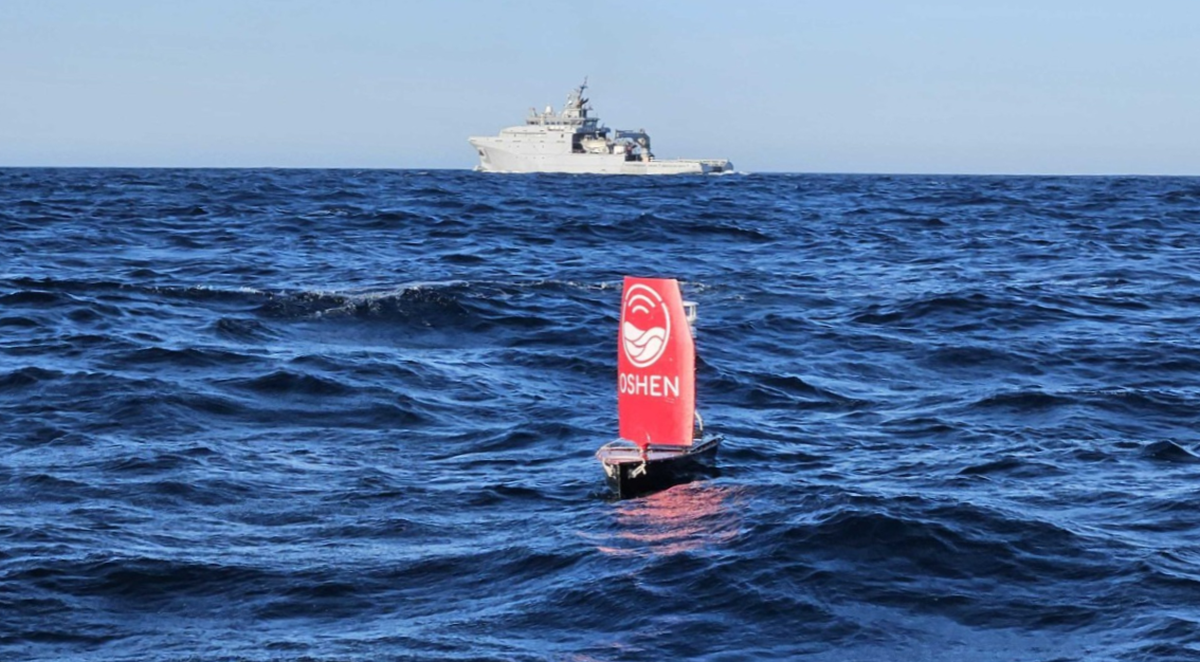
Network of robot boats with hydrophones deployed to monitor subsea activity
Autonomous vessels have been deployed with passive sonar to provide surveillance of underwater operations in a month-long ocean trial


A network of autonomous vessels, each with a hydrophone on board, has been deployed to create a distributed surveillance network during a short-term maritime robotics exercise.
Passive sonar monitoring in this trial involves six 1.2-m robotic sailboats deployed in a line to be tested against live targets.
Plymouth, UK-headquartered Oshen is demonstrating what it is calling a world-first “acoustic picket line” capability with these C-Star uncrewed boats and hydrophones.
It uses a line of small vessels with low-cost sensors, supplied by Systems Engineering and Assessment, spread over a wide area to increase the likelihood of detecting underwater structures, objects, and movements in what can be a defence or commercial application.
C-Star autonomous boats can hold position to create an acoustic barrier across any stretch of water.
This network shape and density can be adjusted in response to operator requirements, while multi-perspective monitoring can identify the location, not just bearing, of a target.
Oshan sees this network as an alternative to passive sonar monitoring, which involves surface vessels pulling platforms fitted with up to 100 hydrophones behind them.
These provide excellent local sensing and bearing-finding capabilities, but are sensitive to noise pollution from the towing vessel or nearby ships and cover a limited area.
C-Stars have survived and transmitted data from inside a category 5 hurricane, said Oshan.
If individual units are lost, the network could be easily adapted to continue providing sensor coverage.
“A defensive network built from a host of individual hydrophone platforms behaves very differently from one built from a handful of expensive towed arrays,” said Oshen manager for defence and oceanography, Gordon Jones.
“It is wider, more resilient and harder for an adversary to characterise. It points the way to how persistent undersea surveillance can be evolved.”
NATO’s Repmus exercise is the first real test of that model against live targets. The whole ocean exercise was designed to test new robotic technologies and command and control across a mixed fleet in a congested, kinetic environment.
Oshen has three active projects with the Royal Navy and holds a cooperative research and development agreement with the US Navy covering single-beam sonar applications.
In October, eight C-Star vessels will take part in the maritime big-play exercise in San Diego, California, US, to test the acoustic picket line concept again.




Related to this Story


Events

Maritime Regulations Webinar Week
 16 Dec 2025
 GMT - ONLINE

Floating energy: successfully unlocking stranded gas using FLNGs and FSRUs
24 Feb 2026GMT - ONLINE
© 2026 Riviera Maritime Media Ltd.


