


Business Sectors
Business Sectors
Events
Contents
Register to read more articles.
Aegir urges caution as developers target Italian offshore wind opportunities
The Italian offshore wind sector is booming, with 39 grid applications submitted to the authorities and 64 expressions of interest in developing floating windfarms, but consultant Aegir Insights believes that not all wind areas in the country’s waters are equally attractive


Speaking exclusively to OWJ, Aegir Insights managing director Scott Urquhart said developers are scrambling to pick up low-cost offshore wind sites in Italy. However, the Italian Government has so far only expressed a relatively low level of ambition for offshore wind compared with other forms of renewable energy. With many Italian sites relatively expensive in a European context, Italy could remain a niche market for floating wind, Mr Urquhart told OWJ, until such time as the government sends a stronger signal to the market.
“Much of the scramble for sites seems to be for what we perceive to be relatively immature projects,” Mr Urquhart said, citing a report Aegir Insights has produced as part of a series of bi-weekly Big Float Intelligence series.
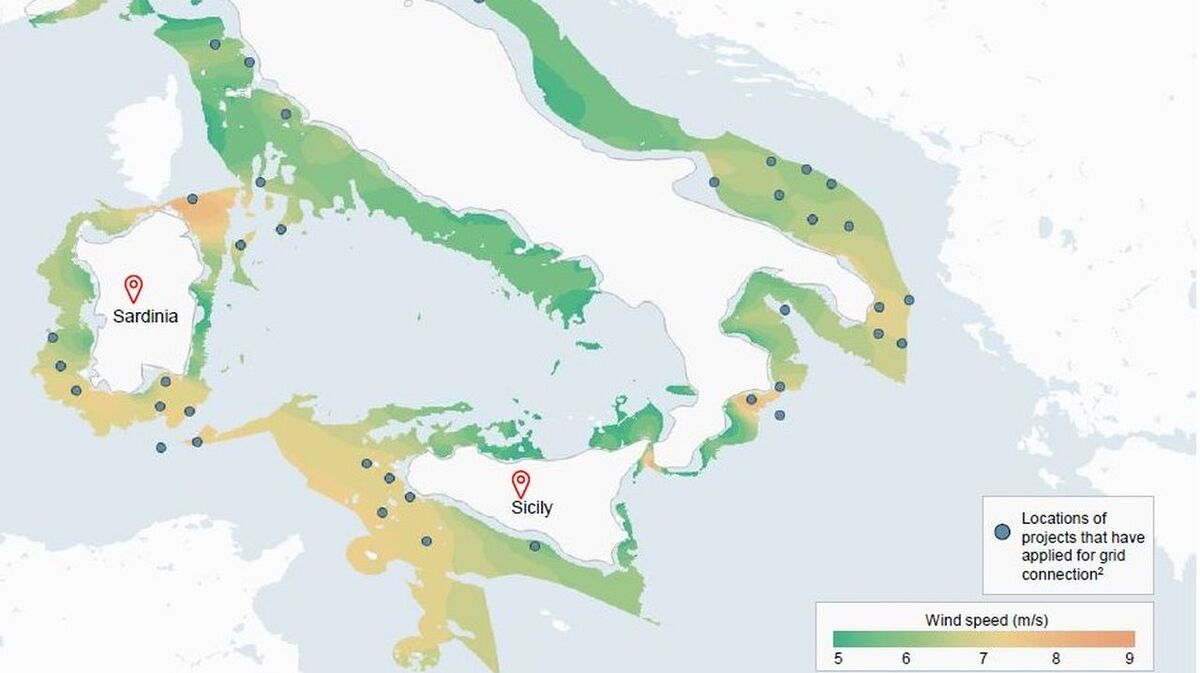
Mr Urquhart explained that although there has been a torrent of projects announced by developers, and although Italy’s National Integrated Plan for Climate and Energy 2030 was reasonably ambitious and set a target for renewables of 93 GW, offshore wind only accounts for 900 MW of that total. “This lack of ambition from the government has received plenty of criticism from industry,” he explained. Moreover, he cautions that the Italian offshore sector is characterised by low wind speeds with ‘small pockets’ of higher wind speeds. This means developers are battling for the best sites and some may be disappointed.
Aegir Insights’ analysis of the market suggests that several projects that have been announced are in areas that could be expensive, with costs up to €105/MWh (US$118/MWh). Others come in around €70/MWh, he said, highlighting how important it is to find good sites.
Mr Urquhart and his team have benchmarked Italian projects with others in Europe and found that Italy has the highest levelised cost of energy (LCoE) in Aegir Insights’ ‘Big Float 40’ dataset. This is largely due to low wind speeds.
“Comparing Italy to other European markets, two things stand out,” he told OWJ. “Firstly, Italian projects have an average LCoE of €92/MWh, while the average in Europe is €72 MWh. Secondly, Italian projects have an average wind speed of 7.4 m/s. The average elsewhere is 9 m/s. Many Italian sites have even lower wind speeds, which is a significant challenge. These factors – a relatively high LCoE for floating wind and an uncertain permitting and support regime – mean that Italy could remain a niche market until we get stronger signals from the government.” Sardinia and Sicily have the highest wind speeds, of up to 8.6 m/s and 7.7 m/s respectively, but other areas have markedly lower wind speeds.
“There is such great variety between sites,” he told OWJ. “It is uncertain whether all the projects will be floating, but most are located in areas deeper than 60 m, meaning that floating foundations are going to be required. However, with capacities ranging from 30 MW to 2.8 GW, it is not clear yet which projects will be floating and which fixed-bottom.”
Among the 64 developers that have expressed an interest in building floating wind projects to the Ministry of Ecological Transition are industry leaders such as Copenhagen Industry Partners, DEME Offshore, Eni SpA , Falck Renewables, Fincantieri SpA , Fred Olsen Renewables, Renexia, Ocean Winds, Principle Power, RWE Renewables, Saipem and Vestas.
At the moment, Renexia’s 2.9-GW floating offshore wind project offshore Sicily is the largest. The developer, a subsidiary of Toto Holding, is progressing an environmental impact assessment and expects to initiate construction in 2023 and commission the project in 2025. Some in the Italian senate have expressed concern about its size, but Greenpeace, Legambiente and WWF have announced their support for it.
Falck Renewables and BlueFloat Energy have announced projects of 1.3 GW and 1.2 GW in the Adriatic. The projects, Odra Energia and Kailia Energia, should soon be ready to compile the documentation required to start the authorisation process and a voluntary preliminary consultation to scope out an environmental impact assessment.
“It could very well be that of the 39 projects that have submitted an application for a grid connection, a number of them are really opportunistic in nature,” Mr Urquhart concluded. “The permitting and support regime will determine the future of offshore wind in Italy and that is not yet clear. It is a complex game finding competitive water depth, port facilities and grid connection.
“The sheer number of grid applications show that developers believe there is a potential market. Italy has attracted a healthy mix of local and international developers, but the number of grid applications might be significantly higher than the number of realistic projects that get built, at least in this decade.”



Related to this Story

Events

Maritime Regulations Webinar Week
 16 Dec 2025
 GMT - ONLINE
Floating energy: successfully unlocking stranded gas using FLNGs and FSRUs
24 Feb 2026GMT - ONLINE
© 2026 Riviera Maritime Media Ltd.


