


Business Sectors
Business Sectors
Events
Contents
Register to read more articles.
Vessel operators’ BWMS installation and testing obligations
In the first Riviera Maritime Media ballast water webinar of 2023, experts assess vessel operators’ new and continuing BWMS installation and testing obligations


There is still a lot of confusion concerning the purpose of the different sorts of commissioning that take place in the ballast water management system industry and one of the aims of the Vessel operators’ new and continuing BWMS installation and testing obligations webinar* that took place 31 January 2023 was to dispel some of the myths.
Three experts, Atlantium Technologies chief technical officer Ytzhak (Itzik) Rozenberg, ERMA FIRST ESK Engineering Solutions chief scientific officer and president Ballast Water Equipment Manufacturers Association Dr Efi Tsolaki, and BAWAT chief executive Marcus Hummer, were recruited to answer questions on the issue of commissioning.
The Vessel operators’ new and continuing BWMS installation and testing obligations webinar was sponsored by Purestream by Atlantium, and Bawat.
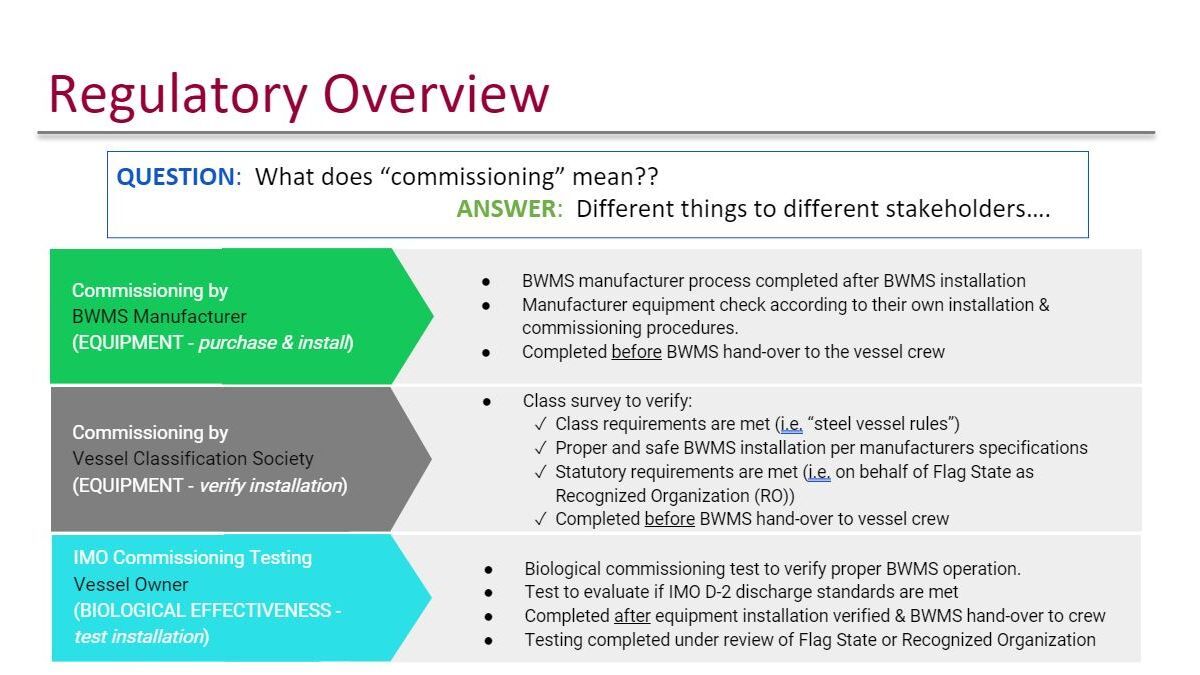
Dr Tsolaki provided the table (see main image) which explained the different commissioning processes that take place. The order of commissioning testing is that the first takes place after the installation of the ballast water treatment system when the provider will undertake commissioning to ensure the installation is as per its instructions.
Then the classification society will check, through its commissioning process, that the ballast water management system (BWMS) is in line with regulations required by the flag state.
The vessel owner engages a third party for commissioning testing that the BWMS satisfies IMO D-2 discharge standards.
To this list could be added a precommissioning stage of the type-approval process for IMO or US Coast Guard certification, and in a poll, one third of the webinar delegates agreed in whole or part to the statement: “A BWMS that has IMO and USCG type-approval guarantees the system will pass biological tests” (see polls).
Mr Rozenberg pointed out being able to install or retrofit install a ballast water system on a vessel and have it functioning to the required standard depends on the robustness of the design solution.
“The ballast water management system is an add-on to the existing (ballast) system,” he said. In the case of the Purestream by Atlantium system, the robustness of the system is built-in at the design stage with each UV lamp having its own sensor.
Once a type-approved BWMS is installed on a vessel and has undergone all the commissioning testing, then a certificate of compliance is issued, but as Dr Tsolaki pointed out, remaining in compliance is down to the vessel operator and crew to maintain the BWMS, “Crew training is a key issue and very important for the vessel to be compliant throughout the lifecycle of the vessel.”
Mr Hummer was keen that delegates understand the root purpose of the Convention, “It is crucial to understand and remember when we speak about compliance, the ballast water convention is that discharge convention, it is not an equipment convention,” he said.
He added, “Just because you have bought a type of proof ballast water system and installed it, does not mean you are in compliance. Compliance means the discharge ballast water from your vessel is in use in compliance with discharge bacteria on zooplankton, phytoplankton and bacteria.”
He noted commissioning testing is raising some common issues. One is that vessel owners believe they can undertake the commissioning testing. This is not allowed, said Mr Hummer, it has to be an independent body and that excludes the BWMS provider.
There are also practical considerations, “Your sampling point must be compliant and should be communicated to the testing company before they enter your vessels to make sure they can draw water from it.”
In the case of the BAWAT system, the sampling point is on the exit of the system and as this a one-pass system using heat. “It does not matter what the quality of the water in the tanks, or in the sea, or whether the water is seawater, fresh water, dirty water, clean water - heat always works,” said Mr Hummer, “A BAWAT system has never failed a biological compliance test.”
*A full report on the webinar will appear in the supplement Ballast Water Treatment Technology 2023.
Webinar poll results
Attendees were asked to vote on a series of poll questions during the webinar. Here is a summary of the results.
Do you know which organism groups most often fail a biological test for ballast water compliance?
Almost exclusively larger organisms (≥70 µm) that fail testing: 12%
Almost exclusively larger organisms (≥60 µm) that fail testing: 4%
Almost exclusively larger organisms (≥50 µm) that fail testing: 55%
Almost exclusively larger organisms (≥40 µm) that fail testing: 9%
Almost exclusively larger organisms (≥30 µm) that fail testing: 20%
The correct answer is (≥50 µm).
How would you characterise your familiarity with the biological test results of ballast water gained during the experience building period?
Not at all familiar: 20%
Slightly familiar: 14%
Somewhat familiar: 28%
Moderately familiar: 16%
Extremely familiar: 22%
Have any of your vessels been on the receiving end of the law enforcement act from port state authorities due to discharging water that is not in line with the D-2 standard?
Yes: 6%
No: 75%
Possibly: 19%
Commissioning testing should be carried out on an annual basis for validity of proper operation
Agree: 68%
Disagree: 32%
What is the primary root cause of noncompliant commissioning test?
Outside SDLs: 11%
G2 sampling point is not part of the installation: 11%
BW tank contamination: 60%
Sample contamination: 18%
Two approved BWMS: the first is with enhanced measurements, monitoring all operational and functional parameters. The second unit has fewer monitoring parameters. Which one is more likely to meet the D2 tests over time?
The first unit: 44%
The second unit: 10%
Both, since both are approved: 46%
In our experience, so long as we carry out preventive maintenance according to the maker’s instructions, we can be confident the BWMS will pass the biological tests
Strongly disagree: 4%
Disagree: 6%
Somewhat disagree: 19%
Neither agree nor disagree: 4%
Somewhat agree: 19%
Agree: 39%
Strongly agree: 9%
A BWMS that has IMO and USCG type-approval guarantees the system will pass biological tests
Strongly disagree: 26%
Disagree: 18%
Somewhat disagree: 17%
Neither agree nor disagree: 6%
Somewhat agree: 9%
Agree: 20%
Strongly agree: 4%
Source: Riviera Maritime Media

From left to tight: Atlantium Technologies chief technical officer Ytzhak (Itzik) Rozenberg, BAWAT chief executive Marcus Hummer, and ERMA FIRST ESK Engineering Solutions chief scientific officer and president Ballast Water Equipment Manufacturers Association (BEMA) Dr Efi Tsolaki



Related to this Story


Events

Maritime Regulations Webinar Week
 16 Dec 2025
 GMT - ONLINE
Floating energy: successfully unlocking stranded gas using FLNGs and FSRUs
24 Feb 2026GMT - ONLINE
© 2026 Riviera Maritime Media Ltd.


