


Business Sectors
Business Sectors
Events
Contents

Register to read more articles.
How cargo-stowage optimisation enhances cargo-carrying efficiency
A holistic approach to designing stowage solutions is helping owners increase their earning potential and minimise the environmental footprint of their ships


While optimising efficiency in goods transport is fundamental to a ship’s earning capability, owners sometimes pay insufficient attention to the vessel’s cargo-handling system during the early design stage. In a typical design process, parts of the cargo-handling system are treated as separate entities, with lower priority than other critical components of the ship.
By the time the stowage infrastructure is in place, a unique opportunity to maximise cargo-carrying efficiency has been missed, and any major changes to the vessel in the future will involve significant downtime and loss of revenue.
According to MacGregor, planning a newbuild around its stowage requirements is the key to optimising cargo capacity and earnings from the vessel’s maiden voyage.
“Often, during the initial stages of ship design, stowage arrangements don’t receive the consideration they deserve, and the vessel ends up with a sub-optimal loading capacity and flexibility, which limits its profitability,” comments MacGregor sales manager for multi-purpose vessels (MPV) and general cargo vessels Esa Lukkala. “If the owner wants to rectify this at a later stage, it will cost them a lot of time and money. Taking a holistic view of the cargo-handling system and its desired capabilities in the early design process pays off in the future.”
By addressing stowage arrangements from the beginning, an owner can ensure the system’s constituent parts – such as weather and tween-deck hatch covers, moveable bulkheads, cranes, lashing bridges, container stanchion and fittings, and the cell-guide system – function optimally as a combined unit, adds Mr Lukkala.
Able to design and deliver all these products, MacGregor takes a holistic approach to cargo handling. Its cargo-stowage solution serves MPV, general cargo, and container vessels of all sizes. For example, MPV can offer flexibility by accommodating different cargo configurations, making them adaptable to various trade routes and cargo demands.
Fewer emissions per carried container
Considering stowage arrangements at the earliest opportunity is necessary for reasons other than profit. Modern shipowners have growing environmental, social and corporate governance (ESG) responsibilities, not to mention regulatory obligations. Compliance with the International Maritime Organization (IMO)’s Carbon Intensity Indicator (CII), for example, is a planning priority for shipping companies worldwide.
“Shipowners and yards are doing a lot of good things to reduce their vessels’ environmental footprint, such as adopting digital tools for more efficient route planning and optimising hull forms for reduced friction,” says MacGregor sales manager for lashings and cargo boost Arto Toivonen. “However, what tends to be overlooked is the extent to which a carefully conceived stowage system can contribute to ESG agendas.”
By allowing owners to safely transport more cargo per voyage, the MacGregor cargo-stowage solution minimises emissions per carried twenty-foot-equivalent unit (TEU). In fact, Mr Toivonen reports that a highly efficient cargo-handling system, when compared with the average stowage arrangements, can cut emissions per TEU by up to 15%, depending on the ship.
Ultimately, decreasing emissions in line with IMO targets will rely on the widespread adoption of cleaner energy sources, but alternative fuels are also considerably more expensive and have greater storage demands than conventional heavy fuel oil. Thus, as shipping’s green transition advances, the importance of an efficient cargo-handling system will only become more evident, Mr Toivonen explains.
“Eventually, we will reach the point where incremental performance enhancements are no longer enough to maintain regulatory compliance, and shipowners will simply have to make the switch to greener fuels,” he says. “Optimised cargo handling will help them to offset the significant costs involved while compensating somewhat for the reduced hold space resulting from more complex fuel-storage requirements.”

Optimising stowage on board existing ships presents a different set of issues, but this does not mean owners of ships in service have no options for improving their cargo-carrying efficiency. MacGregor has developed its Cargo Boost solution specifically to help owners of existing vessels overcome the challenges of sub-optimal loading capacity.
“It’s common for shipowners who have followed a design process that doesn’t account for stowage requirements from the outset to approach us later on requesting our expertise in increasing their vessels’ cargo capacity,” notes Mr Toivonen. “The solution we provide in such cases, Cargo Boost, has proved popular with customers as it offers a second chance to optimise cargo-carrying efficiency while enabling a quick return on investment.”
While the average cargo-handling system has a utilisation rate of approximately 80%, MacGregor’s target is at least 90%, Mr Toivonen continues. “For a 10,000-TEU vessel, this equates to an extra 1,000 TEU transported per voyage. Yet in certain cases, we can increase a ship’s cargo capacity beyond its expected maximum, allowing a 10,000-TEU vessel to carry, say, 11,000 TEU.”
Implemented across a 10-vessel fleet, Cargo Boost can increase fleetwide capacity by the equivalent of an additional ship, resulting in the earning potential of 11 vessels with the costs and emissions of 10. “This makes it an easier, cheaper alternative to the early adoption of alternative fuels,” says Mr Toivonen. “Of course, all shipowners will have to make the changeover eventually, but Cargo Boost can buy them time until alternative energy sources are more mature and their price point has come down.”
With its cargo-stowage solutions and Cargo Boost, MacGregor has developed a service offering that covers the full scope of shipowners’ cargo carrying optimisation needs, says Mr Toivonen. “Most companies that supply stowage systems work solely with shipyards, but we work with owners as well. We have an indepth understanding of how our clients operate their vessels, and we use this knowledge to design tailored systems whose constituent parts work in harmony to deliver the highest levels of cargo-carrying efficiency.”
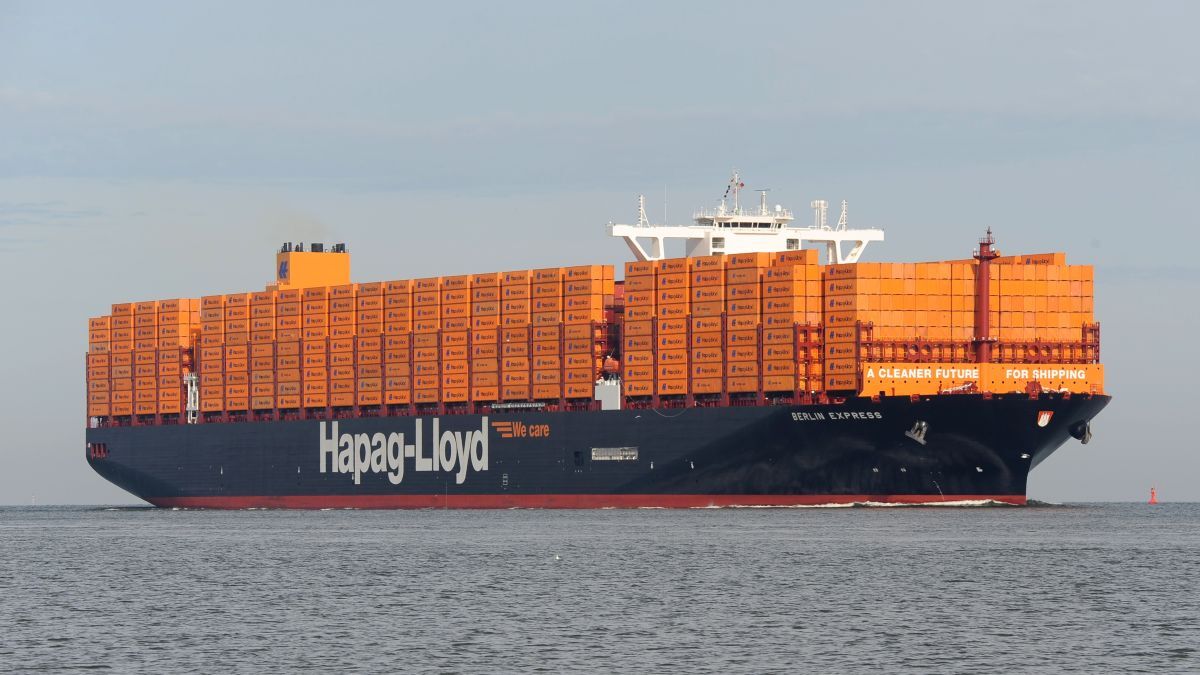
Hapag-Lloyd’s 23,600-TEU Berlin Express, built in 2023 features a cargo system designed by MacGregor.
“Designing the cargo system with seamless optimisation between lashing systems, lashing bridges, and hatch covers makes a significant difference,” says Mr Toivonen. “Early collaboration with MacGregor really pays off in terms of optimising cargo-carrying efficiency.”
Sign up for Riviera’s series of technical and operational webinars and conferences in 2023:
- Register to attend by visiting our events page.
- Watch recordings from all of our webinars in the webinar library.



Related to this Story

Events

Maritime Regulations Webinar Week
 16 Dec 2025
 GMT - ONLINE
Floating energy: successfully unlocking stranded gas using FLNGs and FSRUs
24 Feb 2026GMT - ONLINE
© 2026 Riviera Maritime Media Ltd.


