


Business Sectors
Business Sectors
Events
Contents
Register to read more articles.
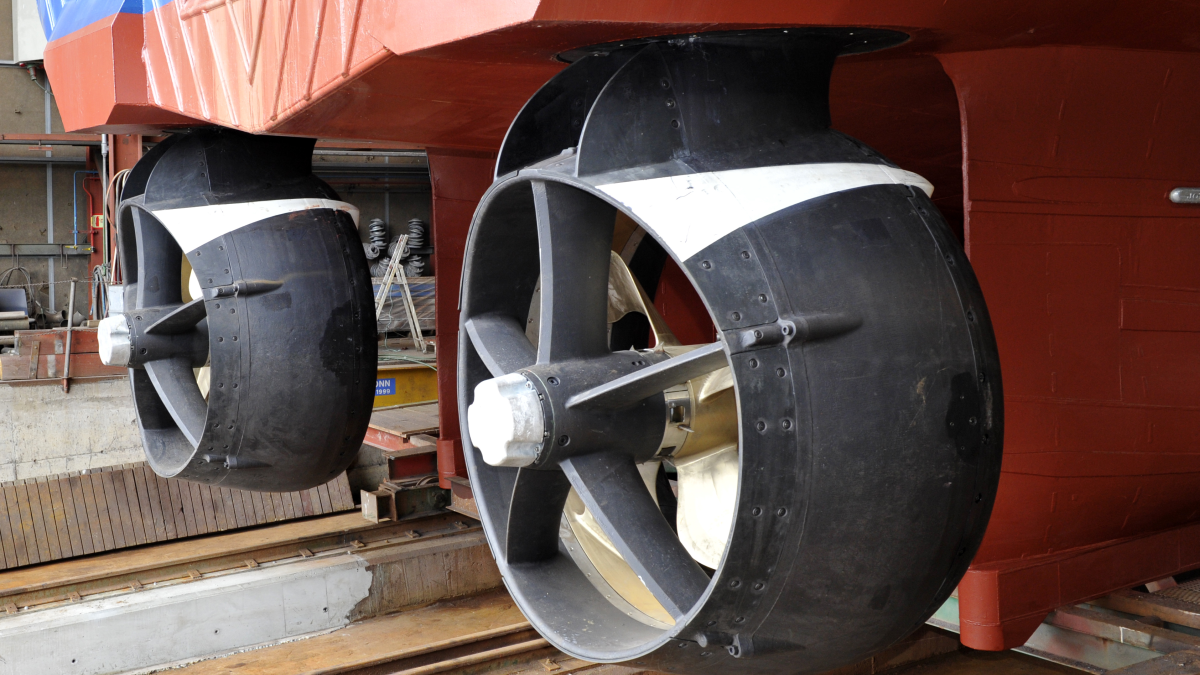
Rim-drive thrusters developed for next-generation OSVs
Kongsberg Maritime is expanding its range of rim-drive azimuth and tunnel thrusters and advancing the technology for newbuild offshore support vessels


It has been more than 10 years since the first installation of a rim-drive azimuth thruster, onboard Norwegian research vessel Gunnerus (in 2015), and the testing of prototype tunnel thrusters on anchor handler Olympic Octopus (2007).
This range has since evolved in both tunnel (RD-TT) and azimuth (RD-AZ) configurations for various applications, such as dynamic positioning on OSVs and propulsion pods on various vessels.
Kongsberg has almost 100 deliveries and orders for rim-drive thrusters, with the next installations on commissioning service operation vessels (CSOVs), SOVs, oceanographic research and passenger vessels.
All these rim-drive thrusters have a permanent magnetic motor at the rim of the nozzle and the propeller, as part of the rotor for generating revolutions and thrust.
Kongsberg’s range currently includes RD-AZ 1900 with a 1,900 mm diameter thruster and up to 1,100 kW of power, RD-AZ 2300 in a power range of 1,100 to 2,000 kW and RD-AZ 2600 (a power range of 2,000 to 2,600 kW).
Kongsberg technical product manager, Kjartan Røyset, said the company was currently investigating whether to introduce a RD-AZ 3300 rim-drive thruster with a 3,300 mm diameter propeller with power ranging up to 3.5 MW, mainly for subsea construction and support vessels.
Its tunnel thruster range consists of RD-TT 1600 with a propeller diameter of 1,600 mm and power of 1,100 kW and RD-TT 2000 with power of 1,600 kW.
“We are developing RD TT 2300 and RD TT 2600 ready for 2026, for large OSVs and cruise vessels,” said Mr Røyset.
The company is also looking at developing an RD TT 1000 with a power output of around 400 to 600 kW, for large workboats and smaller OSVs.
Kongsberg has orders to deliver rim-drive thrusters for vessels anticipated for 2026 delivery, including for two subsea construction vessels being built in China for Olympic Subsea, two oilfield service vessels for Shell Australia and SOVs for Norwind Offshore and Bibby.
These all total about 20 various thrusters that have been sold and not yet delivered or installed, Mr Røyset said.
The next developments in rim-drive thrusters will focus on reducing the amount of rare-earth materials used, improving efficiency and reducing underwater radiated noise.
Kongsberg technology manager for electrical products Gunnar Johnsen noted that developments include 3D printing of a composite propeller, developing polymer encapsulated electric components and structures, testing different nozzle inlet and outlet shapes and tilting of the nozzle outlet to gain more thrust.
“We have a 200-kW composite propeller for testing and we expect a commercial thruster is coming soon,” said Mr Johnsen. “We are working to reduce underwater radiated noise and improve the hydrodynamic efficiency,” he said.
This includes using 3D modelling and computational fluid dynamics in stream lining the flow from the thruster.
The six-blade propeller in a rim-drive thruster with a uniform propeller inflow will not produce any vortex cavitation turbulence or noise, said the company. Real-time measurement has proved that the RD-AZ 2600 is the only propulsion unit that fulfils the requirement for research vessels, such as DNV notation for Silent R, added the company.
Riviera’s Maritime Decarbonization Americas Conference will be held in Houston, Texas, 22-23 January 2026. Click here for more information on this industry-leading event

Related to this Story

Events

Maritime Regulations Webinar Week
 16 Dec 2025
 GMT - ONLINE
Floating energy: successfully unlocking stranded gas using FLNGs and FSRUs
24 Feb 2026GMT - ONLINE
© 2026 Riviera Maritime Media Ltd.


