


Business Sectors
Business Sectors
Events
Contents
Volstad companies set different course for growth


In Ålesund, Norway, two brothers, both owning shipping companies with their origins in the Volstad group, are building a fleet of offshore vessels for long term charters but have chosen to target different sectors
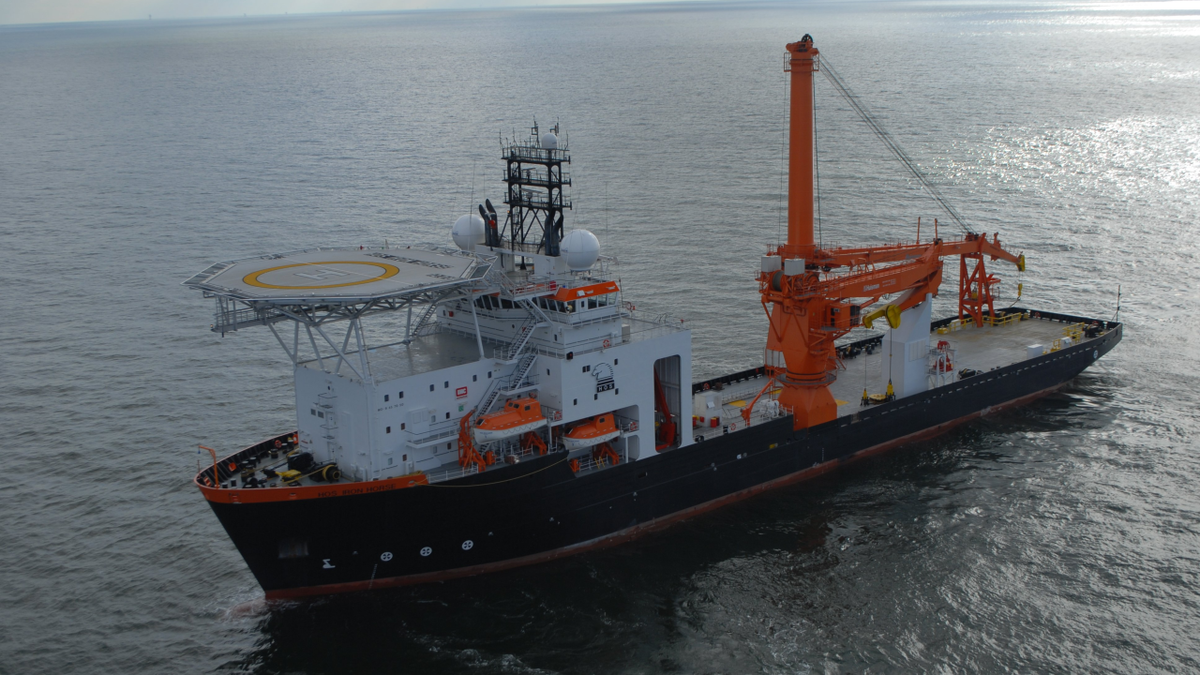
Norwegian firm Volstad Maritime’s management is focussed on further growth. The enterprise has recently taken delivery of its second diving support vessel (DSV) and has a seismic source and acquisition vessel along with a subsea construction ship on order. The company’s fleet grew in May this year when Bibby Topaz, a light subsea construction/DSV design, was released from Fosen Yards in Trondheim, Norway and started a long term charter with UK contractor Bibby Offshore.
This 106m vessel is the second DSV to have started working for Bibby in the North Sea, where demand for such ships is high currently. It has the ability to deploy a diving saturation system for 18 men in 300m of water from a 150 tonne crane, and the ship has accommodation for 106 offshore workers.
Created by Skipsteknisk as the ST256 L design, Bibby Topaz was scheduled for delivery in September 2007 from the Norwegian yard, but it finally arrived for Bibby in April to start work in the UK and Dutch sectors of the North Sea. It is longer than the ST253 L design Bibby Sapphire, which has been working for Bibby Offshore since 2005; that 94m ship came from the Aker Langsten yard with a 12-man diving saturation system and 120 tonne crane, and was more recently upgraded to full diving support mode at Northwestern Shiprepairs in the UK.
Volstad Maritime also ordered another light subsea construction vessel, in order to move further into the growing deepwater market, and this has also just been delivered by Fosen Yards. Volantis, as it is named (see elsewhere in this issue of OSJ), is similar to Bibby Topaz in terms of basic design and length, but it will be equipped with facilities to deploy ROVs and will have accommodation for 90.
It also differs from Bibby Topaz in as much as it is outfitted to operate as a multi-purpose trencher and supply vessel. The hull was built at Landskrona Varvet and outfitting was completed at Fosen, and the vessel is now the subject of a long term charter with DeepOcean – one of its first jobs is removal of the tanker loading system at Venture’s Kittiwake platform.
DeepOcean and Volstad Maritime ordered a further subsea survey and maintenance vessel, known as Cygnus, from Fosen. This ship will be a multi-role support design, which will be able to do trenching and lay cables, umbilicals and small diameter flexible flowlines once delivered in 2009.
Volstad Maritime’s commitment to building a business in owning seismic vessels started before a split in the original Volstad group, and Volstad Maritime has two vessels of this type, a sophisticated 3-D seismic survey ship and a source ship, on long term charter with Western Geco.
The 1999-built Geco Bluefin has the highest specification in Volstad’s seismic fleet, and is working at the top end of the industry. The 80m long design is able to undertake four component surveys that include the laying of cables on the seabed in water depths of 30-1,500m.
The 1982-built Geco Tau was upgraded in 2003 so it could work with Western Geco as a seismic source vessel on a long term charter, and Volstad Maritime is further enhancing its seismic fleet this year with the arrival of Geowave Endeavour, also built by Fosen.
This is another design from Skipsteknisk, a ST256 L model, which will be able to undertake 3-D seismic surveys; it will go on long term charter with Norwegian contractor Wavefield Inseis once complete.
Once this ship and Volantis are delivered, Volstad Maritime will have an offshore fleet of six vessels, more than double the number it had at the start of this year. Christoffer Syversen, a project analyst with Volstad Maritime, told OSJ that the company is growing in the subsea and seismic sectors because, although the offshore market as a whole is buoyant, it sees these as particularly strong sectors for the future. Revenues will be rising strongly this year, now the majority of the newbuildings are delivered and operating on long term charters.
A second company, Volstad Shipping, is also on the path to growth via the construction of a fleet of offshore vessels, but started on this path a little later than Volstad Maritime.
After it split from the other Volstad company, Volstad Shipping concentrated on the fishing sector, but in 2007 started gaining revenues from the offshore industry, and took delivery of two PSVs last year; by this summer it will have a third.
In fact, Volstad Shipping ordered its first offshore vessel in 2005 and also went to the Ålesund-based design consultancy Skipsteknisk (whose offices are in the same building as both Volstad shipping companies).
It became an offshore vessel operator when the PSV Volstad Viking was delivered in April 2007; Volstad Supplier joined the fleet in October that year, both being ST216 L CD designs from the Aker Yards Brattvaag facility in Norway; both are on long term charter with US oil major ConocoPhillips, in the UK and Norwegian sectors.
“Our third PSV is Volstad Princess (see also elsewhere in this issue) and this will be chartered to StatoilHydro for three years once delivered,” said Volstad Shipping’s managing director, Eivind Volstad. “It has an ice strengthened hull and propeller so is specially built for Arctic waters. For our PSVs we have obtained good charters in a positive market.”
The new vessel is also a ST216 L CD design and is 93m in length; its ice class hull will ensure it is capable of operating in the Norwegian and Barents Seas. It is also one of a number of new environment friendly OSVs that are coming out of Norwegian yards, and has selective catalytic reduction (SCR) equipment that will extract nitrous oxides from exhaust emissions.
Not content to operate PSVs, Volstad Shipping has also ordered two hulls for light subsea construction from a Turkish yard. Once launched, these Skipsteknisk ST253 designs will be outfitted in Norway and Spain with the latest equipment for deploying ROVs in deepwater, and for installing small subsea modules.
The first of these will be named Acergy Merlin and is due to be chartered to Aberdeen-based subsea contractor Acergy for work worldwide in early 2009. Acergy Merlin is set to be launched in August and will go up to the Baatbygg yard in Maaløy, Norway for all the offshore and subsea construction equipment to be fitted. This will include a 70 tonne heave compensated crane from TTS, to enable subsea modules to be deployed, also SCR equipment to reduce emissions.
The second light subsea construction vessel ordered by the company will have a similar specification to Acergy Merlin and should be delivered in 2009; however, Volstad Shipping was unable to find a Norwegian yard with an available slot for outfitting, so it turned to Spain for the work to be completed. The ship will therefore be going to Freire Shipyard in Vigo, northwest Spain in 2009 once it is launched from the Turkish yard fabricating the hull. After outfitting is complete, the ship will be delivered in the fourth quarter of 2009, ready to start its first charter.
Mr Volstad said he sees this ship as being ideal for the North Sea market because of its high environmental specification and continuing demand for light subsea construction vessels in the region. The company has not yet secured a charter for this second ship, but Mr Volstad is optimistic that demand for such designs will remain high and is confident that a term charter will be obtained well before the vessel is delivered.
“We decided to go for a Spanish yard because it had a slot that suited the delivery time. We have already secured the main equipment from Rolls-Royce and ABB so the yard can outfit the vessel in a short time,” says Mr Volstad. “Today, it is almost impossible to purchase equipment such as cranes, propellers, thrusters and engines for delivery until 2010 or even 2011, and there are no slots in Norwegian yards.”
Volstad may own the ships, but it prefers to let another company worry about the manning and daily operations. It outsources all these tasks to the Sandnes, Norway office of Gulf Offshore, a subsidiary of US group GulfMark.
“Gulf Offshore takes care of the day-to-day management and crewing of our vessels,” Mr Volstad explained, noting that it has been a busy period for the company since 2005, so his management team have not ordered more vessels, and wants to gain more experience with the vessels it already has.
“We have experienced a high level of growth since we ordered the first vessel in 2005, so it has been very hectic. We are not in any discussions, nor do we have plans for more ships, but our fleet will grow with the delivery of the two subsea ships,”Mr Volstad concluded. OSJ
Related to this Story
Events

Maritime Regulations Webinar Week
 16 Dec 2025
 GMT - ONLINE
Floating energy: successfully unlocking stranded gas using FLNGs and FSRUs
24 Feb 2026GMT - ONLINE
© 2026 Riviera Maritime Media Ltd.


