


Business Sectors
Business Sectors
Events
Contents

Register to read more articles.

Oldendorff on what a global shipping decarbonisation framework should deliver
What are the key ingredients for a global emissions framework, and what is the practical path towards decarbonisation?


As the shipping industry gathers this week in Hamburg for SMM 2026, coinciding with the IMO’s environmental talks, Oldendorff Carriers Managing Director Fleet Scott Bergeron discusses these questions in an interview with Riviera, while also addressing geopolitics and dry bulk shipping fundamentals.
Oldendorff Carriers is Germany’s largest dry bulk shipping company, overseeing a fleet of about 780 vessels. As the company invests in making its fleet more efficient and less fuel-intensive, the shipping industry is also seeking a regulatory framework that can enable and support this transition.
“The shipping industry needs a global framework for decarbonisation, and we continue to believe that the IMO is the right forum to develop and implement such a framework,” Mr Bergeron told Riviera.
He emphasised that a globally applied solution is preferable to an increasingly fragmented landscape of regional and national regulations, “which creates complexity, administrative burden and higher costs without necessarily delivering better environmental outcomes.”
Mr Bergeron noted that Oldendorff recognises the significant effort that has gone into developing the Net-Zero Framework. However, discussions over the past year have highlighted “a number of legitimate concerns around implementation, fuel availability, cost, complexity and political acceptability,” he added.
“The fact that IMO member states continue to look for broader convergence demonstrates that there is still work to be done to ensure that any final framework is both environmentally effective and practically workable,” Mr Bergeron said.
At this stage, Oldendorff is less focused on supporting any single proposal submitted to the IMO and more focused on the principles that should underpin a successful outcome.
“We believe future measures should be technology-neutral, provide clear and predictable investment signals, recognise the role of operational and energy-efficiency improvements, and maintain a realistic connection to the affordability, availability and scalability of alternative fuels,” Mr Bergeron said.
“Those principles are reflected in several of the proposals currently under discussion and provide a constructive basis for building consensus,” he added.
Regulators, Mr Bergeron continued, need to create conditions that “encourage innovation and investment without imposing obligations that outpace the real-world availability of compliant fuels.”
But decarbonisation is already underway across the industry. Significant reductions can be achieved through better ship design, operational optimisation and energy-efficiency technologies, Mr Bergeron explained.
He pointed out that the most practical pathway towards decarbonisation combines continuous improvements in vessel efficiency with the gradual uptake of lower-carbon fuels as they become safe, scalable and commercially viable.
“Ultimately,” Mr Bergeron said, “decarbonisation will be achieved not through regulation alone, but through a combination of smart regulation, technological innovation, operational efficiency and commercially scalable low-carbon energy solutions.”
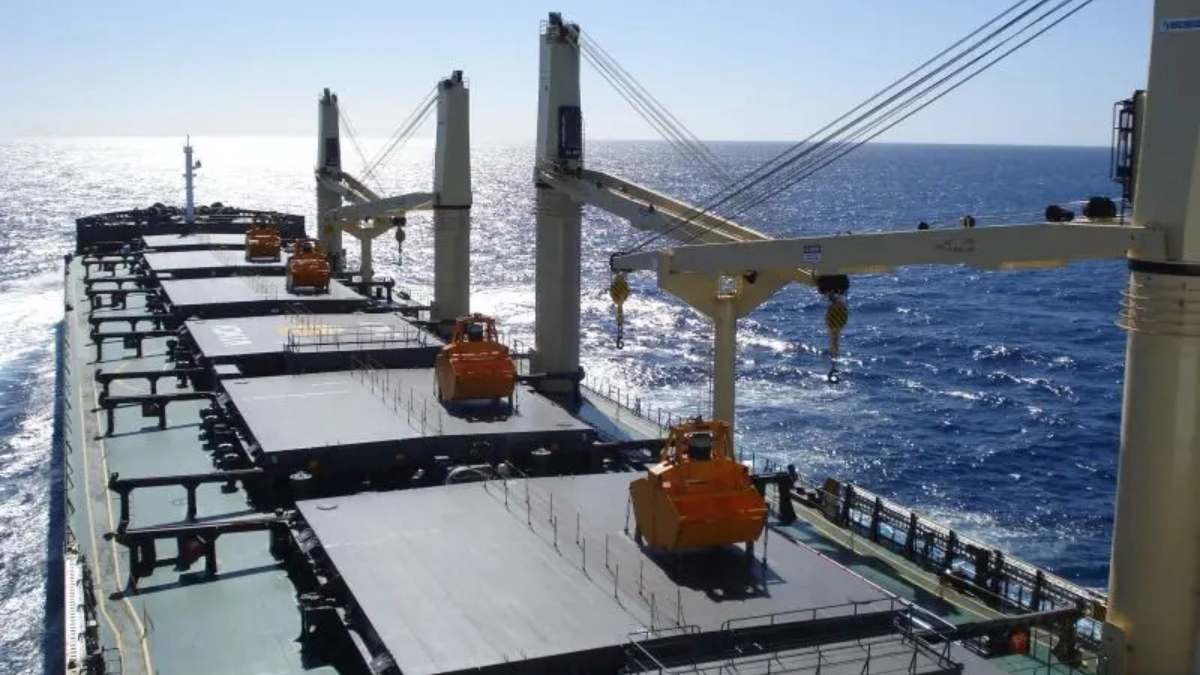
As far as Oldendorff itself is concerned, Mr Bergeron said the company has invested heavily in more efficient vessels and operational measures that reduce fuel consumption.
“We will continue to support pragmatic solutions that deliver meaningful emissions reductions while preserving the competitiveness and reliability of global maritime transport,” he added.
Adjusting in crises
Shipping has had to adapt to a rapidly evolving geopolitical environment in recent months, with the Strait of Hormuz crisis at the forefront of the disruption.
Mr Bergeron said the situation has created a “significantly more challenging” operating environment. Oldendorff has vessels located in the wider region, “which require constant and extraordinary vigilance by crew and our shore-based staff.”
The situation has inevitably affected voyage planning and routing decisions across parts of Oldendorff’s fleet.
“At the same time, developments in fuel prices and availability remain an important consideration, with the potential to further affect voyage economics and operational planning,” Mr Bergeron said.
“Given how quickly the situation can change, we continue to assess developments on a case-by-case basis and adapt our operations accordingly,” he explained.
Mr Bergeron praised seafarers who, despite bearing the brunt of the crisis, “have had to continue their day-to-day work in an unusually uncertain and demanding environment.”
“Their professionalism, resilience and commitment throughout this period have been exceptional,” he added.
Shifting to another area of continued disruption, the Black Sea, Mr Bergeron highlighted that the situation will inevitably affect trade flows and related logistics, given the region’s importance to global grain exports.
“The longer current constraints persist, the greater the potential pressure on supply chains, freight costs and global food security,” he added.
However, the significance of these effects is difficult to assess, “particularly as grain markets are influenced by a range of factors beyond shipping, including production levels, inventories and geopolitical developments.”
Against this backdrop, Oldendorff’s priority is to respond efficiently to changing trade flows and customer requirements while carefully assessing the security environment, Mr Bergeron said.
Firm dry bulk market, but caution over growing orderbook
Looking at dry bulk market fundamentals, Mr Bergeron noted that the sector has shown resilience in recent months despite ongoing disruption, “supported by relatively firm demand across key commodity trades and shifts in global trading patterns.”
Geopolitical developments and operational constraints continue to influence vessel availability and market dynamics, he added.
Mr Bergeron also emphasised the importance of the Chinese market to dry bulk shipping, with China remaining a key driver of global commodity trade.
“At the same time, its economy and commodity requirements are evolving, making the longer-term impact on individual trades difficult to assess,” he added.
Oldendorff is also seeing commodity flows become increasingly diversified, with growing activity across a number of emerging markets.
On the supply side, Mr Bergeron has observed a significant level of newbuilding activity, with Oldendorff watching the growing orderbook cautiously.
The senior shipping executive warned that if ordering continues at the current pace, there is a risk that additional capacity could put pressure on the supply-demand balance in the coming years.
While the market is currently benefiting from a number of factors supporting freight rates and vessel utilisation, some of these effects may normalise over time. As more of the vessels currently on order enter the fleet, market conditions could become more challenging, he explained.
For Oldendorff, the focus remains on maintaining a flexible and efficient fleet, “allowing us to respond quickly to changing cargo flows and market conditions,” Mr Bergeron concluded.





Related to this Story

Events

Maritime Regulations Webinar Week
 16 Dec 2025
 GMT - ONLINE

Floating energy: successfully unlocking stranded gas using FLNGs and FSRUs
24 Feb 2026GMT - ONLINE
© 2026 Riviera Maritime Media Ltd.


