


Business Sectors
Business Sectors
Events
Contents

Register to read more articles.
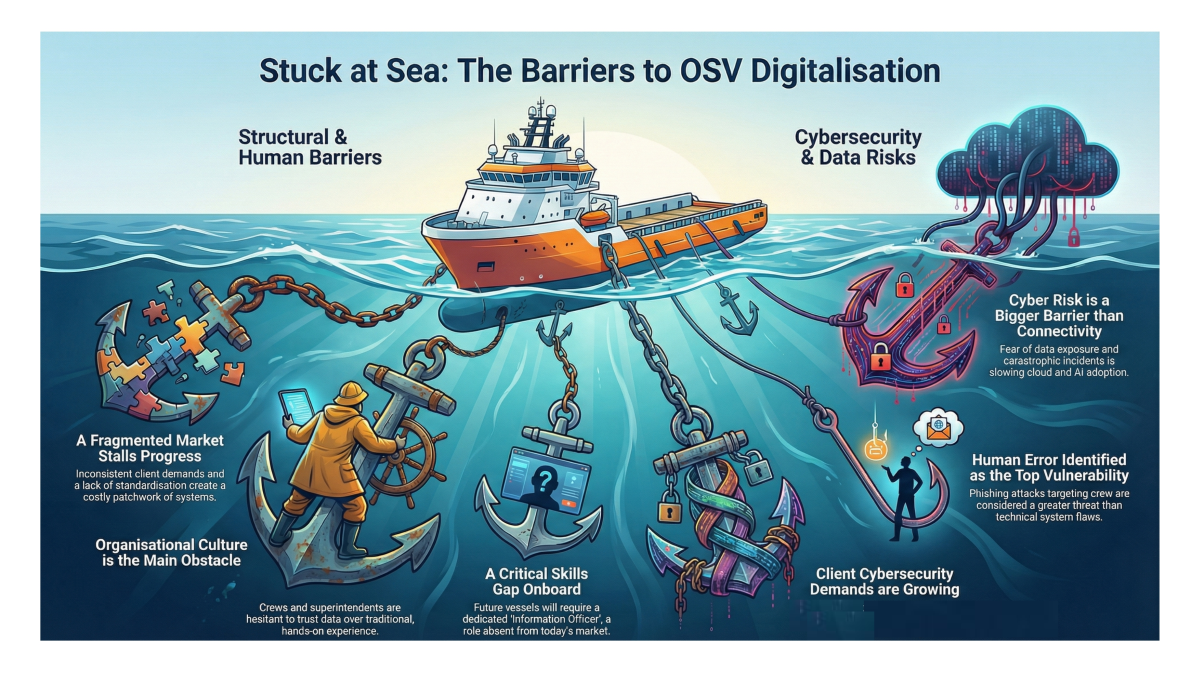
OSV digitalisation stalls amid sector fragmentation, entrenched attitudes
Roundtable discussions revealed the OSV sector is struggling to translate available technology into operational gains, with cyber risk and talent gaps seen as critical barriers


Senior figures from across the offshore vessel sector have expressed concern that the industry remains trapped in ‘baby steps’ on digitalisation despite widespread availability of proven technology, with organisational culture and market fragmentation identified as more significant obstacles than cost or bandwidth constraints.
Speaking at an Inmarsat‑sponsored roundtable, held under the Chatham House Rule during Riviera’s OSJ Conference, Middle East in Dubai, participants from shipmanagement, vessel ownership and offshore contracting agreed the sector is still far from the step‑change in predictive maintenance, fuel optimisation and data integration that other transport industries achieved years ago.
Technical capability outpaces implementation
Attendees said the core challenge is not technological. One participant with extensive experience leading large technical organisations noted that sensors, artificial intelligence tools and monitoring systems are now “fairly cheap,” yet the industry has struggled to move beyond scheduled and preventive maintenance toward genuinely predictive models, despite discussing the need for a decade.
“I don’t think we’ve scratched the surface of AI,” the participant said, adding that while remote monitoring and digital twins are in limited use, no fundamental transformation has occurred. “The main obstacle is that our organisations are not geared for it.”
This view was echoed by a shipmanagement executive who observed that while substantial operational data has been collected over many years, turning it into actionable intelligence remains elusive. “Collecting data for the sake of collecting data doesn’t do anything,” the executive said, highlighting the difficulty of persuading superintendents and vessel crews to trust and act on algorithmic recommendations that contradict traditional practice.
Charterer requirements drive inconsistent investment
Operators reported that environmental and emissions reporting requirements embedded in tender documents by major energy companies are accelerating investment in fuel monitoring systems and digital compliance platforms. One offshore services provider explained that what was once a charterer-driven demand has now become standard practice, with vessels routinely fitted with telemetry for real-time fuel and performance data.
Multiple participants stressed that charterer requirements remain highly inconsistent. “Total have a different ESG reporting system to Eni. BP has a different one again. Exxon has a different one again,” said one attendee, describing the administrative burden and cost of maintaining compliance across multiple bespoke frameworks. The lack of standardisation extends to approved equipment lists, with some operators finding that installing a particular monitoring system on one vessel renders it incompatible with certain clients’ preferred platforms.
This fragmentation was identified as a structural barrier to digitalisation at scale. While consolidation among technology suppliers may eventually ease integration challenges, the current landscape forces even well-resourced operators to manage a patchwork of incompatible systems.
Cyber-security concerns constrain cloud adoption
Cyber security emerged as a dominant theme. When asked whether bandwidth constraints still limit cloud application deployment, most participants indicated that connectivity is no longer the primary bottleneck; it is cyber risk.
Several operators cited reluctance to adopt cloud-based platforms due to concerns over data exposure, with one noting that IT teams’ caution around AI integration stems directly from the potential for catastrophic cyber incidents.
A poll of attendees revealed that none had experienced a cyber incident requiring vessel system shutdown in the past year, though several acknowledged involvement in phishing attack simulations where personnel had been compromised. Participants unanimously identified human error, particularly phishing attempts targeting crew, as a greater vulnerability than technical system gaps.
One source described a large-scale GPS spoofing incident in the Gulf earlier this year that left multiple vessels with falsified positioning data, causing operational chaos and forcing clients to suspend activities even where crews were fully prepared to operate manually. “None of the clients want to take a risk in such situations,” the executive said, underlining the commercial consequences of degraded digital systems.
New OSV contracts are increasingly embedding mandatory, auditable cyber-security requirements that exceed basic IMO compliance, with some Middle Eastern clients imposing complex security frameworks that require operators to rewrite procedures on a client-by-client basis
Crew capability and the information officer gap
The human dimension of digitalisation received sustained attention. Participants noted that the role of the electro-technical officer is shifting rapidly from electrical maintenance to data systems management, raising questions about training, competency and remuneration structures.
For advanced vessel types, including newbuild walk-to-work units under construction, operators acknowledged that a single electro-technical officer will be insufficient. One source suggested that future crew complements may require a dedicated information officer to manage cyber security, data flows and system integration, a skill set currently absent from the maritime labour market.
Investment priorities: safety over maintenance
Looking ahead to 2026, attendees identified predictive maintenance and fuel monitoring as critical digitalisation gaps but indicated that investment is flowing more readily into safety-related applications. AI-driven tools for generating multilingual training content, automating safety observation reporting and detecting unsafe acts via CCTV were cited as delivering immediate, measurable returns with lower client resistance than technical systems.
One source with shipmanagement responsibilities said the technology exists to support condition-based and predictive maintenance, but persuading vessel owners to invest in third-party managed tonnage remains a recurring challenge. “We need to convince the owners to invest in it,” the source said.
Market structure limits progress
Several participants argued that the industry’s fundamental fragmentation inhibits the kind of data sharing and standardisation that enabled digitalisation in the aviation and automotive sectors. With global ship ownership averaging fewer than three vessels per owner, the commercial incentive and organisational capacity for large-scale digital transformation is limited.
One attendee suggested that only binding international regulation could enforce the standardisation and data collaboration necessary to replicate other industries’ progress. “There’s no global market,” the source said, noting divergent trajectories in southeast Asia, the Middle East, Africa, Northern Europe and North America.
Another called for operators to share more real-time operational data, including vessel availability and maintenance status, to improve sectorwide safety and efficiency, drawing parallels with airline industry practices.
Talent and mindset
The discussion concluded with recognition that attracting digital talent into maritime remains a challenge. One participant questioned whether the industry actively seeks such expertise or whether technology professionals simply find shipping unattractive compared with major technology firms.
“Is this because our industry is not looking for that talent or is that talent not interested to work in our industry?” the delegate asked, suggesting talent acquisition may prove as critical as technology selection in determining whether the OSV sector can close its digitalisation gap in the years ahead.
Riviera’s Annual Offshore Support Journal Conference, Awards & Exhibition 2026 will be held in London on 3-4 February 2026. Use this link for more information and to register for the event.

Related to this Story



Events

Maritime Regulations Webinar Week
 16 Dec 2025
 GMT - ONLINE
Floating energy: successfully unlocking stranded gas using FLNGs and FSRUs
24 Feb 2026GMT - ONLINE
© 2026 Riviera Maritime Media Ltd.


