


Business Sectors
Events
Contents

More efficient, less carbon-intensive FPSOs drive Brazil’s oil production ambitions
Seatrium has delivered the 37th FPSO project for Petrobras, with the first of six P-Series units to use carbon capture, utilisation and storage technology


When it comes to floating production, storage and offloading (FPSO) technology, there is no place like Brazil. The South American country is the world’s largest FPSO market, with nearly 50 units in operation in its pre-salt deepwater Campos and Santos basins.
Increased production from existing units and the deployment of new FPSOs allowed Brazilian oil major Petrobras to achieve record oil and gas production results in 2025, reaching 2.99M barrels of oil equivalent per day (boed), an 11% year-on-year increase.
And new, more efficient, larger capacity units like P-78 are expected to propel the South American country’s ambitions to be among the top five oil producers within four years, while lowering the carbon-intensity per barrel.
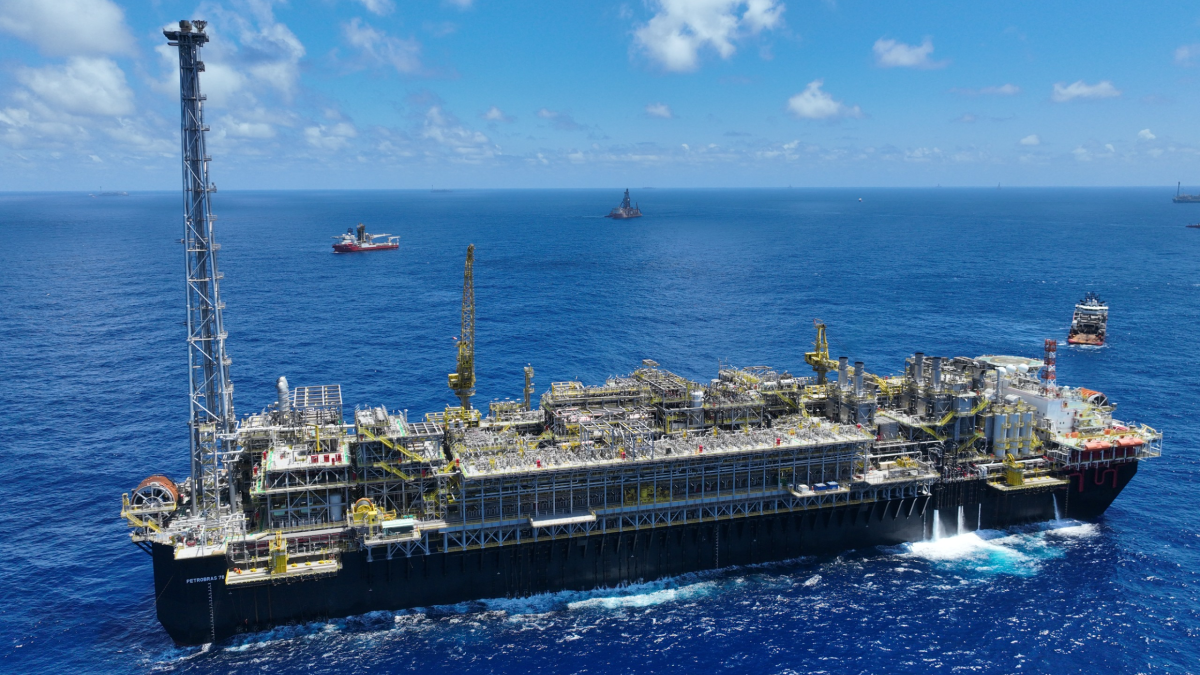
P-78 is the first of six P-Series FPSOs built by Singapore’s Seatrium, a long-time partner of Petrobras. Permanently moored in 2,100 m of water in the Búzios field in Santos Basin about 200 km off the coast of Rio de Janeiro, P-78 is one of the largest FPSOs in Brazil. It is designed to produce as much as 180,000 bbl of oil per day (bopd) and 7.2M cubic metres of gas per day, and store up to 2M bbl of oil.
Seatrium has a long legacy of building and converting FPSOs for Petrobras. P-78 is the 37th such project. Built to ABS class, 335-m-long it is the first FPSO to use Seatrium’s ‘One Seatrium Global Delivery Model’, tapping the marine engineering group’s resources in Brazil, China and Singapore. The vessel was able to achieve first oil in the Búzios field on 31 December 2026, marking an expansion of Seatrium’s engineering, procurement, construction and commissioning (EPCC) approach to FPSOs. The FPSO arrived at the Búzios field with all major marine and production systems fully operational, enabling rapid offshore start-up and ‘first oil’ readiness.
“Innovative sustainability features to support Petrobras’s decarbonisation journey”
Seatrium Energy (Americas) executive vice president, Marlin Khiew, said the lessons learned from P-78 would be used in completing the five remaining P-Series FPSOs, “each showcasing innovative sustainability features to support Petrobras’s decarbonisation journey.”
The six P-Series FPSOs (P-78, P-80, P-82, P-83, P-84 and P-85) will use carbon capture, utilisation and storage (CCUS) technology to mitigate CO2 emissions. The CCUS will allow the reinjection of CO2 into the reservoir for safe storage, minimising the need for gas flaring. The vessels will also feature energy recovery systems for thermal energy, waste heat and gas, as well as seawater deaeration to lower fuel consumption and carbon emissions.
Instead of gas turbines, the last two in the series, P-84 and P-85, will use electric drives for all major machinery, significantly lowering CO2 and greenhouse gas emissions.
When commissioned in 2029 and 2030, the all-electric vessels are estimated to produce oil and gas with 30% less GHG emissions, placing them among the most efficient FPSOs to come into operation in Brazil.
The FPSO P-84 at Atapu and P-85 at Sépia will each have a daily production capacity of 225,000 bopd and capacity to process 10M cubic metres of gas per day.
In 2024, Seatrium reported the value of the contracts to build the units totalled about US$8.1Bn.
Latin America’s largest oil producer and ninth biggest in the world, Brazil plans to increase its oil production to 5.4M barrels of oil per day (bopd) by 2029, making it the world’s fourth largest, while achieving a goal of net-zero emissions from operations by 2050.
Related to this Story

Events

Maritime Regulations Webinar Week
 16 Dec 2025
 GMT - ONLINE
Floating energy: successfully unlocking stranded gas using FLNGs and FSRUs
24 Feb 2026GMT - ONLINE
© 2024 Riviera Maritime Media Ltd.


