


Business Sectors
Business Sectors
Events
Contents


OSV newbuilds required, but who will finance them?
Newbuild offshore support vessels (OSVs) will be required to ensure there is sufficient available capacity for energy companies to fulfil their hydrocarbon and renewables developments


Global OSV markets have swung in owners’ favour with rising utilisation and charter rates but a shortage of available vessels, delegates heard at Riviera Maritime Media’s Annual Offshore Support Journal Conference, in London, UK, 7 February.
Vessels are ageing due to a lack of newbuild deliveries in the past 10 years, and more than 50% of platform supply vessels (PSVs) and anchor handlers will be over 15 years old within the next two years.
This should encourage owners to consider expanding or modernising their fleets with newbuildings, but inflation means vessels cost 50% more to build than 10 years ago, there are a lack of shipyard slots and available finance.
During a panel debate at the conference, DOF board member Harry Knox said those willing to provide finance and capital would require vessels built ready to service both offshore oil and renewables sectors with emissions-reduction technology on board.
“Owners should look at how to finance new energy support vessels and not just OSVs,” he commented. “Those that just focus on oil and gas will struggle. Those focused on renewables will get more finance and more opportunities for their business model.”
But vessels are needed to support oil and gas developments and maintenance requirements. “There is high demand and lack of supply, it is a tight market with not enough ships,” said Mr Knox. “Something needs to change. But the financing landscape has changed dramatically and it is a struggle to get finance.”
Arctic Securities head of shipping and offshore corporate finance Truls Wiel said owners purely focused on renewables could also struggle as they may not have sufficient cash flow or long-term contracts. He said there are alternatives to bank finance, such as alternative or debt capital markets and private equity providers, especially for companies looking to recapitalise existing debt.
“Owners should look at how to finance new energy support vessels"
Oaktree Capital Management’s European principal group vice president Fredrik Ulstein said alternative lenders are ready to provide finance for the right deal. He said Oaktree supports owners with fleets of 3-10 vessels in acquisitions to expand fleets, and converting debt to equity. “This is a reliable alternative to shipowners, with more favourable terms than available from banks,” he said.
Export Finance Norway Eksfin, head of maritime and shipyards Solveig Frøland said if owners need finance for newbuilds “vessels would need to service a range of offshore needs including oil, gas and renewables” and they would “need cash flow and long-term charters.”
But with the lack of shipyard slots, any OSV ordered in 2024 will not be delivered until 2026 or 2027.
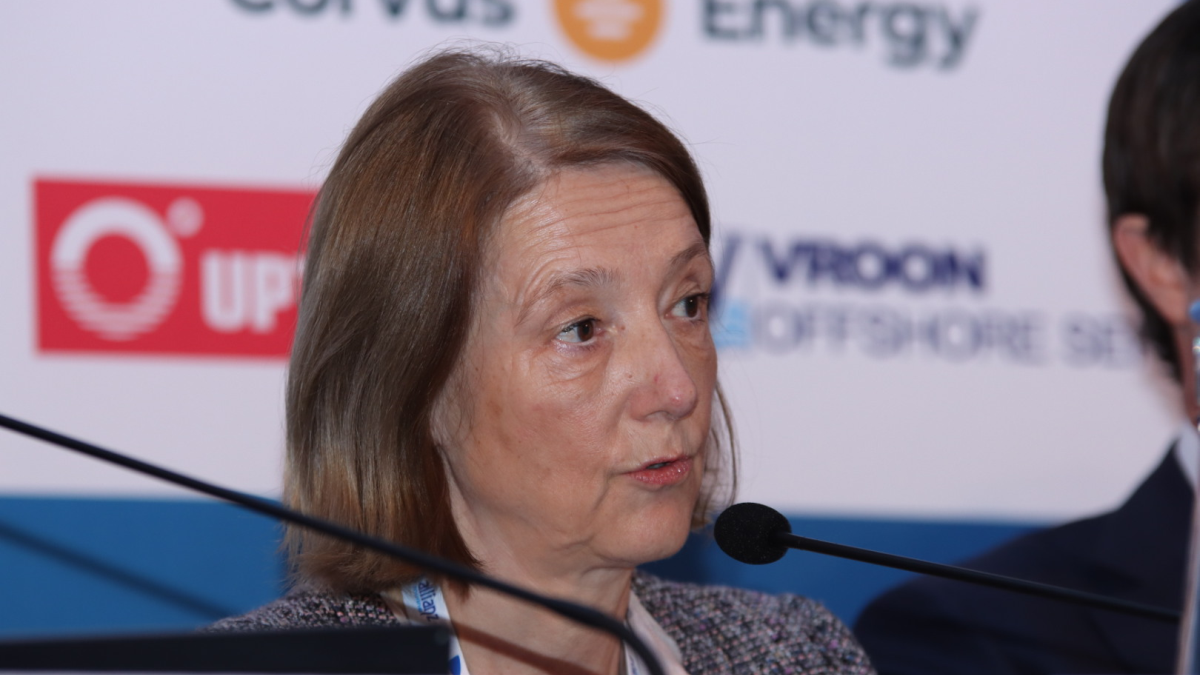
Session two of the conference commenced with ADNOC Logistics & Services senior vice president for offshore logistics Capt Mohamed Al Ali providing a keynote address on how one of the Middle East’s largest integrated shipping and logistics group meets increasing demands from its state-backed energy company owner.
This includes reducing emissions from its own and chartered-in vessels, using digitalisation and optimised fleet management, investing in shore power and onboard batteries and using biodiesel. “By the end of 2024 we will achieve a 30% fuel reduction compared with 2018. We will convert and modify vessels with hybrid propulsion,” he said.
Financial options
His address was followed by a round-up of OSV markets, demand and supply balances and expectations for vessel reactivations, build completions and deliveries.
Braemar managing director and global head of offshore energy services Edward Molyneux said there could be 120 vessels in a premium lay-up, those that are less than 15 years old and well maintained, mostly in west Africa and Americas that could return to the market.
There are also 47 vessels, 14 PSVs and 33 AHTS, that were ordered in the last market boom and are being completed in Chinese shipyards to be delivered in 2024 or 2025. But most are already allocated to owners.
“We will need newbuilds to replace 25-year-old vessels, as they age the maintenance increases, fuel efficiencies decrease and equipment needs to be replaced,” said Mr Molyneux.
Fearnley Offshore Supply analyst Jesper Skjong said owners would be most interested in ordering large PSVs for operations in the North Sea and deepwater regions, or construction support vessels, which are earning premium rates and are in high demand.
“Who will build them?” he asks. “Owners need market capital and good relations with financiers; only a few could do so. Even established players cannot order vessels without long-term charters and rising debt.”
Riviera Maritime Media’s OSJ Conference, Americas, part of the annual global OSJ Conference series, returns to Houston in June 2024. This two-day event will bring together the OSV Community to explore emerging opportunities in the resurgent regional offshore energy sector, including traditional oil, gas, and wind.





Related to this Story

Events

Maritime Regulations Webinar Week
 16 Dec 2025
 GMT - ONLINE

Floating energy: successfully unlocking stranded gas using FLNGs and FSRUs
24 Feb 2026GMT - ONLINE
© 2026 Riviera Maritime Media Ltd.


