


Business Sectors
Business Sectors
Events
Contents

OSV operators’ triple threat: GPS jamming, cyber gaps and crew skills crisis
GPS jamming, cyber vulnerabilities and thinning seamanship are quietly rewriting the risk calculus for offshore support vessels, an Inmarsat-sponsored roundtable (held under the Chatham House Rule) heard at Riviera’s Annual OSJ Conference in London


In some regions, signal interference has become so commonplace that isolated incidents scarcely merit a log entry, delegates reported. Cyber-security checks remain inconsistent, often postponed until charterers or regulators insist. And a new generation of dynamic-positioning officers, trained amid automation, can find itself exposed when the electronics falter, and old-fashioned shiphandling is suddenly back in charge.
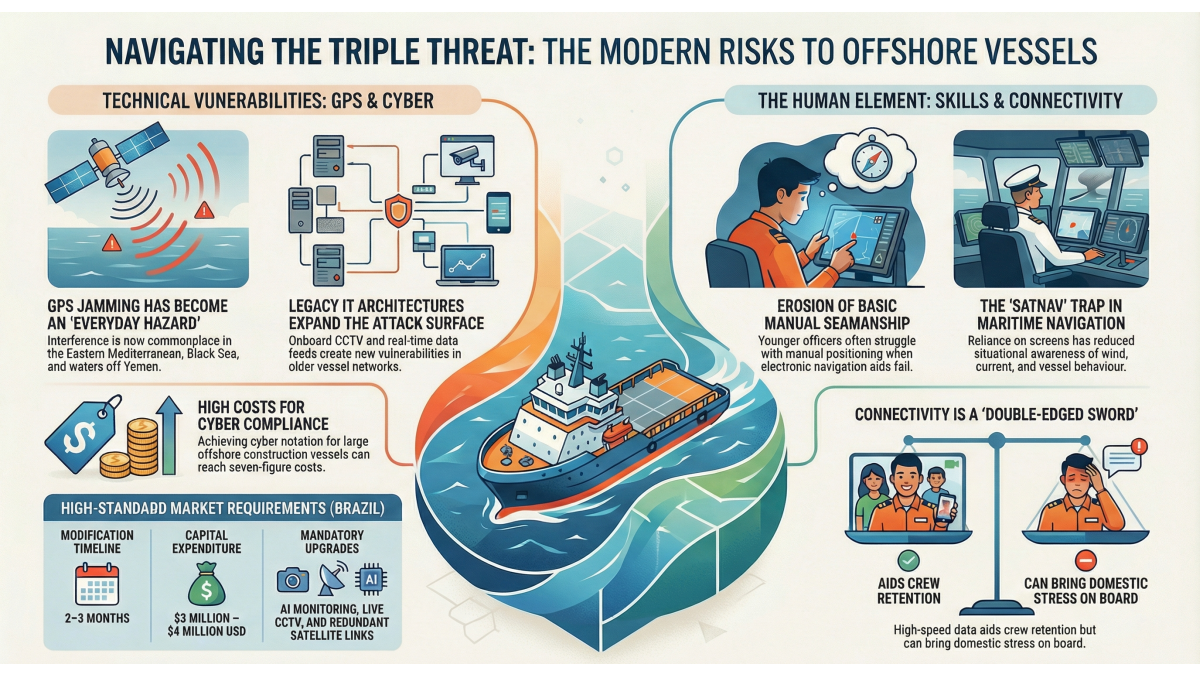
GPS jamming is now just Tuesday
A show-of-hands survey split the room roughly three ways: some vessel operators reported multiple GPS jamming or spoofing incidents requiring backup positioning systems; others had seen isolated events; and a third group reported no confirmed interference, though several noted they do not operate in the affected regions.
The Eastern Mediterranean, Black Sea and waters off Yemen came up repeatedly. Electronic warfare has moved from an edge case to an everyday hazard in those areas. Vessels in DP mode during drilling or construction support must transition to alternative reference systems without losing station. That means terrestrial sources or rig-mounted transponders, and it means co-ordination with clients to make sure backup infrastructure actually works when needed.
One participant described receiving a call from insurers insisting a vessel was in Yemeni territorial waters, travelling at 50 knots. It wasn’t. GPS spoofing had corrupted the position data being transmitted ashore, triggering alarms and confusion until the crew confirmed their actual location.
The technical fix is relatively straightforward, but the human element is harder. Industry sources at the meeting suggested that younger DP operators often lack the manual positioning skills that were standard among earlier generations. Several attendees pressed the point that crews must understand vessel behaviour and spatial awareness. A vessel is not a dot on a chart. It occupies a physical domain that changes with wind, current and thruster response.
Simulator training helps, but it is not enough. Real-world drills using visual and radar references were described as essential to maintaining operational resilience, yet they are not always prioritised. The competency gap is widening, not closing.
Cyber assessments are patchy at best
When asked whether they had conducted third-party cyber vulnerability assessments of DP systems within the past year, responses were mixed. A minority confirmed recent assessments; others were planning reviews or relying on original equipment manufacturer security certifications; and a notable proportion had done nothing, in part because class societies and charterers have not yet made assessments mandatory.
Cyber notation for newbuilds is now required by several classification societies, and indicative compliance costs for larger offshore construction and accommodation vessels run into seven figures. For existing tonnage, the picture is more fragmented. Vessel owners and operators are weighing the cost and complexity of retrofitting older vessels against the evolving expectations of charterers, particularly in markets where clients are starting to specify cyber resilience as a contractual precondition.
The most common attack vectors are vessel-network intrusions through crew connectivity, supplier remote access and satellite-communication compromise. Network segmentation alone does not adequately address these threats. The proliferation of onboard systems, such as CCTV, environmental monitoring and real-time client data feeds, has expanded the attack surface considerably. Many vessels still operate with legacy IT architectures that were never designed with cyber security in mind.
Geopolitical disruption tests decision-making under pressure
The discussion touched on recent political transitions in Venezuela and what it means to operate in jurisdictions subject to a sudden regime change or international sanctions. No vessel operators reported significant connectivity or operational disruption during the January transition, but the broader point landed. The offshore sector increasingly operates in regions where geopolitical volatility is normal.
Resilience in such environments depends less on accumulating more data streams and more on empowering onboard leadership to make rapid decisions with the information available. Shore-based teams must trust masters and senior officers to assess conditions locally and act without waiting for remote approval.
Social media blackouts and communications restrictions during political crises complicate crew welfare management, particularly when families ashore are anxious for contact. Vessel operators described balancing operational security with crew expectations of regular contact with home. The advice given to seafarers was pragmatic. Maintain communication with family where possible, but avoid any public commentary or social media activity that could draw unwanted attention to the vessel.
Brazil sets the bar for costly compliance
The Brazilian offshore market provided a case study in escalating technology costs. Operators serving major charterers in that jurisdiction reported modification timelines of two to three months per vessel and capital expenditures in the range of US$3M to US$4M. Upgrades include extensive CCTV coverage with live streaming to shore-based operations centres, artificial intelligence-enabled monitoring, client-specific interface requirements and redundant satellite connectivity.
These specifications are non-negotiable. Vessels that cannot meet the technical and compliance standards are simply not licensed to trade. Modifications are generally treated as part of the competitive day rate rather than separately compensated, so the financial burden falls squarely on owners and operators. Some of the investment is reversible between contracts, but much of it becomes a permanent feature of the vessel.
Operating costs add up quickly. Participants described maintaining multiple satellite links solely to provide backup internet access for client representatives, even when those links see little active use. The volume of data transmitted from accommodation vessels has made connectivity a substantial line item in vessel operating expenses. Real-time video, environmental sensors, client telemetry. It all adds up.
Connectivity cuts both ways
Improved onboard connectivity is both a critical retention tool and a source of new operational and welfare challenges. Unlimited or near-unlimited data packages have become standard across much of the OSV fleet, driven by crew expectations and competitive pressure. Several operators reported that seafarers now routinely consume terabytes of data per month, much of it for personal streaming and social media.
Enhanced connectivity supports morale and helps operators attract and retain personnel. But it also introduces complications. Constant contact with family ashore can bring domestic problems onto the vessel, affecting crew focus and well-being. Connectivity is essential, but it is no substitute for effective onboard leadership, peer support and a culture that encourages resilience and situational awareness.
Retention strategies discussed at the meeting centred less on technology and more on fundamentals. Timely pay; predictable rotation schedules; open communication between ship and shore; and visible senior management engagement. One operator reported retaining crew for three years or more by maintaining direct, personal lines of communication and ensuring that sign-on and sign-off dates are never delayed. Technology can support retention, but it cannot replace trust, respect and operational reliability.
The erosion of basic seamanship
Concern over the erosion of manual ship-handling and navigational skills came up repeatedly. Multiple participants observed that cadets and junior officers often arrive on board with a limited practical understanding of vessel dynamics, spatial judgement or situational awareness beyond what is displayed on electronic chart systems.
The challenge was framed not as a failure of formal training institutions, but as a mismatch between classroom-based STCW curricula and the demands of real-world operations. Several attendees emphasised the need for vessels to function as training platforms, with experienced officers actively mentoring younger crew and reinforcing the importance of looking outside the bridge windows rather than solely at screens.
The problem extends beyond offshore. Deepsea operators report similar difficulties. The reliance on automated systems has created a generation of mariners who do not know how to move the vessel when electronic aids fail. Resilience means not only having backup systems but ensuring that the crew can operate effectively when those systems are unavailable.
One participant drew a parallel with driver navigation. People type in the destination and start driving without knowing where they’re going. The GPS tells them when to turn. If it fails, they are lost.
Contract structures haven’t caught up
Rising technology costs are colliding with static contract mechanisms. OSV day rates were historically set on the assumption that capital equipment had a service life of 15 to 20 years. Technology refresh cycles have compressed to five years or less, yet few charterers are willing to share the cost burden through surcharges, performance bonuses or data-sharing arrangements.
When asked about contract structure preferences, most participants indicated they would accept whatever the market demands. There is limited negotiating leverage in a buyer-driven environment. Some vessel operators have succeeded in recovering connectivity costs when charterers require dedicated data transmission, but such arrangements remain the exception.
What comes next
Participants identified resilience as the defining priority, both technical and human. The industry has layered complexity upon complexity without always ensuring that seafarers, shore staff and systems can function effectively under stress. The path forward lies in simplification where possible, rigorous training that emphasises judgement and manual skills, and a cultural shift that recognises technology as an aid rather than a substitute for competence.
Regulatory pressure will drive necessary investment. Mandatory cyber notations and evolving charterer expectations are already pushing change. But several participants warned that without parallel attention to crew development, operational discipline and cross-industry knowledge sharing, the offshore sector risks building sophisticated systems that cannot be operated safely when conditions deviate from the norm.
Ultimately, participants agreed, when the electronics fail, someone still has to know how to move the vessel.
Riviera’s Offshore Support Journal Conference, Brazil, will be held in Rio de Janeiro on 13-14 October 2026. Use this link for more information and to register for the event.

Related to this Story




Events

Maritime Regulations Webinar Week
 16 Dec 2025
 GMT - ONLINE
Floating energy: successfully unlocking stranded gas using FLNGs and FSRUs
24 Feb 2026GMT - ONLINE
© 2026 Riviera Maritime Media Ltd.


