


Business Sectors
Business Sectors
Events
Contents

Register to read more articles.

Panama reaches mid-point in its hybrid-electric newbuild tug campaign
Panama Canal Authority has seen the first 10 battery-hybrid tractor tugs built in Spain start handling ships through the locks of the waterway between the Caribbean and the Pacific


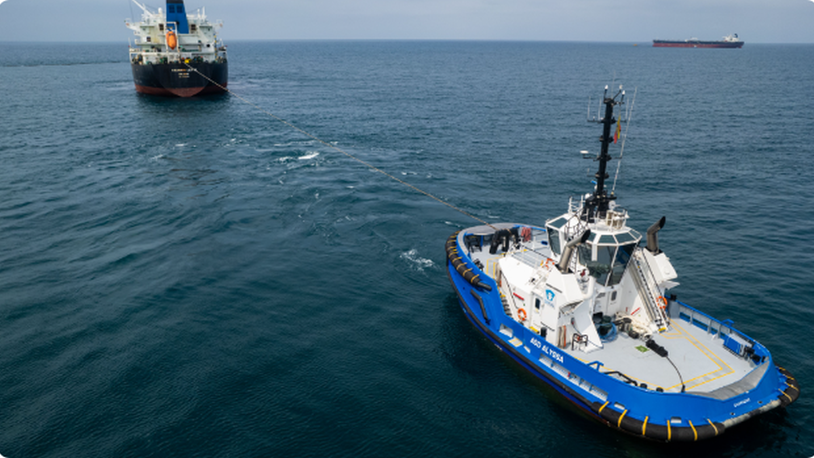
Armon Shipyards has completed the first 10 newbuild harbour tugboats that the Panama Canal Authority (ACP) ordered in 2023 to support ships through the locks of the busy maritime throughfare between the Caribbean and the Pacific Ocean.
Delivery of 489-gt Isla Otoque, the 10th of these vessels, means the authority is halfway through its fleet renewal and expansion drive as it exercised an option, in 2026, for 10 more of these tugboats from Armon’s Navia shipyard in Spain.
According to automatic identification system (AIS) data, Isla Otoque was delivered in October and had reached Panama by the beginning of November, following a transatlantic crossing.
In 2026, Armon completed five of these tugboats: Isla Coiba in February; Isla Farallon in April; Isla Galeta in June; Isla Jicaron in August; followed by Isla Otoque in October.
Sister tugs Isla Barro Colorado, Isla Bastimentos, Isla Bona, Isla Canas, and Isla Cebaco were delivered sequentially between April and December 2025.
All of these ABS-class tractor tugs have hybrid-electric propulsion with Corvus energy storage systems (ESS’s) reducing the amount of CO2 emitted during vessel transits and mobilisations, while increasing the available power for ship handling and towage.
This US$300M construction campaign is propelling the ACP to the top in terms of global operators of battery-electric tugboats; it is also making Armon one of the biggest builders of them.
With an overall length of almost 29 m, a beam of 14 m, and maximum draught of just over 6 m, each of these tugs is equipped with two Wabtec 8L250 MDA four-stroke marine diesel engines, each delivering 2,331-kW, a 445-kW Corvus Orca ESS with nickel-manganese-cobalt batteries and two azimuth thrusters and each tug generates 80 tonnes of bollard pull and a top speed of 12.5 knots.
Wabtec’s Latin American channel partner Marinsa International is supporting the installation and commissioning of the engines in Spain, along with the service support of the operating fleet in Panama.
Combining conventional diesel engines with batteries yields several advantages from both an environmental perspective and an operational standpoint.
The batteries level out heavy transient loads on the primary Wabtec diesel engines and deliver additional energy when a tug needs immediate maximum power, preventing engine strain and maintaining fuel-burn efficiency.
At low speeds or when idling, the Orca ESS provides the power to the thrusters and internal systems, minimising noise and vibration and cutting fuel usage and greenhouse gas emissions by 30% to 60%.
The ESS acts as an integrated, fail-safe emergency backup power supply, stepping in when there is engine failure to maintain steering and propulsion control.
Using energy storage for low- and zero-emissions operation means less wear and fewer operating hours on the engines, extending component life and time between overhauls.The ACP estimates that engine wear is reduced by 50%,
The tugs are enhancing the canal’s operational efficiency as they can work reliably for up to 700 hours per month, which the authority said is beyond that typically seen with conventional harbour tugs. ACP’s tugs also have a FiFi1 system for fighting fires and enhanced accommodation for crew.
Connect with the international tug community at TUGTECHNOLOGY ‘27, the industry’s premier technical gathering, taking place in Rotterdam, the Netherlands, on 19-20 May 2027. Join tug owners, operators, builders, designers and technology providers for two days of industry insight, knowledge sharing and valuable networking. Find out more here.





Related to this Story


Events

Maritime Regulations Webinar Week
 16 Dec 2025
 GMT - ONLINE

Floating energy: successfully unlocking stranded gas using FLNGs and FSRUs
24 Feb 2026GMT - ONLINE
© 2026 Riviera Maritime Media Ltd.


