


Business Sectors
Business Sectors
Events
Contents

Rigs report: Exxon takes US$12.7Bn FID on fifth Guyana project; Valaris reveals new deals
ExxonMobil has green-lit an oil development project in Guyana’s offshore Starbroek block following government approval and another discovery at the Lancetfish-1 well, while Valaris has reported new contracts and extensions for its jack-ups and floaters


As ExxonMobil’s project partner in the Starbroek developments, Hess Corp hinted in announcing the new oil discovery last week, project operator ExxonMobil has now received Guyanese government approvals for the Uaru project.
Production is slated to begin in 2026, with a production capacity of approximately 250,000 gross barrels of oil per day, and ExxonMobil’s final investment decision has unlocked nearly US$13Bn in earmarked investments.
Uauru will be the fifth of the Starbroek developments, with the currently sanctioned projects reportedly bearing some 11Bn barrels of oil.
The US$12.7Bn Uaru project plans to include up to 10 drill centres and 44 production and injection wells aimed at developing an estimated resource of more than 800M barrels of oil, according to ExxonMobil.
“Our fifth, multi-billion-dollar investment in Guyana exemplifies ExxonMobil’s long-term commitment to the country’s sustained economic growth,” said ExxonMobil Upstream Co president Liam Mallon.
The company said it aims to have six FPSOs online by the end of 2027, which would bring Guyana’s production capacity to more than 1.2M barrels of oil per day.
ExxonMobil has also struck a 10-year operations and maintenance (O&M) agreement with Dutch FPSO specialist SBM Offshore that covers O&M for four rigs: Liza Destiny, Liza Unity, Prosperity and One Guyana.
According to SBM, which said the contracts added some US$3Bn to its revenue backlog, the first two FPSOs listed are in production, Prosperity is expected to come online in late 2023 and the company said FPSO One Guyana’s topsides fabrication is progressing as planned, with first oil expected at the end of 2025.
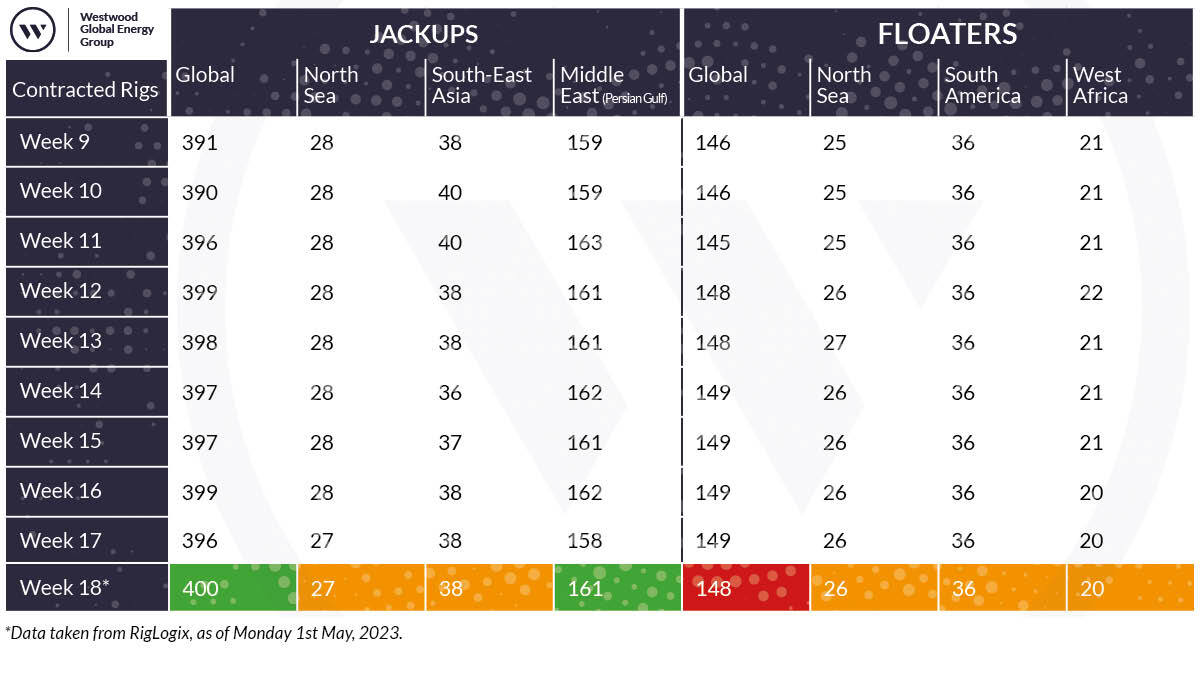
In contracts news, Valaris has published its updated fleet status report, detailing new contract wins for its jack-up and floating rig units.
The New York Stock Exchange-listed offshore drilling company said it has signed a three-year contract with state oil major Petrobras in Brazil for Drillship DS-8. The floater is being reactivated for the approximately US$500M contract, which includes US$30M in mobilisation costs. And TotalEnergies has exercised an option to extend the contract for drillship Valaris DS-15 through Q2 2024 for approximately 100 days at a day rate of US$254,000, also for work in Brazil.
In West Africa, a TotalEnergies subsidiary contracted the Valaris DS-12 drillship for 100 days from Q2 2023.
Valaris has also won a two-year contract extension starting Q1 2024 with Harbour Energy in the UK North Sea for its jack-up Valaris 92 at a day rate of US$95,000, continuing its existing contract.
Heavy-duty modern jack-up Valaris 107 has won a US$26M, 70-day contract with Beach Energy offshore New Zealand with the contract to commence Q3 2023.
And heavy-duty ultra-harsh environment jack-up Valaris Norway has a one-well contract with NEO Energy in the UK North Sea set to begin in July 2023 with an estimated duration of 20 days at a day rate of US$105,000.
Valaris also confirmed it has completed the sale of its 40-year-old jack-up Valaris 54 for US$28.5M.
Valaris said its 50/50 joint venture with Saudi Aramco, ARO Drilling, has appointed as its chief executive former TBT Diagnostics chief executive and SLB executive Mohamed Hegazi. Mr Hegazi replaces Derek Kent as ARO chief executive, who will be retiring following a handover period, the company said.
According to reports, offshore drilling contractor Transocean has landed a contract for its Transocean Barents drilling rig that TotalEnergies will use for an exploration well in Block 9 offshore Lebanon. The French oil major is operating the block in partnership with Italian major Eni and QatarEnergy. The rig is due to start as soon as possible in 2023.
Releasing its Q1 earnings statement this week, Transocean was upbeat, saying new contracts announced during the quarter offered evidence of a "broad, sustained upcycle".
Transocean chief executive Jeremy Thigpen said the company’s “strong performance is the result of excellent revenue efficiency of nearly 98% and exemplifies our commitment to operational excellence”.
“Additionally, the contracts we secured during the quarter, which were predominantly for our harsh environment fleet, complement the wave of ultra-deepwater fixtures we announced over the last several quarters, providing further evidence of a broad, sustained upcycle,” Mr Thigpen said.
In mid-April, Transocean announced major deals for four of its harsh environment jack-up rigs. Transocean Enabler was awarded a 19-well contract in Norway at a day rate of US$377,000 with options for eight wells. Transocean Encourage inked a nine-well contract in Norway at US$350,000 per day. Wintershall Dea exercised four one-well options in Norway for Transocean Norge. Day rates stand at US$338,000 per day, US$358,000, $358,000 and US$408,000 respectively. And Transocean Endurance secured a multi-well plug and abandonment contract in Australia at a rate of US$380,000 per day plus options. As of 18 April 2023, the drilling contractor’s total backlog stood at approximately US$8.6Bn.
Shelf Drilling has secured a contract for the Shelf Drilling Barsk jack-up rig with Equinor for operations at the Sleipner Vest field located in the Norwegian Continental Shelf. The firm term of the contract is two wells for approximately 270 days of work, in total. The contract value for the firm period excluding certain integrated services is approximately US$61M. The contract also includes options for two additional wells, and the planned start-up of operations is between May and July 2024, the company said.
Also offshore Norway, Norwegian safety regulator Petroleum Safety Authority Norway granted Equinor clearance to use Odfjell Drilling’s semi-submersible rig Deepsea Stavanger for drilling activities in the Norwegian Sea. The licence in the drilling block runs thorugh February 2027.
And, finally, Neptune Energy, Vår Energi, Sval Energi and DNO announced production has commenced from the Fenja oil and gas field in the Norwegian Sea. Fenja is expected to produce 35,000 barrels of oil equivalent per day, gross.
Sign up for Riviera’s series of technical and operational webinars and conferences in 2023:
- You can register to attend by visiting our events page.
- Watch recordings from all of our webinars in the webinar library.



Related to this Story
Events

Maritime Regulations Webinar Week
 16 Dec 2025
 GMT - ONLINE
Floating energy: successfully unlocking stranded gas using FLNGs and FSRUs
24 Feb 2026GMT - ONLINE
© 2026 Riviera Maritime Media Ltd.


