


Business Sectors
Business Sectors
Events
Contents

Register to read more articles.
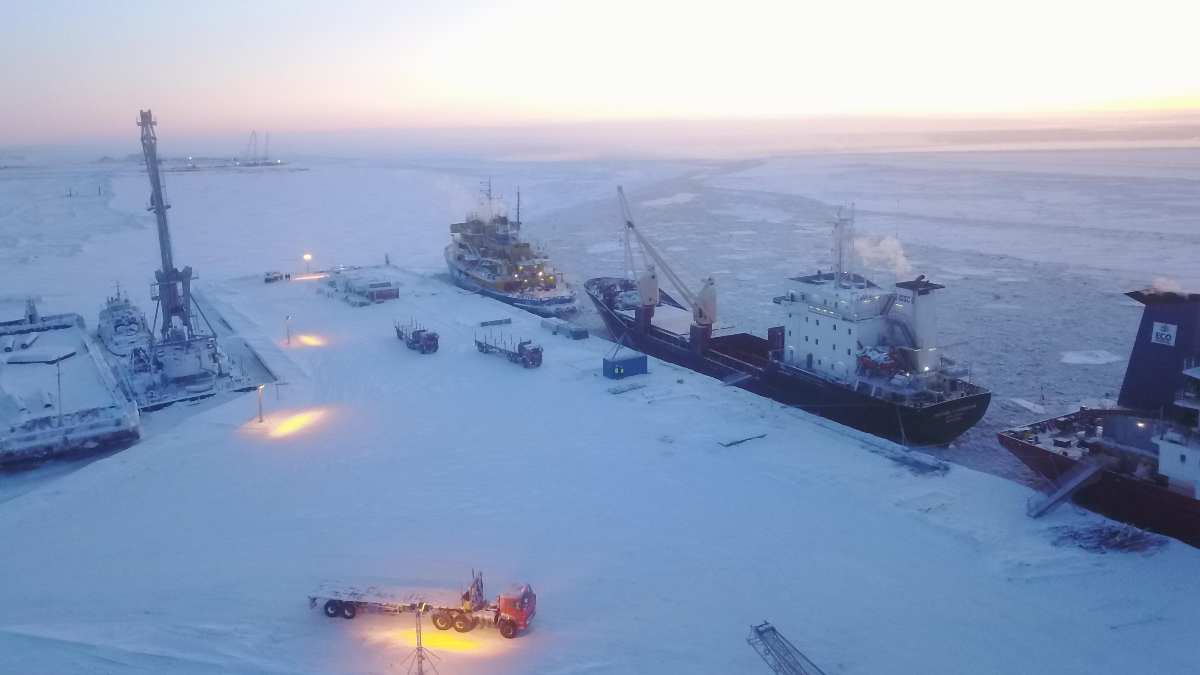
Russia linked to LNG carrier purchases amid rising demand in Europe and Asia
Russian interests are reportedly paying premium prices for secondhand LNG carriers, reflecting the country’s need to secure additional tonnage to meet rising demand in Europe and Asia


Last month, a Greek-owned, 2007-built 155,000-m³ LNG carrier with TFDE technology was reportedly sold for around US$80M – significantly above typical valuations for vessels of this size and specification.
Drewry Maritime Research lead LNG shipping analyst Pratiksha Negi told Riviera that the premium can be associated with the vessel’s DFDE/TFDE propulsion system. “We don’t expect steam turbine LNG carriers to command such a premium, unless they are acquired for conversion, as several steam carriers are becoming available following the expiry of their charters,” she said.
“However, even for conversions, a high premium is not the norm across all vessels; it applies only to select units, depending on their specifications,” Ms Negi added.
Potential Russian links
Notably, the vessel has already been renamed, now flies the Sierra Leone flag, and is associated with Indian ownership.
This recent sale could potentially be linked to Russian interests, Ms Negi said.
Earlier in January, Russian buyers reportedly acquired four LNG carriers built between 2005 and 2006. The vessels – previously owned by an Omani shipping company and now renamed Orion, Luch, Merkuriy, and Kosmos – have recently been reflagged to Russia.
“While this does not clearly signal the current transaction, it aligns with Russia’s broader strategy to expand exports despite sanctions constraints,” Ms Negi explained.
According to Ms Negi, Russia will require additional LNG carriers to meet growing demand in both Europe and Asia. She noted that China and other countries, including India, are increasing their reliance on Russian LNG amid tight global supply, ongoing tensions in the Middle East, and a slow recovery in exports through the Strait of Hormuz following the fragile ceasefire.
“Additionally, longer voyage routes via the Cape of Good Hope necessitate a larger fleet to sustain exports to Asia,” Ms Negi said.
Russia must also expand its shipping capabilities for both Yamal LNG and Arctic LNG 2 (which has borne the brunt of sanctions since its launch) to maintain robust flows and respond effectively to current market tightness.
She added that the EU may also delay a full ban on Russian LNG imports until late 2027, rather than January 2027.
Ms Negi noted that the EU imported about 15% of its LNG from Russia in 2025.
“At present, the global LNG supply picture has changed significantly amid the ongoing supply shortage from the Middle East,” she said.
She added that a reduction in supply from Qatar and the UAE would be consequential in 2026, with effects likely to extend into the following year.
Some industry figures, including Eni chief executive Claudio Descalzi, have called for suspending the EU’s planned 2027 Russian LNG ban, citing the strain of Middle East tensions on European gas markets.
“It is my personal view that, given current developments, there is a possibility that the bloc’s decision could be deferred to a later date,” Ms Negi added.
In any case, she concluded that an expansion of the Russian fleet – or dark fleet – is likely, fortifying the role of Russian LNG. “In that context, such a surge in secondhand deals with Russian ties would make sense.”
Steam carrier fundamentals
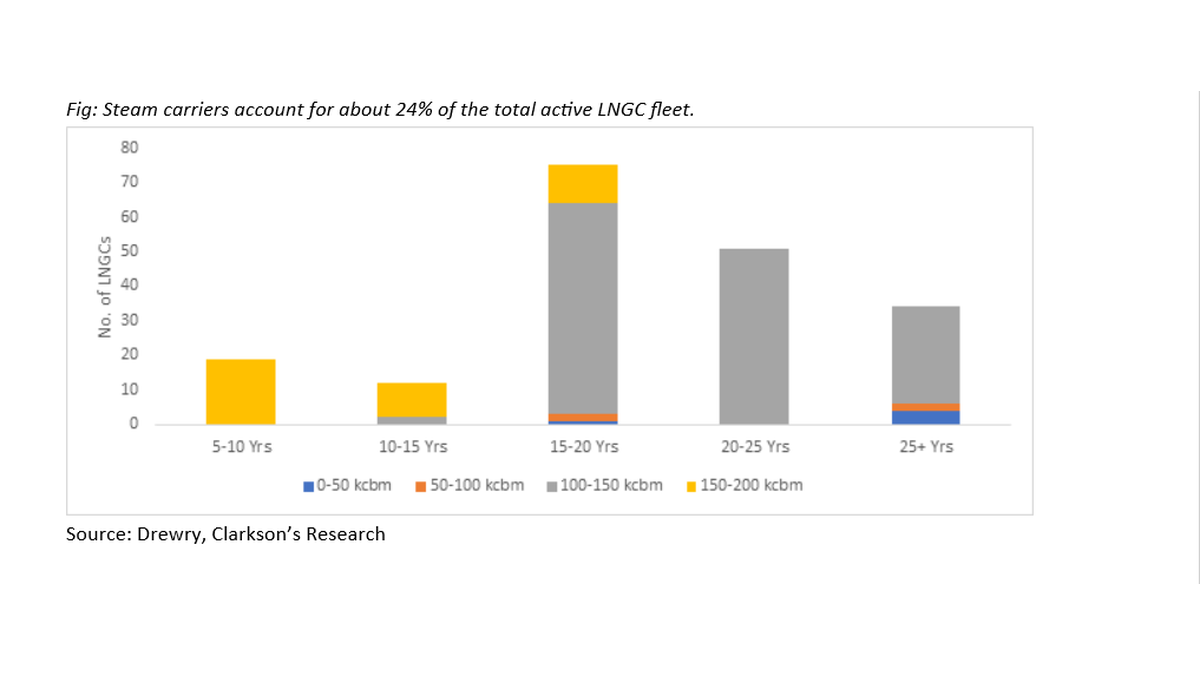
Data from Drewry Maritime Research shows there are 191 active steam LNG carriers globally, accounting for around 24% of the existing fleet.
Of these, approximately 75 vessels fall within the 15-20 year age range, while 51 are between 20 and 25 years old. A further 34 ships are more than 25 years old.
In contrast, 19 vessels are between five and 10 years old, and 12 fall within the 10-15 year bracket.
Riviera’s LNG Shipping & Terminals Conference will be held on 10-11 November 2026. Use this link for more information and to register for the event.




Related to this Story

Events
Maritime Regulations Webinar Week
 16 Dec 2025
 GMT - ONLINE
Floating energy: successfully unlocking stranded gas using FLNGs and FSRUs
24 Feb 2026GMT - ONLINE
© 2026 Riviera Maritime Media Ltd.


