


Business Sectors
Business Sectors
Events
Contents
Register to read more articles.
How a framework for high-definition data sets is set to upgrade safe vessel navigation
The International Hydrographic Organisation’s S-100 framework is transforming maritime navigation as high-definition data sets become available


With the development of the S-100 framework for electronic navigational charts (ENCs) by the International Hydrographic Organisation (IHO), mariners can access dynamic, interoperable data streams.
An expert panel on Riviera’s Beyond compliance: turning S-100 into your navigational advantage webinar agreed S-100 would unlock safer, smarter and more efficient voyages, especially in constricted waterways and ports.
This webinar was held on 24 November 2025 during Riveria’s Maritime Navigation Innovation Webinar Week. On the panel were Sperry Marine technical manager Simon Cooke, Carnival Corp CSMART manager for simulation studies Antonio di Lieto and UK Hydrographic Office head of technical partnerships Thomas Mellor.
With S-100 product specifications such as S-101 for ENCs, S-102 for the bathymetric surface, S-104 covering sea water levels and S-111 for surface currents now live, the maritime industry stands at the threshold of a new era for safe navigation.
Adopting S-100 data effectively can support dynamic under-keel clearance and enable just-in-time (JiT) voyage optimisation.
“This will revolutionise vessel operations and allow things like JiT arrivals”
Mr Mellor said the S-100 framework has a much wider scope than the existing S-57 standard and covers a much greater depth of hydrographic information.
Phase one of IHO’s development involves ensuring S-100 is ready for use in ECDIS on vessel bridges, while the phase two incorporates product specifications to improve voyage planning.
“When we overlay on top of [ENCs] the surface current information, we are starting to build up a very, very a powerful tool for the mariner for navigating his vessel,” said Mr Mellor. “S-102 is a powerful data set that can enhance navigation.”
This high-fidelity data opens new sailing routes for vessels and improves safety margins for port manoeuvres.
When using S-57 data-based ENCs on ECDIS, a mariner may see an area of sea as too dangerous to sail through due to the visualised safety contours.
“[ENC] would show the whole area was dangerous to navigate through, so the vessel would either have had to go round or accept and acknowledge the fact that it looked dangerous,” Mr Mellor explained.
But with S-100 high-definition data, there could be one of two channels accessible for the vessel in the same sea area.
“For a vessel with a draught of 7.5 m, when we have that 7.5 m safety contour in the ECDIS system or pilot portable unit, it makes the navigable channel and a secondary channel both available,” said Mr Mellor.
“So, when you are entering confined waterways and spaces like rivers, having access to high-resolution survey information and S-102 datasets enables you to set much greater fidelity of safety contour.”
Adding dynamic data covering tides (S-104) and surface currents (S-111) will enable voyage optimisation and fuel efficiency. “This will revolutionise vessel operations and allow JiT arrivals,” he added. “Combined together, this is a powerful dynamic mix of data sets.”
S-100 framework is extendable and can be altered to accommodate future navigational technological changes.
S-100’s operational standards have now been approved, paving the way for ECDIS units to begin using them. International trials of S-100 datasets are ongoing, and standards are being refined to address user needs and close integration gaps.
Requirements for IMO type-approved ECDIS performance compliance are expected to come into force after January 2029, when all new ECDIS installations need to meet IMO S-100 performance standards.
Mr Cooke said introducing S-100 standards will help mitigate the problems mariners face in vessel voyages, such as finding workarounds for safety contours that are too conservative and constraining, and alert fatigue from constant navigational alarms.
Where S-102 data is available, the ECDIS will be able to use this detailed, gridded bathymetric data to develop an enhanced safety contour from the additional information “removing the need for mariners to implement those workarounds,” said Mr Cooke.
“Where S-104 data is available, the ECDIS will be able to take this gridded information into account to perform water level adjustments of the seabed depths, so that, for the first time, the ECDIS will no longer be tied to using the chart datum when it presents depths.”
“Mariners will be able to select whether crossing the safety contour is going to raise an alarm or not,” said Mr Cooke. “It is about giving the mariner a lot more control than they had in the past. We are also going to give mariners a better awareness of the dangers by automatically highlighting dangers along the current route and next legs as a minimum.”
Training simulators
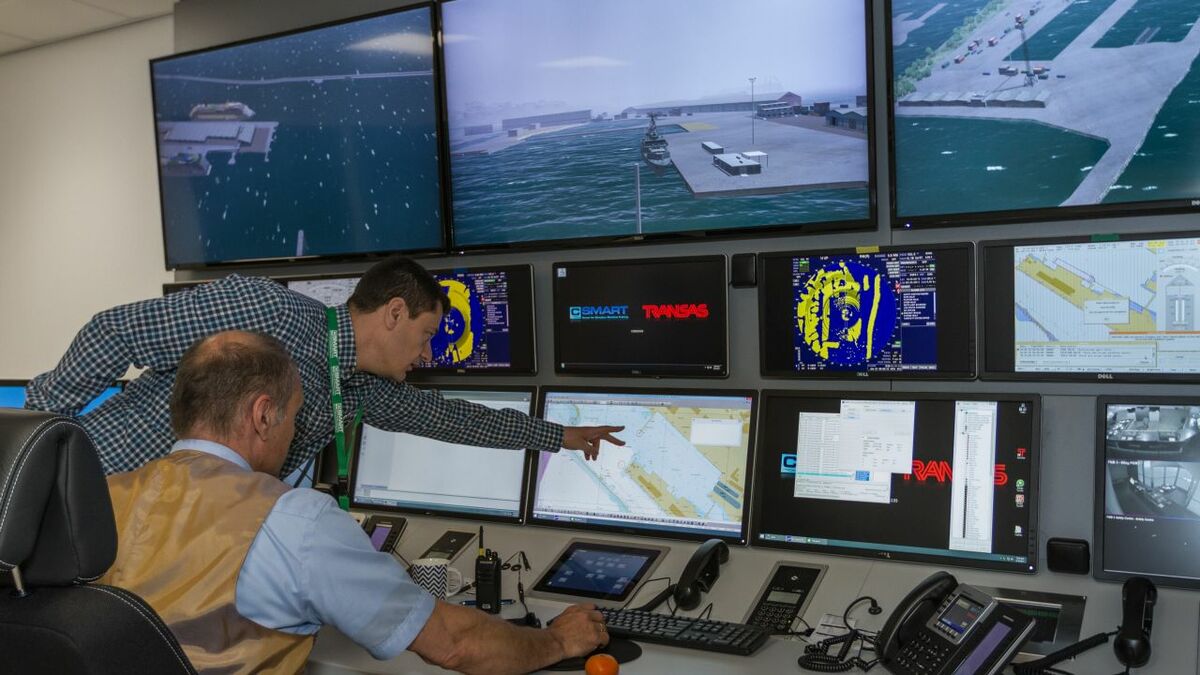
Mr di Lieto said mariners need training to use the S-100 data within ENCs and on ECDIS in daily ship operations using simulators, such as those housed at Carnival’s CSMART centre in the Netherlands.
“We need to make a leap going beyond compliance, especially when it comes to training,” he said, adding S-100 will enhance safety and enable greater operation of cruise ships.
“The understanding of these overlays and the nuances of the data and the interoperability of the data sources will require much deeper understanding than the one that was required for the transition from paper charts to ECDIS.”
Mr di Lieto said CSMART is already using S-100 data in simulators to enhance cruise ship navigation in constrained waterways through advanced training. It is simulating ship voyages through these areas and finding accessible channels on S-100 where there were none with existing S-57 data ENCs.
“We create the simulator model, which creates the right mathematical interaction with the ships to replicate the real world,” explained Mr di Lieto “We need to have a very accurate model in the simulator.”
He provided an example in a bay near Melbourne, Australia, where safety margins of cruise ships indicate there are no accessible routes without dangers using S-57. But with S-100 data, such as tide and current information, at least one channel appears with a 200-m safety margin, adequate for cruise ship navigation.
Navigation information is enhanced through overlays to enable dynamic clearance, removing sailing constraints and enabling JiT arrival. “This system might give us the confidence to remove constraints to enable operations,” said Mr di Lieto
This is simulated for ship captains and navigators to practise voyages into these constrained coastal areas, so they can be replicated in the real world with confidence.

On the panel of Riviera’s Beyond compliance: turning S-100 into your navigational advantage webinar were (left to right): Sperry Marine technical manager Simon Cooke, Carnival Corp’s CSMART manager for simulation studies Antonio di Lieto and UK Hydrographic Office head of technical partnerships Thomas Mellor.
Webinar poll results
Attendees were asked to vote on a series of poll questions during the webinar. Here is a summary of the results.
What do you see as the main driver for adopting S-100?
Safety improvements: 91%
Reduced mariner workload: 0%
Improved fuel efficiency: 9%
What will be the main barrier to adopting S-100?
Data cost: 11%
Data availability: 62%
Training requirements: 27%
When will your fleet adopt S-100 ECDIS?
2026-2027: 26%
2028-2029: 10%
After 2029 mandate: 53%
Never/minimal compliance only: 11%
Should S-100 data be free or charged?
Free for safety products: 32%
Charged at current rates: 25%
Premium pricing for enhanced features: 26%
Government subsidised: 17%
What’s the most valuable S-100 feature?
Enhanced safety contours: 63%
Real-time water levels: 29%
Reduced alerts: 4%
Current integration: 4%
(source: Riviera Maritime Media)
Riviera’s Maritime Decarbonization Americas Conference will be held in Houston, Texas, 22-23 January 2026. Click here for more information on this industry-leading event.
Related to this Story

Events

Maritime Regulations Webinar Week
 16 Dec 2025
 GMT - ONLINE
Floating energy: successfully unlocking stranded gas using FLNGs and FSRUs
24 Feb 2026GMT - ONLINE
© 2026 Riviera Maritime Media Ltd.


