


Business Sectors
Events

Offshore Support Journal Conference, Middle East 2025
 09 Dec 2025
 DUBAI
DUBAIContents
Register to read more articles.
Commercial USVs and acoustic sensors join academic deep-dive on 'dynamic' deepwater currents
Uncrewed surface vessels and advanced sensors have, for the first time, observed deep-ocean currents that can be disruptive to offshore infrastructure


A strong deep-ocean current that loops around the US Gulf of Mexico (Gulf of America) has been studied and measured using a combination of an uncrewed vessel and suite of sensors as part of a collaborative scientific and industry research project.
The work took place as part of a project commissioned by and undertaken in collaboration with the University of Rhode Island and funded by the US National Academies of Sciences, Engineering and Medicine’s Gulf research programme.
Research data from the project is likely to be used to develop predictive models that could help industry and academia to better understand movements and mitigate hazards to subsea structures from deep-ocean currents.
“Sustained deep-ocean measurements remain rare despite their importance,” said University of Rhode Island professor of oceanography Randy Watts.
“This project demonstrates how commercially available instruments and uncrewed vessels can deliver science-ready data in strong current systems, overcoming the dual challenges of station-keeping where most USVs fail and cost-effective deployment without expensive research vessels.”
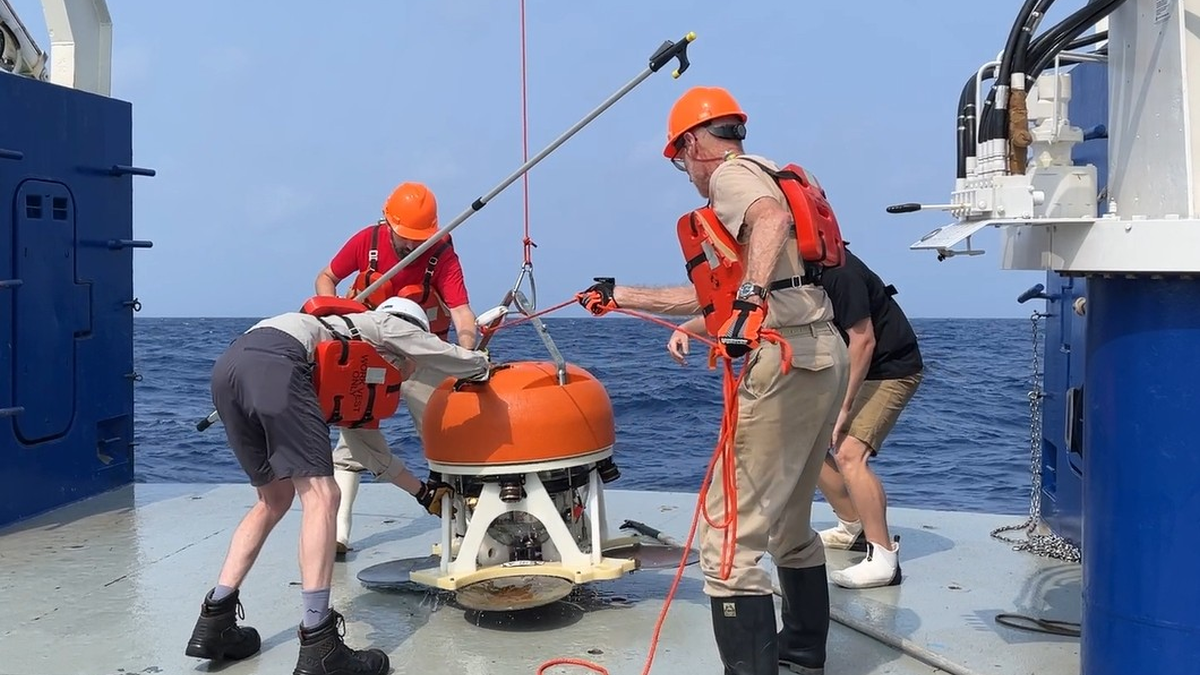
Commercial contributors to the project, SeaTrac Systems’ uncrewed surface vehicles (USVs) and Sonardyne’s acoustic sensors observed in near real-time the US Gulf’s loop current system that forms the beginning of the North Atlantic Gulf stream. The current occasionally ’sheds’ large, circular eddies of warm water that drift westwards and can pose hazards to subsea offshore structures.
The project team tasked SeaTrac’s solar and battery-powered, remotely piloted SP-48 with navigating the variable ocean currents and weather conditions in the US Gulf to reach the subsea sensor locations and harvest the data.
Over 18 months, four of Sonardyne’s Origin 65 seabed acoustic Doppler current profilers and five pressure inverted echosounders were deployed in 1,800 to 3,200 m water depth, in the centre of the loop current, around 200 nautical miles off the coast of Louisiana.
Origin 65 is a low frequency profiler, rated to 4,100 m of water and can profile up to an 800-m range in time-aligned, high resolution.
“This mission has demonstrated a new global precedent for using USVs to make critical, sustained ocean data accessible, consistently – with zero crew risk, zero emissions and a repeatable approach we can scale to other regions,” said SeaTrac director of operations and business development Hobie Boeschenstein.
The SP-48 used Sonardyne’s HPT 7000 transceiver and Iridium Certus and Starlink low Earth orbit satellite links to transfer real-time data from these seabed sensors back to shore.
During three deployments covering more than 30 days, the SP-48 gathered and transmitted 135 GB of high-resolution data on these ocean currents.
“With SeaTrac, we have proven that long-term, persistent monitoring of powerful and dynamic ocean systems with USVs instead of traditional vessels is now a reality,” said Sonardyne business development manager for ocean science Michelle Barnett.
“Remote-commanded systems can reliably deliver the high-quality oceanographic data researchers and industry need, when they need it with lower operational costs than traditional vessels.”
Riviera’s OSJ Subsea Conference will be held in London on 2 February 2026. Use this link for more information and to register for the event.
Related to this Story

Events
Offshore Support Journal Conference, Middle East 2025
09 Dec 2025DUBAI
Maritime Regulations Webinar Week
16 Dec 2025GMT - ONLINE
Maritime Decarbonization Conference, Americas 2026
22 Jan 2026HOUSTON
Offshore Wind Journal Conference 2026
02 Feb 2026London
© 2024 Riviera Maritime Media Ltd.


