


Business Sectors
Business Sectors
Events
Contents
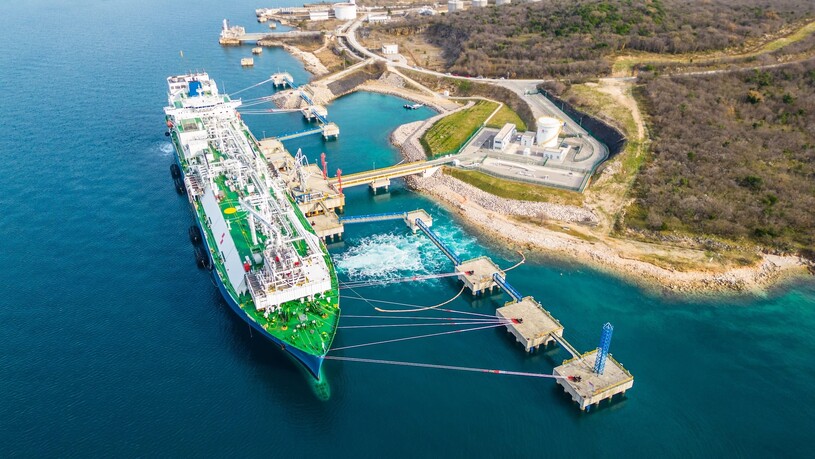

Trump uses social media to order 'complete blockade' of sanctioned tankers visiting Venezuela
Trump makes claim on social media platform he owns, using term that carries legal weight, with specifics from the White House or government agencies yet to follow


US President Donald Trump’s account on the social media platform he owns, Truth Social, has posted a claim that the US President is ordering a ’blockade’ of oil tankers visiting Venezuela.
Specifically, the claim says the blockade will apply to sanctioned oil tankers, preventing those in port from leaving and those destined for Venezuela from entering its waters.
"I am ordering A TOTAL AND COMPLETE BLOCKADE OF ALL SANCTIONED OIL TANKERS going into, and out of, Venezuela," the account, verified to Donald J Trump, wrote. The claim was one sentence in a long post with capitalisations and descriptions characteristic of the US President’s writing and speaking habits, including a related claim that "Venezuela is completely surrounded by the largest Armada ever assembled in the History of South America."
The ’Armada’, Mr Trump’s account claimed, ’will only get bigger’.
The US has, of late, amassed a large naval force in the Caribbean region and undertaken a weeks-long campaign of aerial bombardment of small boats in the Caribbean Sea that has killed at least 87 people in what the UN has termed ’extrajudicial executions’. Drug trafficking has been used by the Trump administration as a premise for the administration’s actions, and in late November 2025, US Secretary of State Marco Rubio said the US was designating current Venezuelan President Nicolás Maduro as a terrorist based on his alleged control of the designated foreign terrorist organisation, the Cartel de los Soles.
"For the theft of our Assets, and many other reasons, including Terrorism, Drug Smuggling, and Human Trafficking, the Venezuelan Regime has been designated a FOREIGN TERRORIST ORGANIZATION," President Trump’s Truth Social account claimed.
The Donald J Trump account’s post said the US forces would remain in place "until such time as [Venezuela] return to the United States of America all of the Oil, Land, and other Assets that they previously stole from us. The illegitimate Maduro Regime is using Oil from these stolen Oil Fields to finance themselves, Drug Terrorism, Human Trafficking, Murder, and Kidnapping".
Some have linked the allegations of ’stolen oil fields’ to Venezuela’s nationalisation of internationally operated oil projects in 2007 under the Hugo Chavez administration that preceded the Maduro administration.
Legal basis of the term ’blockade’
The use of a blockade is defined as an instrument of war in various international treaties, and is regulated under international maritime and humanitarian law by requiring specific conditions to be met before a blockade is enacted.
US politicians and legal scholars have opined on President Trump’s apparent assertion that the US would at least partially blockade Venezuelan ports with University of California legal scholar Elena Chachko quoted by Reuters as saying the act of a blockade would raise "serious questions on both the domestic law front and the international law fronts" about whether the US President has the power to order a blockade and the legality of such an act.
In US domestic law, the US Constitution grants US Congress, not US Presidents, the sole power to declare war. While it is common for US presidents to use military force internationally without a formal declaration of war from Congress, declarations or enactment of "instruments of war" such as blockades would appear to contravene the US Constitution’s terms.
In international humanitarian law, the use of a blockade is addressed in internationally recognised legal texts including the Declaration Respecting Maritime Law adopted in Paris on 16 April 1856, by the Declaration Concerning the Laws of Naval War’s articles 1-21 adopted on 26 February 1909 in London and by the San Remo Manual on International Law Applicable to Armed Conflicts at Sea adopted on 12 June 1994, according to Médecins Sans Frontières. The Paris-based, international medical humanitarian organisation, Médecins Sans Frontières’, Guide to Humanitarian Law defines a blockade as "an act of war that is regulated by international law".
"In order for [a blockade] to be binding to third-party States, it must be effective, and its existence must be officially declared along with a starting date, the territorial geographical limits and a time provided for neutral vessels or aircrafts to be able to leave the area," Médecins Sans Frontières said.
Whether oil tankers already in Venezuela have freedom of movement is questionable, with ship-tracking organisations and news reports documenting a de facto embargo, with vessels remaining in port following a sudden and unannounced seizure of a VLCC by US forces in early December. A new round of sanctions from the US followed the vessel seizure, and a White House press briefing from the US did not rule out further seizures of vessels.
Market reaction
Market analysts Kpler said that the US claim of a forthcoming blockade had not much affected oil prices.
"The move has so far failed to provide a meaningful boost to oil prices or to overturn underlying fundamentals, largely because the market is two-tiered and even
the sanctioned segment remains crowded," Kpler said.
Kpler’s analysis pointed to a ’limited group of buyers’ affected by any disruption to Venezuelan oil supply, with the broader global market sufficiently supplied to absorb potential shortfalls arising from US actions.
Venezuela produces around 900,000 barrels per day (b/d) of crude oil and condensate, which accounts for about 1% of total worldwide supply.
"Of the 765,000 b/d exported, about 76% is bound for China, exclusively to teapot refiners, as state-owned firms continue to shun these barrels due to sanctions concerns. The US has taken around 17% [of Venezuelan exports] so far this year – down from a 35% share in 2024 following changes to Chevron’s licence – while the remaining cargoes are shipped to Cuba and a handful of other destinations such as Spain and Italy under the previous licences," Kpler said.
Kpler’s analysts said that the US President’s call for a blockade on sanctioned oil tankers implies that oil bound for the US under Chevron’s licence could continue to flow uninterrupted.
Sign up for Riviera’s series of technical and operational webinars and conferences:
- Register to attend by visiting our events page.
- Watch recordings from all of our webinars in the webinar library.

Related to this Story

Events

Maritime Regulations Webinar Week
 16 Dec 2025
 GMT - ONLINE
Floating energy: successfully unlocking stranded gas using FLNGs and FSRUs
24 Feb 2026GMT - ONLINE
© 2026 Riviera Maritime Media Ltd.


