


Business Sectors
Business Sectors
Events
Contents

Register to read more articles.
'Unprecedented uncertainty' reshaping global commodity flows
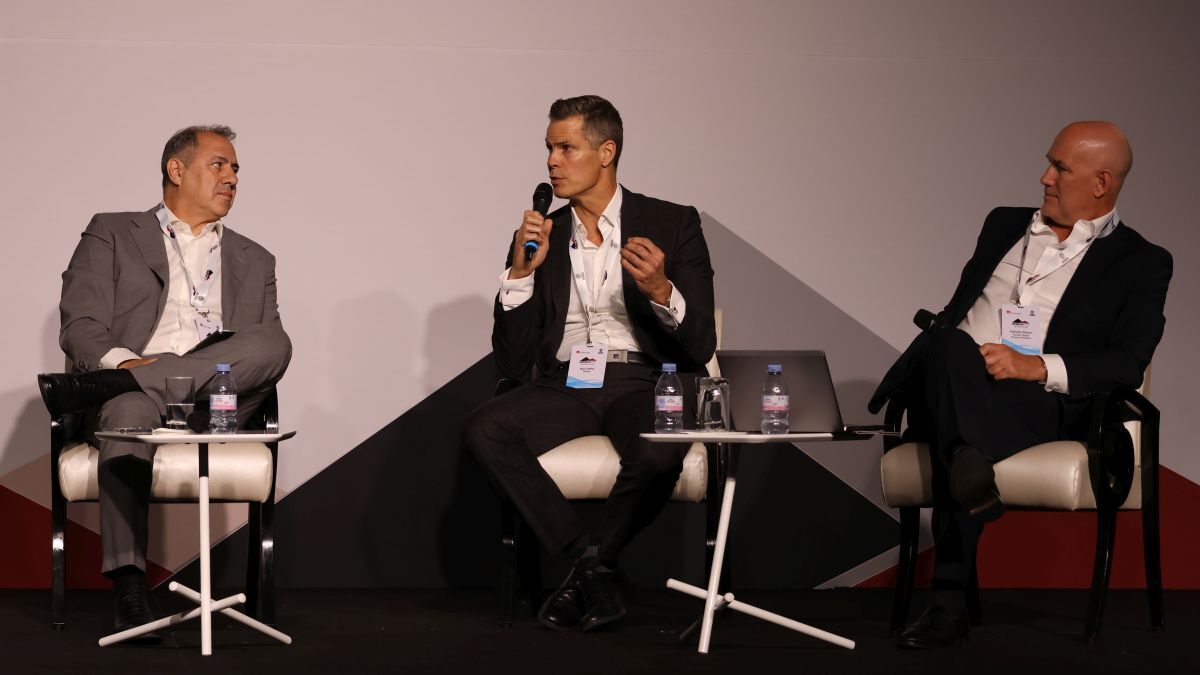
The United States appears headed for recession while China occupies a markedly stronger position than during previous trade tensions, Trafigura’s chief economist told delegates at Geneva Dry 2025, forecasting a period of "unprecedented uncertainty" that could reshape global commodity flows


"We’ve gone from US exceptionalism to now looking like we are in a recession," Saad Rahim told the Commodities Shipping Outlook panel, describing a dramatic reversal from his predictions at last year’s conference. "This represents multiple percentage points of a hit to US GDP, while for China, it’s probably about a half percentage point hit in the worst-case scenario, which is manageable."
The striking shift stems from China’s successful economic diversification since the 2018-19 trade tensions. "China has diversified away from the US," Mr Rahim explained. "Exports to the US, while the dollar value hasn’t changed much, as a share of China’s total exports have fallen markedly."
This strengthened position explains China’s reluctance to negotiate, contrary to expectations. "Trump keeps saying ’they’re going to call me,’ and they’re saying ’you can keep waiting,’" Mr Rahim noted, adding that instead of stimulating its economy, China has largely withheld new measures while industrial production picks up ahead of tariff implementation.
For shipowners, this economic uncertainty compounds existing challenges around environmental regulation and alternative fuels, creating what chief executive of Ariston Navigation and chairman of Intercargo John Xylas, called "a speculative bet" with newbuilding decisions.
"I’ve been close to 40 years in the industry, and I can confirm this is one in a lifetime," Mr Xylas stated, drawing parallels to shipping’s difficult period in the 1980s but highlighting a crucial difference, "Back then, there was certainty the market would turn around at some point. Today, you don’t have that certainty because you don’t know what the lifespan of your assets will be. Newbuildings today are a speculative bet because you don’t know if their lifespan will be 25 years or just 10 years."
Mr Xylas expressed particular scepticism about alternative fuels’ availability, questioning the industry’s approach to environmental targets, "We try to become green ahead of everyone else. Shipping is responsible for about 800M tonnes of CO2, less than 3% of the 36Bn tonnes of manmade CO2. And still, we want to be ahead of the remaining 97%. That doesn’t really make sense."
President and chief executive of Fednav and president designate of BIMCO, Paul Pathy, warned inflationary pressures from tariffs would likely depress trade volumes, "Tariffs equal slower global growth and cost for everybody. When you factor in the Trump tariffs and other administration policies, you’re increasing the cost of everything, and that’s generally bad for trade."
Mr Pathy pointed to multiple cost inflators affecting shipping, "The EU has new fuel standards adding cost. New fuels cost more, new ships cost more, everything costs more. The only way to deal with that is to dial down costs by doing a bit less."
Regulatory developments featured prominently in the discussion, with Bureau Veritas corporate affairs director Nick Brown providing insights on IMO’s new net-zero framework. "Under the draft regulations, ships will be required to comply with a new global fuel standard that must reduce greenhouse gas intensity over time," Mr Brown explained, noting the well-to-wake approach had gained acceptance.
The framework includes economic measures where "ships emitting above two tiers will be required to accumulate remedial units that need to be settled," with the first settlement date in June 2028. An IMO Net Zero Fund will collect pricing contributions and disperse funds for innovations, research, infrastructure and transition initiatives.
Mr Xylas offered a measured assessment of the IMO outcome, "It is a start. It is better than nothing. It is a very complicated piece of legislation." However, he expressed reservations about implementation, "This is a new global tax. Let’s not kid ourselves. The tax will fall between US$80 per tonne in 2028 to about US$650 in 2035. I’m not sure whether any alternative fuels will be cheaper than that. We may end up in a situation where it’s cheaper to pollute and pay."
Both shipowner panellists expressed extreme caution about newbuilding investments. "The market just won’t work to order a newbuilding. This is the reality," Mr Xylas stated, suggesting 5-10-year-old tonnage represented a more prudent investment.
Mr Pathy summarised the dilemma facing shipowners, "We’ve spent a billion dollars on ships over the years. How do you spend the next billion? I would want to be in hardware, on ships, but I don’t even know today how we go about doing that because of all the uncertainty."
For all the market disruption, Mr Rahim concluded with one potentially positive development for commodity markets, "If you start to see interest rates come down, the dollar come down, and rest of the world growth pick up, that’s actually quite good for commodities demand, because US growth has not been as commodity-intensive."
Responding to an audience question about when global trade might normalise, Mr Rahim suggested recovery could begin next year, though likely after "a couple quarters of really negative growth," concluding, "Nothing lasts forever."
Sign up for Riviera’s series of technical and operational webinars and conferences:
- Register to attend by visiting our events page.
- Watch recordings from all of our webinars in the webinar library.
Related to this Story
Events

Maritime Regulations Webinar Week
 16 Dec 2025
 GMT - ONLINE
Floating energy: successfully unlocking stranded gas using FLNGs and FSRUs
24 Feb 2026GMT - ONLINE
© 2026 Riviera Maritime Media Ltd.


