


Business Sectors
Business Sectors
Events
Contents
Register to read more articles.
Updated PIANC guidelines encourage fender testing
The World Association for Waterborne Transport Infrastructure has published new guidance on testing fender performance in realistic port conditions


Jetty and terminal fenders require high-quality materials, must be able to resist ship forces and be long lasting to prevent damaging vessels and docks. To ensure ports have the most effective fendering systems, the World Association for Waterborne Transport Infrastructure (PIANC) published new guidelines in 2024 (WG 211) with best practices and recommendations for fender design, manufacturing and testing.
Trelleborg business unit director for innovation and technology Mishra Kumar was one of the key contributors of these updated guidelines. He tells Riviera Maritime Media these include stringent requirements for designing fenders with a specific focus on testing, which requires better simulation of real-world scenarios.
A key change was to move fender testing from an annex into the main body of the guidance under chapter 10, highlighting its importance in maintaining quality.
“The basic needs of fenders are the performance – the energy absorption capacity and reaction forces – and longevity,” says Mr Kumar. “Fenders need to absorb the kinetic energy of vessels, absorbing the maximum amount of energy to prevent accidents.”
This compresses a fender and generates reaction forces onto the vessel, which must not exceed the hull pressure, to prevent a hull breakage. “That needs to happen for 15-20 years if it is good quality fendering,” says Mr Kumar. Poor-quality fendering could need replacing two or three times during that period.
Initial factory testing of fenders is conducted under a standard fixed temperature and environmental conditions, and a set compression speed at an angle of zero. But this is seldom how it is in real life, as fenders perform differently in high temperatures encountered in the Middle East and Africa, where performance reduces; or in Arctic conditions, where fenders become much harder and their energy absorbance changes.
“In different environmental conditions and atmospheric temperatures, rubber performance changes and these factors need to be taken into consideration,” says Mr Kumar.
Following previous PIANC guidance, relative performance data is produced by manufacturers from standard testing, but these are not representative to actual rubber reactions to forces, he says. Designers could use these data points to select fender type and materials thinking about how they would perform in the different environmental conditions.
“This was wrong as the selection base line was not right,” says Mr Kumar. “Under the new guidelines, manufacturers will publish data at the base value and then different performance factors, such as at various temperatures, compression angles and speeds, therefore applying the correct performance of fenders.”
PIANC also provides guidance on testing fenders’ durability, which could promote higher quality materials, and lessen the risk of damaged fenders needing to be replaced.
Mr Kumar explains the importance of selecting high-quality materials in port fenders. They need the right grade of oil and rubber compound and minimal white fillers, such as calcium carbonate and recycled material. “Fenders with the right polymer and grade of carbon-black oil, and low recycled materials will have high longevity,” he explains.
“It they have high levels of white fillers and recycled materials, there would be an impact on their durability. They could crack over time and would not have the right performance and energy absorbance capacity.”
If fenders are unable to halt ship movements at jetties or quaysides, their failures could cause accidents or damage to vessels.
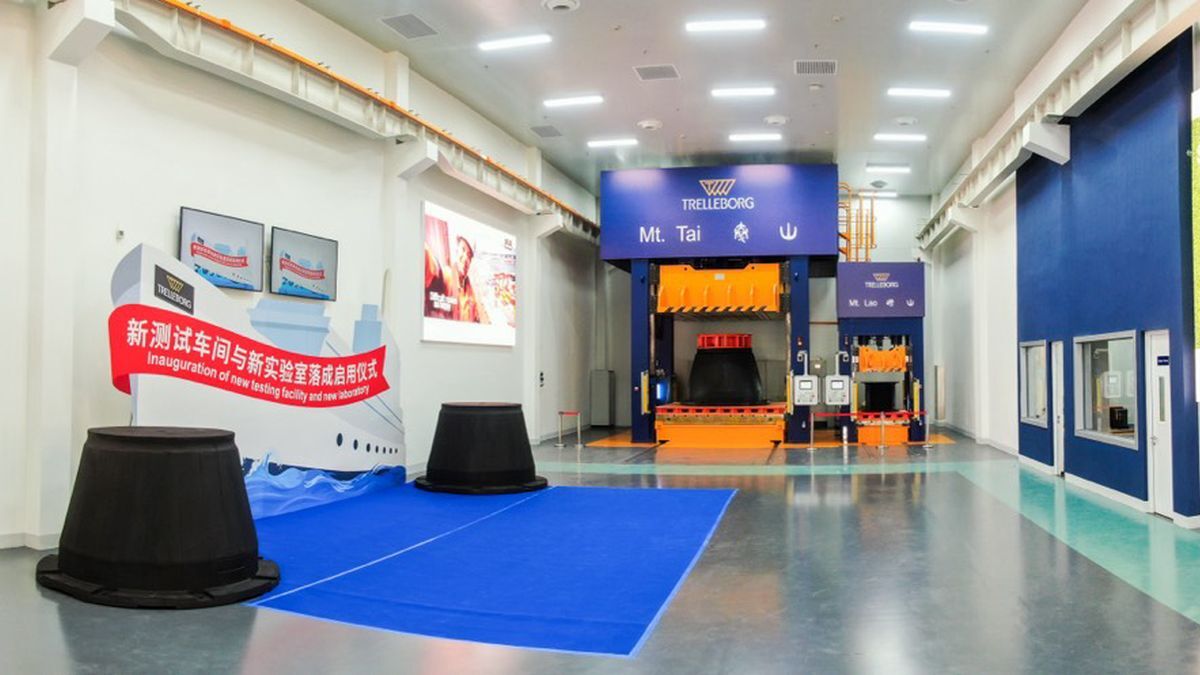
Trelleborg added a testing facility to its Qingdao manufacturing site in China, to verify and test fenders in line with the WG 211 guidelines. Test presses cover the requirements for marine fenders of varying sizes, to evaluate performance under various load conditions and simulate real-world scenarios including shear, fatigue, high speed and shear-compression.
Mr Kumar was the chapter lead for Chapter 10: Test Procedures of Marine Fenders included in the PIANC Fender Guidelines 2024. Trelleborg technical director Marco Gaal was the chapter lead for Chapter 12: Sustainability of Fenders within the PIANC Fender Guidelines 2024. They’re both key members of WG211.
The 27th International Tug & Salvage Convention, Exhibition & Awards will be held in association with Caterpillar in Dubai, UAE, 21-23 May 2024. Use this link for more details of this industry event and the associated social and networking opportunities; and this link to book your ticket for the exhibition, social gatherings and awards night.


Related to this Story
Events

Maritime Regulations Webinar Week
 16 Dec 2025
 GMT - ONLINE
Floating energy: successfully unlocking stranded gas using FLNGs and FSRUs
24 Feb 2026GMT - ONLINE
© 2026 Riviera Maritime Media Ltd.


