


Business Sectors
Business Sectors
Events
Contents

Register to read more articles.
New global fender standards come into force in May
Fender manufacturers have up to 1 May 2026 to comply with the latest guidelines from the World Association for Waterborne Transport Infrastructure


Fenders should meet the World Association for Waterborne Transport Infrastructure (PIANC) 2024 guidelines for strength, stress resistance and material quality, an update to the 2002 guidance.
Guidelines for the Design of Fender Systems was initially produced by Working Group (WG) 33 of the Maritime Navigation Commission with recommendations for designing marine fender systems.
WG 211 updated this guidance to include manufacturing and testing of fender systems, and best practice recommendations to ensure they were sufficiently safe for both vessel and berth.
Since the changes are quite substantial, there is a transition period for applying 2002 and 2024 guidance, which is expected to finish on 1 May 2026.
Fender suppliers should have updated their catalogues according to the new guidelines by that date.
According to PIANC, there is greater focus on fender systems for seagoing vessels, primarily those requiring tug assistance during berthing manoeuvres, but the guidelines do not yet provide design guidance for inland vessels and barges.
WG 211 describes the physical process of berthing differently to WG 33 resulting in higher velocities, lower berthing angles and multiple fender contacts.
It strongly recommends the use of site-specific information and puts more safety emphasis in the fender than in the supporting structure, said PIANC.
Within the guidelines, there are stringent requirements for designing fenders with a specific focus on testing, which requires better simulation of real-world scenarios.
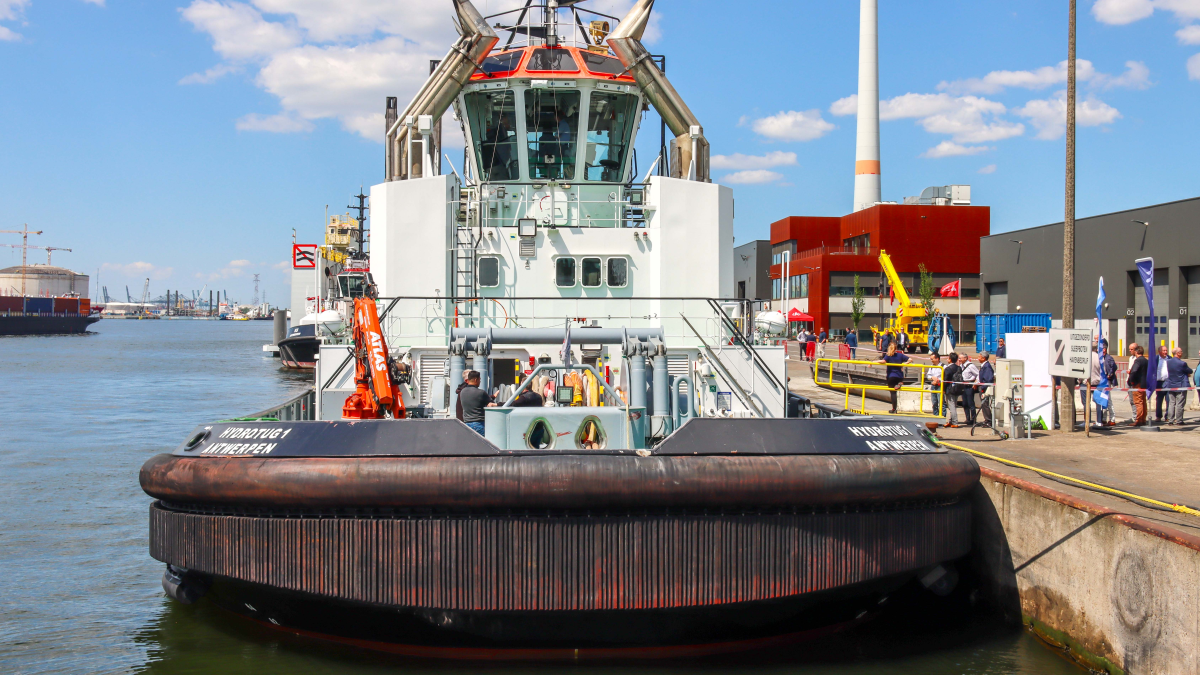
Tugboat fenders should have abrasion resistance, tensile strength, be light weight, low density and be made from durable rubber that provides flexibility and high opposition to pressures coming from pushing ships towards quaysides.
Some tugs are built just with tyres for protection, but those operating in dynamic environments with high potential for damage have dedicated fendering, particularly on the bow and stern, to absorb impacts.
According to Trelleborg Marine, cylindrical fenders are fitted on the bow and stern of tugs for pushing against flared hulls in open sea conditions.
Large cylindrical fenders are often used as the primary pushing fenders as their round shape
is ideal for working with large bow flares, such as on container ships, and they are equally good for pushing flat-sided vessels.
Trelleborg’s cylindrical fenders come in diameters up to 100 cm and in long continuous or spigot-joined lengths.
A longitudinal chain runs down the centre of the fender, supplemented by circumferential straps or chains which are recessed into grooves. Often the ends are tapered.
M-shaped fenders have a large and flexible contact face that exerts low pressure during pushing operations.
The grooves provide extra grip, and the triple legs give a strong attachment to the tugboat.
"W-fenders are made for handling ships in extreme operating conditions"
M-fenders can also be fitted around tight curves, whilst their relative low weight does not much effect tug stability.
W-fenders are made for handling ships in extreme operating conditions, due to their high energy absorption and adaptability to various surfaces.
They can be curved around most hull shapes and provide good grip and stability during pushing operations. Trelleborg said their open bore design makes installation simple.
Block and cube fenders have a keyhole profile, which is strong and ideal for heavy-duty applications, and come grooved or flat face, depending on the required friction levels.
Where very low friction is needed, block and cube fenders can also be made as composite
fenders with integral ultra-high molecular-weight polyethylene faces. This is useful for tugs that operate in ice conditions.
D-shaped, square and wing-D fenders are often used as side beltings to protect the vessel during escort duties and when coming alongside.
Transition blocks are used to provide a smooth interface between side beltings and bow and stern fendering.
Selecting the right fender design and structure increases vessel safety and operational efficiency, while choosing materials meeting the latest durability and testing standards would extend their operational life.
The 28th International Tug & Salvage Convention, Exhibition & Awards will be held in Gothenburg, Sweden, in association with Caterpillar, 19-21 May 2026. Use this link for more details of this industry event and the associated social and networking opportunities.



Related to this Story


Events

Maritime Regulations Webinar Week
 16 Dec 2025
 GMT - ONLINE
Floating energy: successfully unlocking stranded gas using FLNGs and FSRUs
24 Feb 2026GMT - ONLINE
© 2026 Riviera Maritime Media Ltd.


