

Contents
Survey’s/Polls (coming soon)
Special Reports (coming soon)
Business Sectors

Business Sectors
Business Sectors
Business Sectors
Events
Contents
Contents
Survey’s/Polls (coming soon)
Special Reports (coming soon)
Read the views of the experts:

You are viewing 1 of your 10 articles this month.
Register to read more articles.
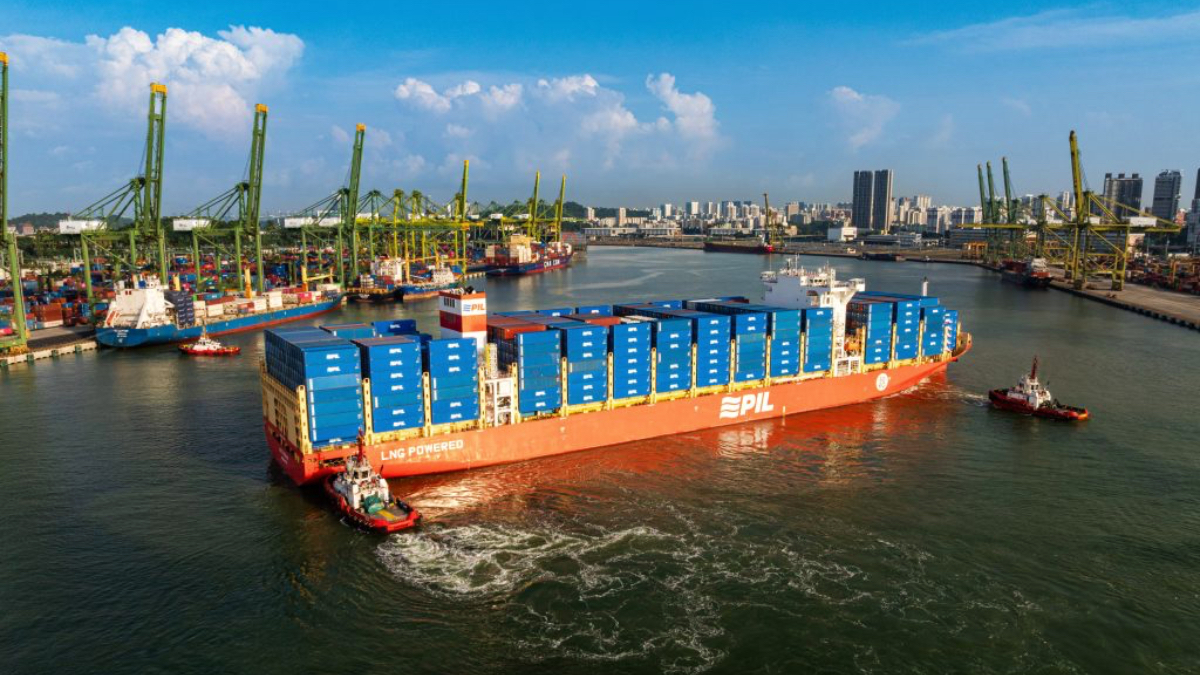
PIL, PSA and DNV launch joint land–sea carbon reduction service in Singapore
28 Apr 2026by John Snyder
A new land–sea service will provide cargo owners and shippers a verifiable pathway to reduce Scope 3 emissions across port, shipping, and logistics operations


Cargo owners and shippers will be able to use a new service to verify and reduce Scope 3 emissions on freight moving through the Port of Singapore.
This new initiative, born out of a memorandum of understanding (MoU) between container liner company Pacific International Lines (PIL), PSA International, and DNV in 2025, launched in April, establishes a joint land-sea green value-added service for cargo transhipped through the port. The service provides a transparent and practical path for shippers and cargo owners to track and reduce Scope 3 emissions – greenhouse gas emitted by third parties during upstream and downstream activities in a company’s supply chain.
Shippers and cargo owners who use the new service can achieve verifiable emissions reductions by allocating carbon reductions generated by the use of lower-carbon fuels across multiple modes of transportation within logistics, shipping, and port operations. Trials of the new service are scheduled to start in May.
PIL is one of the leading shipowners in making investments in alternative fuel-capable tonnage. Controlling more than 300,000 TEU and 100 vessels to 500 locations globally, PIL’s operations touch ports from Africa to the Americas to Asia.
In October, the Singapore-based owner took delivery of Kota Orkid, the fourth in its series of 8,200 TEU LNG dual-fuel ‘O’ Class container vessels. Kota Orkid is the eighth LNG-powered vessel in its fleet. Before the end of the decade, PIL will add 12 LNG dual-fuel vessels from China’s Hudong-Zhonghua Shipbuilding, covering five 13,000 TEU (with deliveries starting in late 2026) and seven 9,000 TEU ships (starting 2027).
PSA’s portfolio comprises over 70 deepsea, rail, and inland terminals across more than 180 locations in 45 countries – including flagship port operations in Singapore and Belgium.
One of the world’s leading class societies, DNV will use its digital capabilities to facilitate standardised data flows and independent verification for maritime emissions data.
PIL chief commercial officer, Lionel Patrice Chatelet, said, “PIL is advancing maritime decarbonisation by leveraging carbon insetting as a practical and impactful lever within our own value chain. By investing in initiatives that directly reduce or remove emissions across our operations, PIL ensures that emissions reductions are real, measurable, and closely tied to our business activities. This approach not only accelerates progress toward our climate targets but also enables customers to access lower-carbon shipping solutions.”
PSA Group head of Operations, Technology and Sustainability, Eddy Ng, said the collaboration underpins “the decarbonisation of maritime supply chains and strengthens Singapore’s position as a hub for sustainable maritime and low-carbon energy solutions.”
Emphasising the importance of transparency, Veracity by DNV executive director, Mikkel Skou, said the new initiative “is a strong example of how a trusted data ecosystem can deliver real value across the maritime value chain. When shipowners, ports, and cargo stakeholders are connected through standardised, verifiable data, emissions reductions can be measured, shared, and applied with confidence”.
Riviera’s Offshore Support Journal Conference, Asia will be held in Singapore on 8-9 September 2026. Use this link for more information and to register for the event.
Editor's Choice
Editor's Choice
Related to this Story

Events

Maritime Regulations Webinar Week
 16 Dec 2025
 GMT - ONLINE
Floating energy: successfully unlocking stranded gas using FLNGs and FSRUs
24 Feb 2026GMT - ONLINE
© 2026 Riviera Maritime Media Ltd.


