


Business Sectors
Business Sectors
Events
Contents
VLCC ordering frenzy in January as EPS adds another pair in China
Another day, another VLCC newbuilding story: Eastern Pacific Shipping (EPS) has returned to China’s Hengli Heavy Industry for an additional pair of tankers, pushing January’s global contracting activity toward one of the highest monthly tallies on record


Guangdong Songfa Ceramics disclosed on 22 January that its subsidiary, Hengli Heavy Industries, has secured an order for two 306,000-dwt VLCCs, valued between US$200–300M.
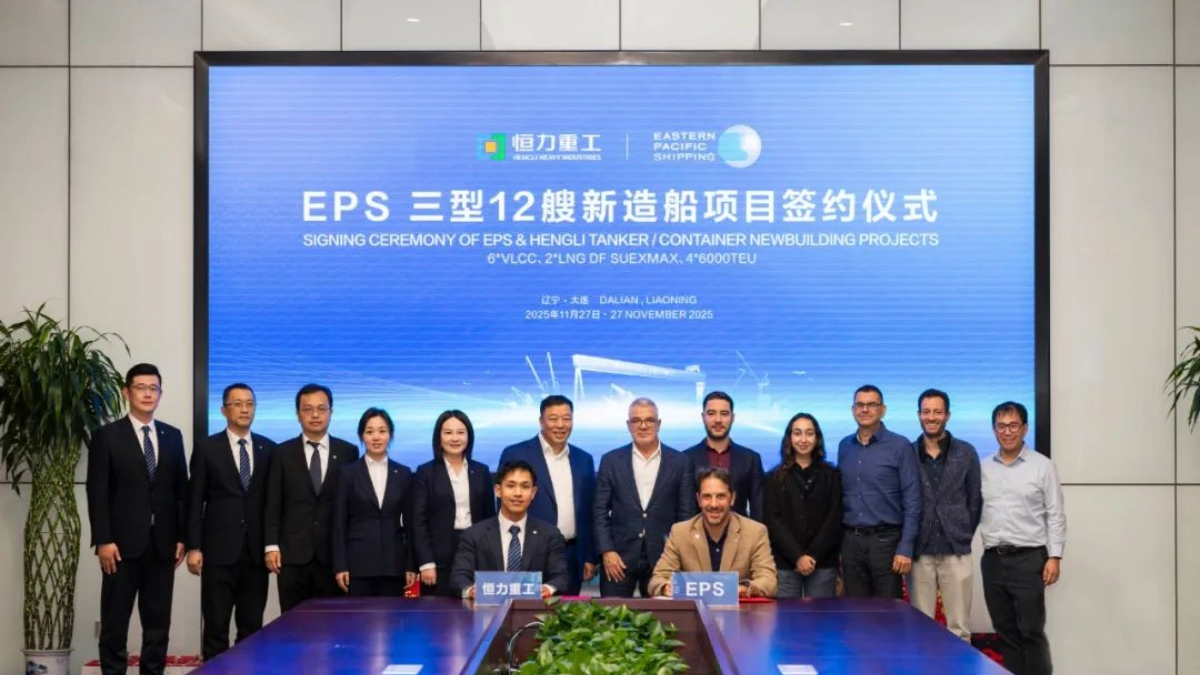
The contracting party is identified as a single-purpose company under Singapore-based EPS. The vessels are scheduled for delivery in the second half of 2028.
The order follows EPS’s first deal with Hengli last November, when the owner contracted six VLCCs alongside additional Suezmax tankers and mid-size container ships.
EPS has been notably active in the newbuilding market this month, also placing orders at CSSC’s Jiangnan Shipyard for two LNG carriers and another two very large ammonia carriers.
Across all segments – including container ships, PCTCs, dry bulk carriers, gas carriers, and tankers – EPS now manages a fleet of about 350 vessels totalling 34.0M dwt.
VLCC ordering bonanza
With this latest EPS order, Riviera counts 13 VLCCs contracted so far in January. Hengli has secured the majority of these, with Dynacom Tankers and Seatankers ordering four and two units, respectively.
Cape Shipping has also placed a firm order with CSSC Qingdao Beihai for one vessel. South Korean and Japanese yards have been active as well: Asyad Shipping has contracted three vessels at Hanwha Ocean, while Kyoei Tanker has signed for one VLCC at Japan Marine United.
Banchero Costa head of research Ralph Leszczynski told Riviera that this month’s contracting level is not an all-time record, but it is “one of the highest monthly figures in history.” He noted that at least 60 VLCCs were contracted in 2025, including 13 in September and another nine in December.
According to Mr Leszczynski’s estimates, the VLCC orderbook is becoming sizeable, with at least 142 units scheduled for delivery between 2026 and 2028 – equivalent to a 17% orderbook-to-fleet ratio.
Why ordering still makes sense
Despite the surge in newbuilding activity, Mr Leszczynski said the rush to contract VLCCs is not alarming from a supply-side perspective. “There is quite a lot of old tonnage out there,” he noted.
Roughly 20% of the global VLCC fleet is now more than 20 years old, “which is usually too old to be acceptable for most oil majors,” he explained.
Much of this ageing fleet is tied up in shadow-trade routes involving Iran or Venezuela, or deployed as floating storage.
But recent geopolitical shifts have cast uncertainty over the continued utilisation of many such vessels. Mr Leszczynski pointed to the US crackdown on shadow-fleet operations – including vessel seizures linked to Venezuelan crude – alongside political changes in Venezuela, potential shifts in Iran, and even the possibility of an end to the war in Ukraine.
Meanwhile, charter rates for ’mainstream’ VLCCs have surged over the past year, and suitable vessels have become scarce in the secondhand market.
Banchero Costa data shows secondhand prices have reached new highs, with five-year-old VLCCs now costing nearly US$120M – only about 6% below the newbuilding price at a South Korean yard, currently around US$128M.
“So at this point, if one wants to invest in VLCCs, it does make sense to go for newbuildings,” Mr Leszczynski concluded.
Riviera’s International Chemical and Product Tanker Conference will be held in London on 21-22 April 2026. Use this link for more information and to register for the event.


Related to this Story


Events

Maritime Regulations Webinar Week
 16 Dec 2025
 GMT - ONLINE
Floating energy: successfully unlocking stranded gas using FLNGs and FSRUs
24 Feb 2026GMT - ONLINE
© 2026 Riviera Maritime Media Ltd.


