


Business Sectors
Business Sectors
Events
Contents
Introducing the world’s first LNG-powered container ship


In this age of environmental awareness the shipping industry is at a pivotal point. Older vessels are becoming uneconomical and although the price of oil has dropped recently, it is only a matter of time before it starts to rise again. Increasingly strict Marpol regulations to control vessel emissions of sulphur dioxide and other pollutants came in to force on 1 January 2015 for the special emission control areas (ECAs) off North America and Europe. Operators in these regions are the first to feel the impact of the rules and need to find cleaner alternatives.
New vessels are being built with smaller, more efficient engines but as technology improves other forms of marine propulsion are becoming more viable. At the forefront of this new technology is liquefied natural gas (LNG). LNG powered vessels have been operating for many years e.g ferries, offshore supply vessels.
The container shipping industry is one sector that is active in investigating LNG propulsion. Apparently ahead of the game is the US Jones Act carrier TOTE which in 2012, through its subsidiary TOTE Shipholdings, placed an order for two LNG-powered container ships. With a combined cost of US$324 million the new Marlin class vessels are the first ships of their kind. The order was placed with the USA’s General Dynamics NASSCO and includes an option for an additional three vessels, all of which are to be constructed at NASSCO’s San Diego shipyard. The initial two vessels will be operated by TOTE subsidiary Sea Star Line and will be deployed on its Puerto Rico trade between the ports of Jacksonville in Florida and San Juan in Puerto Rico.
The Marlin class vessels were designed by Daewoo Shipbuilding & Marine Engineering Co (DSME) subsidiary Daewoo Ship Engineering Co (DSEC) based in Busan, South Korea. For its commercial vessels NASSCO co-operates with DSME, which enables the American shipbuilder to have access to DSME’s state-of-the-art ship design as well as sharing its shipbuilding technology.
Isla Bella’s overall design is based on a proven DSME container ship design that features a double hull. It has an overall length of 233m, a beam of 32.2m which equates to 13 rows of containers, and a draught of 10.5m. Its capacity of 3,100 teu makes Isla Bella the largest container ship currently deployed on the intra-America container trades.
Main propulsion is provided by a single MAN B&W 8L70MEC8.2- GI (ME-GI) unit, which is the world’s first gas-injected, dual-fuel, low speed diesel engine that can run on both gas and standard bunker fuel oil, and is said to be a significant advance in propulsion technology. It provides a total of 25,191kW at 104 rpm, giving Isla Bella a maximum service speed of 22 knots.
The unit was built under licence from MAN Diesel & Turbo by Doosan Engine of South Korea which successfully won the order in 2013. Since then the revolutionary ME-GI design has passed through its design, manufacture and test run stages. On 3 June 2014 the engine successfully completed its first official test run which – as with all new engine designs – is carried out in the presence of the shipowner, the shipyard and relevant classification representatives. Isla Bella’s engine was delivered to the shipyard in July 2014.
Pivotal to the new design passing all its tests was the ME-GI Fuel Gas Supply System (FGSS), which has 300 bar of operating pressure. Doosan tested this at its Changwon plant and after two months of extensive tests the new gas system had passed all regulations and restrictions as set down by the American Bureau of Shipping (ABS) and the United States Coast Guard (USCG).
The main engine is aspirated by two MAN TCA66 turbochargers. Isla Bella will primarily operate on LNG and the ME-GI is a next generation, eco-friendly engine specifically designed to reduce C02, NOx and SOx pollutants when compared with existing diesel engines.
Auxiliary power is provided by three MAN 9L28/32DF auxiliary engines, also manufactured by Doosan Engine, each featuring a single MAN TCR18 turbocharger.
Isla Bella features two stainless steel cryogenic tanks manufactured by Cryo of Sweden and weighing 380 tonnes each. The tanks each have a capacity of 900m3 and are located aft of the accommodation. They provide a total capacity of around 465,000 gallons. DSME’s patented LNG fuel-gas system is used to supply the LNG fuel to the engine.
Delivery of Isla Bella is expected two months ahead of schedule in September 2015. As the trade on which it operates is covered by the Jones Act, it will have an all American crew. Construction of the second vessel, Perla del Caribe, started in May this year with delivery early in 2016.


Related to this Story
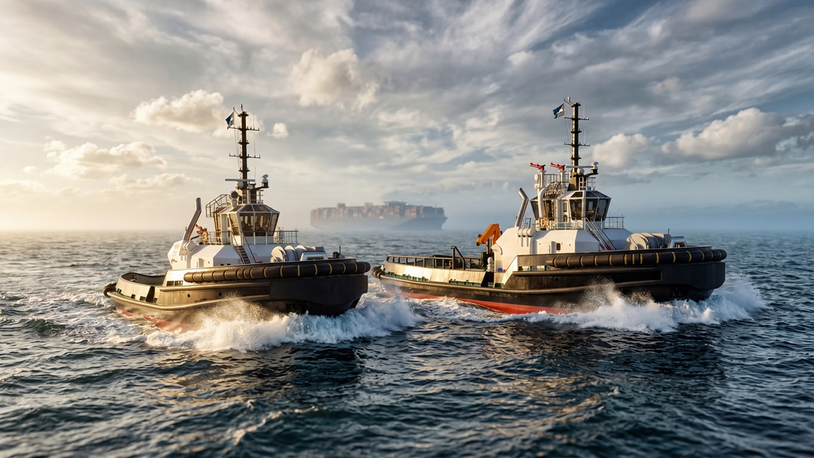
Damen develops fuel-flexible ASD tug designs
Events

© 2026 Riviera Maritime Media Ltd.


