


Business Sectors
Business Sectors
Events
Contents
Damen develops fuel-flexible ASD tug designs
A Dutch shipbuilder has introduced a range of azimuth stern-drive tugs able to run on diesel, HVO or methanol hybrid propulsion


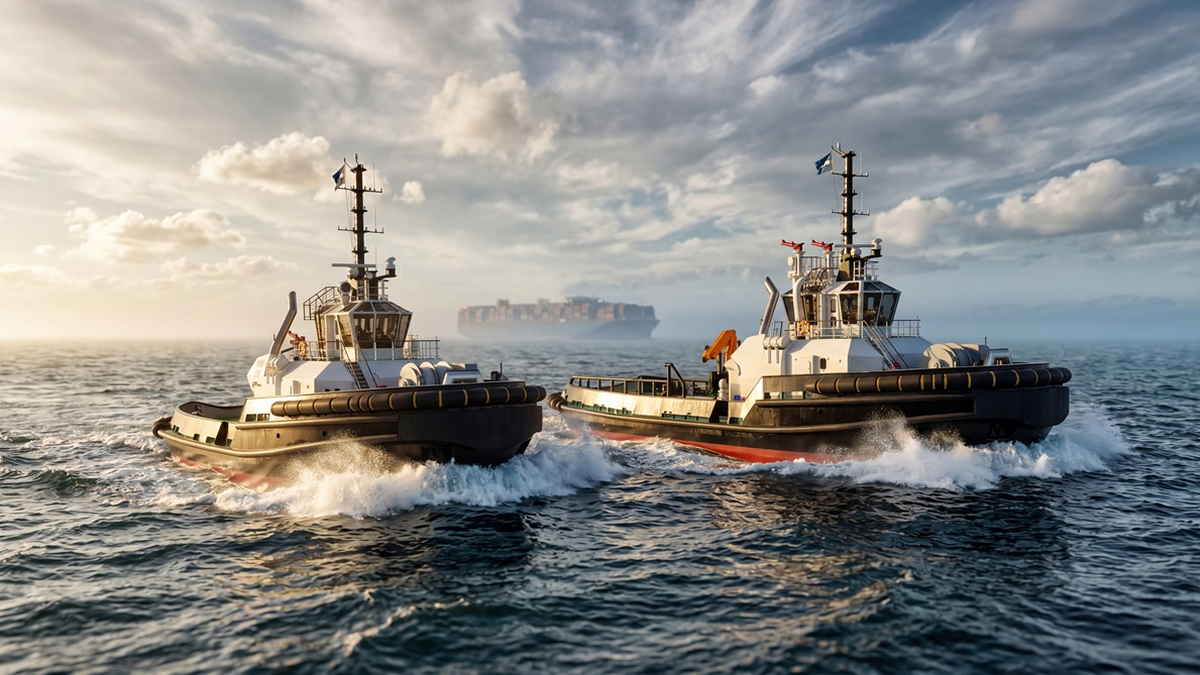
Damen Shipyards has developed naval architecture for azimuth stern drive (ASD) harbour tugs that have flexibility for running on various fuels and in different hybrid-propulsion configurations.
The Netherlands-headquartered shipbuilder has designs for ASD tugs of 25, 27 and 33-m in length for harbour operations and towage near shore and offshore.
These tugboats could be built with hybrid propulsion involving power take-in and take-out (PTI/PTO) gearboxes, generators and engines, which could be configured for consuming diesel, methanol or hydrogenated vegetable oil (HVO) fuels.
Damen’s fuel-flexible series consists currently three tug types. The ASD Tug 2512 FF is a 25-m tug with a beam of 12 m, while the ASD Tug 2713 FF measures 27 m by 13 m and the ASD Tug 3313 FF is 33 m by 13 m.
In each design, Damen has made additional spaces which, in the future, can be used for storage and handling of alternative energy sources.
These vessels would therefore be ready for rapid conversion to different configurations, depending on what is required after months or years of service.
“If, in the future, it becomes commercially attractive – or indeed, mandatory – to sail with hybrid propulsion, HVO or methanol, operators can switch at that moment,” said Damen product manager for tugs, Erik van Schaik.
“Tug owners can undertake a retrofit to a different energy source during the lifetime of the vessel when they are certain there is a business case for it,” he said.
“If that moment never occurs during the lifetime of the vessel no money is lost.”
Damen’s fuel-flexible tugs are prepared for an easy retrofit from diesel or HVO to diesel, or HVO, plus methanol or diesel, or HVO, plus battery electric PTI/PTO hybrid.
“A newbuild tug ordered today may still be in operation three decades from now. Who knows what the fuel picture will be five years from now, never mind 25 or 30 years?” said Mr van Schaik.
Having a vessel ready for future retrofit enables operators to switch as required with lower investment costs and faster returns on that capital outlay, he added.
The type of fuel and propulsion required would be determined by the tug’s operational profile and regulatory environment, both of which can change over the lifetime of the vessel.
“With a predictable port-based towage operation, a fully electric, zero-emissions approach makes sense,” said Mr van Schaik.
“For less predictable operations farther from shore, the way forward is more likely to be a carbon-neutral approach with HVO or green methanol.”
On the regulatory front, the European Union plans to change the range for which its emissions trading scheme will be applied, from currently vessels over 5,000 gross tonnes to covering all vessels over 400 gross tonnes in 2027.
Already in Europe, newbuild tugs delivered into IMO’s emissions control areas have aftertreatment systems for compliance with IMO Tier III emissions standards. If these regulations tighten, then HVO or green methanol fuels will be needed.
The 28th International Tug & Salvage Convention, Exhibition & Awards will be held in Gothenburg, Sweden, in association with Caterpillar, 19-21 May 2026. Use this link for more details of this industry event and the associated social and networking opportunities.



Related to this Story

Events

Maritime Regulations Webinar Week
 16 Dec 2025
 GMT - ONLINE
Floating energy: successfully unlocking stranded gas using FLNGs and FSRUs
24 Feb 2026GMT - ONLINE
© 2026 Riviera Maritime Media Ltd.


