


Business Sectors
Business Sectors
Events
Contents

Register to read more articles.
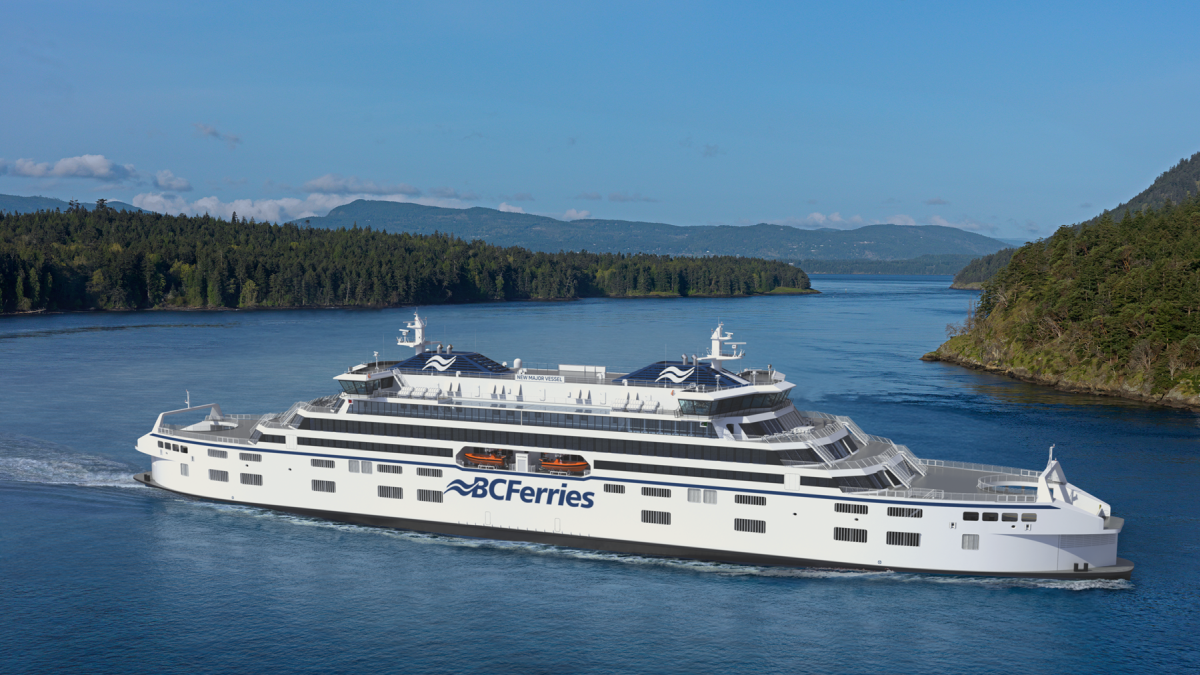
A quiet place: BC Ferries turns down the volume for the orcas
BC Ferries targets a 50% reduction in underwater radiated noise by 2036, with propulsion refits and new vessels to help protect endangered killer whales


A ferry at service speed can drown out the calls between killer whales within 250 m. In the Salish Sea, home to just 76 Southern Residents, BC Ferries is now formally committed to halving that noise.
The Species at Risk Act conservation agreement with Fisheries and Oceans Canada and Transport Canada targets a 50% cut in the fleet’s underwater radiated noise (URN) in critical habitats by 2036, measured against a 2019 baseline.
The goal itself is not new. BC Ferries’ 2021 Long Term Underwater Noise Management Plan set the same ambition. What has changed is a fixed baseline, a deadline and two federal departments watching progress.
These endangered whales need it. The Center for Whale Research counted 76 animals in its 2026 census, two more than a year earlier. Any gain is welcome, but the population remains perilously small.
Ferries sit at the centre of the problem. Chanwoo Bae, senior engineering manager for Naval Architecture at BC Ferries, said the operator accounts for more than half the sailings and hours on the water in the area. "When people talk about noise, everybody points their finger at BC Ferries, because we operate the most vessels in this area," he said.
The acoustics explain the concern. A typical ferry at service speed radiates around 185 dB re 1 µPa at 1 m broadband. A killer whale’s communication call reaches up to about 140 dB. Frequency matters as much as volume. Orcas echolocate at roughly 8 to 80 kHz to find salmon, and call and whistle between 500 Hz and 30 kHz. Ferry noise spans everything from 2 Hz to 100 kHz.
"The best way to reduce the noise is to change the propellers”
Baseline measurements were sobering. The single V-Class ship measured 190 dB broadband and the five C-Class ships 189 dB. The battery-hybrid Island Class came in at 177 dB, against a major vessel target of 175 dB.
They also overturned an article of faith. Slowing down is shipping’s standard noise fix, yet BC Ferries’ large double-enders, with constant-speed controllable pitch propellers, grew noisier as they slowed.

Mr Bae, a ship hydrodynamicist by training, is clear about the remedy: "Obviously, the best way to reduce the noise is to change the propellers. It is very hard to change the hull form."
Many ferry propellers, he explained, were never matched to how the ships run. "In the old days, even 20 years ago, they just picked a propeller matched with the engine power – not much thinking," he said. "So, the propeller can generate, let’s say, 15 knots, but we’re only operating at 12 knots." Running at fixed rpm while taking off pitch pushes such blades towards cavitation, erosion and vibration.
The Coastal Class became the test case. The three 160 m double-enders, built in 2007 and 2008, each carry 1,650 passengers and were driven by 5 m four-bladed CPPs turning at a fixed 140 rpm. Between 2021 and 2023 they were fitted with variable frequency drives. Shaft speed can now vary from 140 rpm down to zero, so the ships run in combinator mode, adjusting rpm and pitch together.
New propellers shrank from 5.0 m to 4.7 m diameter, with more blade area, higher pitch and greater skew. Design speed dropped from 21 to 19.5 knots, closer to the real operating profile. The package cost C$18.0M (roughly US$12.5M) for three ships.
“Going electric did not, by itself, make these ships quieter”
The results at low speed were dramatic. At 13.7 knots, radiated noise fell from 194 dB to 178 dB, a 16 dB reduction. For context, halving sound energy takes just 3 dB. The benefit narrowed with speed. At 17.2 knots the reduction was 4.1 dB, and from about 18 knots upwards the new arrangement measured within 2 dB of the original, sometimes slightly louder.
Fuel told the same story. Power demand at 14 knots fell by 40%, at 18 knots by 16% and at 21 knots by 4%. Overall, BC Ferries puts the fuel saving at about 8%. That fuel saving is what makes quieting affordable. "We can only do that when we have a good return on investment in terms of fuel saving from the new propeller," Mr Bae said.
His opportunity comes at mid-life upgrades, roughly 20 years into a planned 45-year vessel life: "If there’s any potential efficiency gain while the URN can be reduced, then I push the company (for) a new propeller. That is my strategy."
He has plenty to work with. The fleet runs CPPs and fixed-pitch propellers, Kort nozzles, right-angle drives, single and twin screws, single and double-ended hulls. "It’s like a warehouse for the world of propulsion systems – we have everything," he said.
The newer Island Class ferries taught a different lesson. In a 2022 PRADS paper co-authored by Mr Bae with Damen’s Tjakko Keizer and colleagues, six nominally identical vessels were measured in the Black Sea and again in Boundary Pass.
Propeller cavitation was not the dominant source. The loudest peaks came from the upper gear mesh of the azimuthing thrusters at around 400 Hz, with harmonics reaching into the orca communication band.
Because the gears dominated, there was no significant difference in noise between battery, hybrid and diesel-generator modes. Going electric did not, by itself, make these ships quieter.
That finding sits neatly alongside the next generation. The four New Major Vessels, due from China Merchants Industry Weihai from 2029 will use ABB’s gearless Azipod propulsion, which ABB says cuts noise compared with mechanical thrusters.
The same paper showed how slippery measurement can be. At Boundary Pass, tidal currents forced course corrections that triggered extra cavitation, pushing echolocation-band levels 8 dB above the Black Sea results.
Across the orca frequency bands, uncertainty between identical ships settled at about 2 dB. When halving noise energy means 3 dB, that margin is not an academic detail. It is most of the target.
Mr Bae is nonetheless confident about 2036. "I think that is possible because all the new vessels are coming," he said, with old propellers replaced during refits and mid-life upgrades wherever the money can be found. The Coastal Class retrofit shows the trade-offs are not inevitable. A smarter drive and a better-matched propeller delivered quieter water, lower fuel bills and kinder machinery in a single package.





Related to this Story

Events

Maritime Regulations Webinar Week
 16 Dec 2025
 GMT - ONLINE

Floating energy: successfully unlocking stranded gas using FLNGs and FSRUs
24 Feb 2026GMT - ONLINE
© 2026 Riviera Maritime Media Ltd.


