


Business Sectors
Events

Floating energy: successfully unlocking stranded gas using FLNGs and FSRUs
 24 Feb 2026
 GMT - ONLINE
Contents

Register to read more articles.
ABS approves Samsung remote operations, wireless gas detection
Two technologies developed in South Korea have been approved by a North American classification society to improve safety on maritime vessels and offshore units


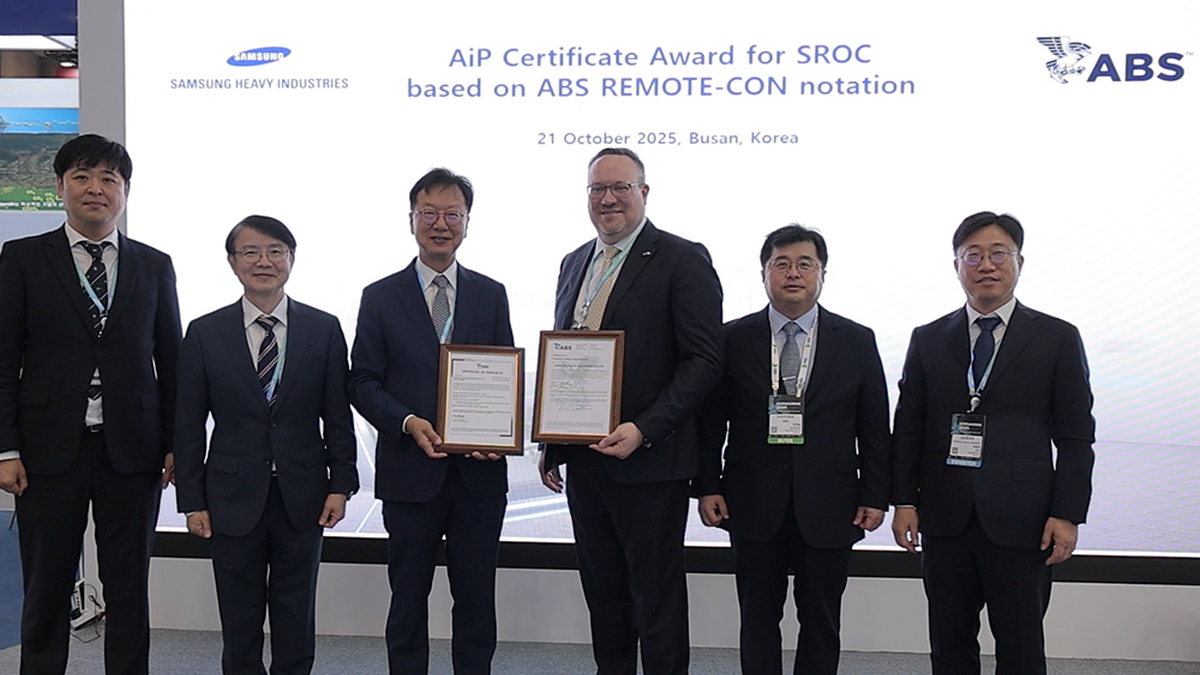
ABS has granted approval in principle (AiPs) for two technologies developed by Samsung affiliates in South Korea to improve the safety of maritime vessels and offshore units.
Samsung’s Remote Operation Center (SROC), which provides real-time monitoring and oversight of vessel systems, was awarded an AiP after the technology was examined and reviewed by ABS for compliance in accordance with the ABS requirements for autonomous and remote-control functions.
ABS recognised its remote operational capability to manage auxiliary and industrial processes, cargo handling, ballast and trim machinery functions.
“Our independently developed technology enables real-time monitoring and remote-control functions for large commercial vessels and offshore units, ensuring enhanced safety, efficient maintenance support, and paving the way for remote inspections and unmanned operations,” said Samsung Heavy Industries (SHI) executive vice president and head of the Ship and Offshore Research Institute, Dong Yeon Lee.
“Receiving the AiP based on ABS class notation Remote-Con is a milestone that marks a significant step towards the future of smart and autonomous ship management.”
ABS senior vice president and chief technology officer Patrick Ryan said, “Remote operation centres provide real-time monitoring and systems oversight, supporting autonomous and remote-control applications.”
In another milestone, SHI was granted an ABS AiP for its design of a wireless fire and gas detection system to provide safer maritime operations.
Unlike conventional detection systems which use power cables to transmit signals to a control panel, SHI’s design utilises a vessel’s metal structure as the low-voltage power transmission medium.
Signals from the fire detection and alarm devices are converted into magnetic waves and are transmitted wirelessly via the ship’s metal surface to the control station.
“This is a unique approach from SHI to provide a wireless detection system that promises to overcome common challenges like shadowing, signal interference, absorption and reflection, found in traditional wireless systems that rely on air as the transmission medium,” said Mr Ryan.
“In addition to reduced cabling, it should also offer the industry more flexibility and scalability with these critical safety systems.”
ABS undertook technical reviews, applying the goal-based standards framework outlined in the ABS rules for alternative arrangements, novel concepts and new technologies.
“By applying surface wave technology to fire and gas detection, we have demonstrated stable and wireless communication performance even within sophisticated vessel environments,” said SHI chief technology officer and executive vice president Haeki Jang. “Based on this achievement, SHI will continue expanding wireless applications to enhance safe, efficient operations in maritime."
Riviera’s Maritime Navigation Innovation Webinar Week will be held 24-26 November. Use this link for more information and to register for these webinars.

Related to this Story

Events

Maritime Regulations Webinar Week
16 Dec 2025GMT - ONLINEFloating energy: successfully unlocking stranded gas using FLNGs and FSRUs
24 Feb 2026GMT - ONLINE
© 2024 Riviera Maritime Media Ltd.


