


Business Sectors
Business Sectors
Events
Contents
Register to read more articles.
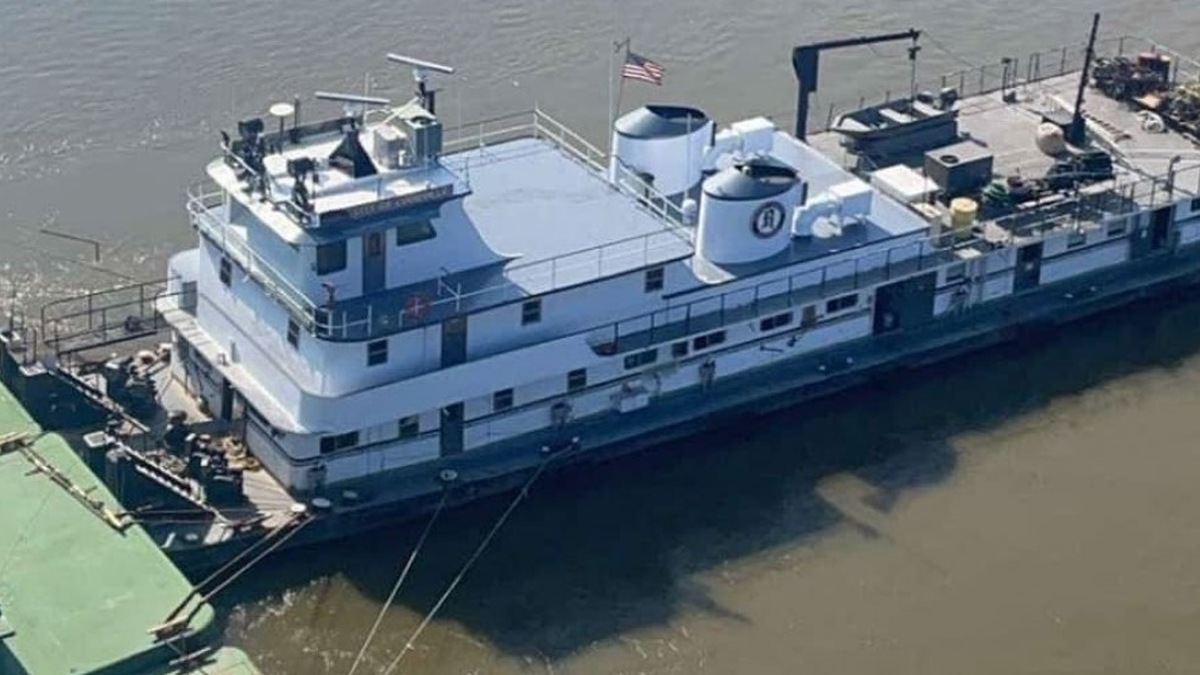
Accident report: towboat grounds in Illinois causing US$2M damage
A towing vessel on a major inland waterway in North America grounded when the helm was left unattended for several minutes


A 1962-built towboat operated by Ceres Tank Barge caused US$2M of damage when it grounded on the Mississippi River in Illinois, USA when it was out of control.
According to the National Transportation Safety Board (NTSB) in its accident report, 42-m City of Louisville grounded near Thebes when the pilot left the helm unattended for several minutes.
The NTSB has warned the towage industry to ensure there is always a competent navigator at the helm of towing vessels and electronics designed to alert others if this is not the case are maintained and working.
City of Louisville grounded on a charted shallow and rocky area as it was travelling upbound on the Mississippi River, while pushing 11 barges on 29 July 2023.
Its grounding caused fractures to the vessel’s bottom plating underneath the engineroom, leading to water flooding into the engineroom, machinery areas and aft accommodation spaces.
There were no injuries, but around 114 litres of gear oil was released into the river and the accident caused US$2M of damage to the 752-gt vessel.
During the accident investigation, the NTSB discovered the pilot was alone on watch in the wheelhouse when the grounding happened. He told NTSB investigators he had left the helm and went to the port side of the wheelhouse for around five 5 minutes, leaving the helm unattended.
“Leaving the helm unattended is contrary to prudent navigation practices when operating on rivers,” the NTSB said in its report. “The Mississippi River, in particular, has frequent turns, and a potential for strong currents and heavy traffic,” it continued.
“Due to these factors, inattention to a vessel’s path, even for a brief time, can result in encountering other vessels and hazards such as shallow areas or structures on the banks nearby.”
During the period the pilot was away from the helm, he missed a course change to starboard along the recommended sailing route up the river.
The pilot said before he left the helm, he checked the swing meter, fathometer (depth meter), and the electronic chart system, which would have displayed the upcoming change in course.
During the investigation, the pilot said he did not realise the tow had begun to progress closer to the right descending bank while he was away from the helm.
According to investigators, this should have been apparent from his reported position on the port side of the wheelhouse.
Wheelhouse alarm
City of Louisville was fitted with an alarm system to alert crew if the helm was unattended. It was designed to sound first in the wheelhouse and then in other vessel spaces to alert other seafarers that the navigator was not responding.
NTSB investigators found the power supply to the pilothouse alert system was missing, but they could not determine when it had been disconnected. Investigators were also not able to determine the interval the alarm was set for.
“A pilothouse alerter, when used as intended, is an effective tool that can help ensure a towing vessel operator remains awake and vigilant while on duty, and notify another crew member if the pilothouse alarm is not acknowledged,” said the NTSB in its report published on 22 May 2025.
“Established procedures for the operation and use of the system should be outlined in the company safety management system and should include the time interval for reset of the alerter system.
“This should be set based on the vessel’s navigational risk and proximity to navigational hazards, including traffic, as well as measures to ensure the system cannot be unintentionally reset.”
Sign up for Riviera’s series of technical and operational webinars and conferences, including those covering ship communications, vessel optimisation and navigation and cyber security:
- Register to attend by visiting our events page.
- Watch recordings from all of our webinars in the webinar library.

Related to this Story
Events

Maritime Regulations Webinar Week
 16 Dec 2025
 GMT - ONLINE
Floating energy: successfully unlocking stranded gas using FLNGs and FSRUs
24 Feb 2026GMT - ONLINE
© 2026 Riviera Maritime Media Ltd.


